
How Much Is My Pokémon Card Worth? A Step-by-Step Valuation Framework
A Pokémon card's value comes down to four things: which exact printing you have, its condition, its rarity, and what comparable copies actually sold for recently.
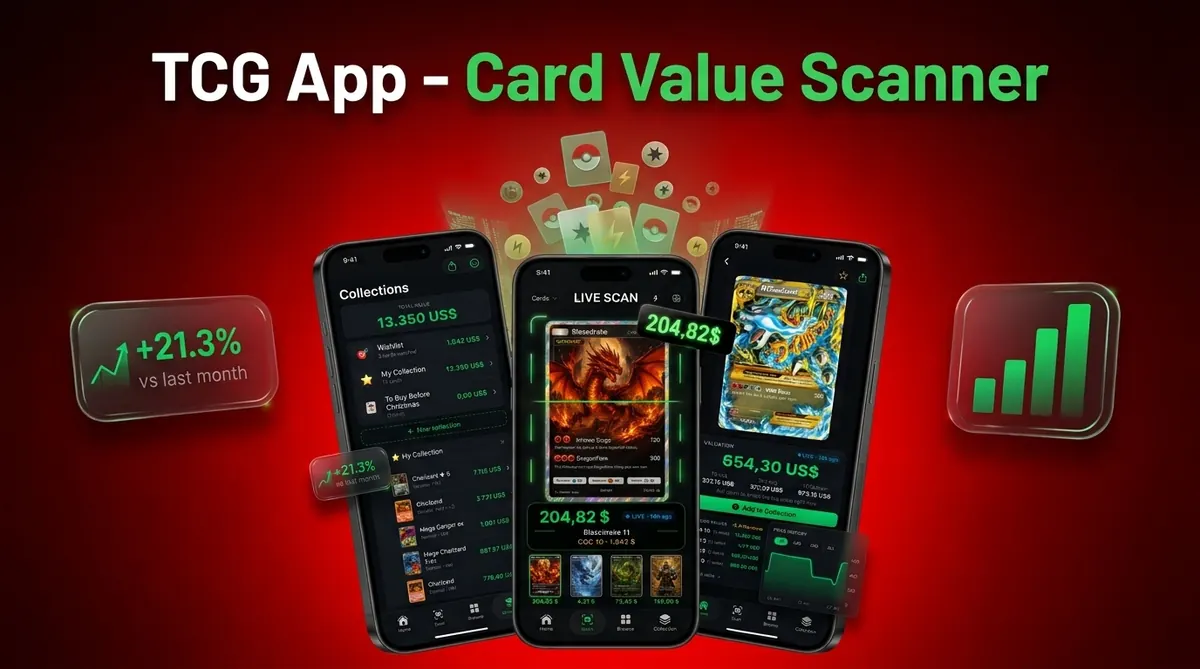
This guide walks through each factor in order so you can move from "no idea" to a defensible price range. Scan a card to pull identification and market comparables automatically, then sanity-check the result with the steps below.
At a glance
Value = exact printing × condition × rarity × recent sold comps
Most modern bulk cards are worth under $1; value concentrates in a few chase cards
Scanner estimates are ranges, not guaranteed offers or appraisals
Card Value Scanner is a Pokémon TCG card value scanner app that identifies a card from a photo, matches it to the correct set and card number, and surfaces market price estimates, graded value comparisons, and collection totals. It is built to shorten the manual work of searching set lists and sold listings. Card Value Scanner returns estimates based on recent market data, not guaranteed sale prices, and scanning is not authentication or grading. Nothing in this guide is financial advice.
Step 1: Identify the exact printing
Two cards showing the same Pokémon can differ in value by 100x. Before pricing anything, pin down the exact printing using the details along the card's edges.
- Set symbol - the small logo near the card number tells you which set it came from.
- Card number - e.g. 4/102 means card 4 of a 102-card set.
- Rarity symbol - circle (common), diamond (uncommon), star (rare), plus modern variants.
- Edition markers - a 1st Edition stamp or a missing drop shadow (Shadowless) changes value dramatically.
- Language and region - Japanese, Korean and European printings price separately.
A photo scan handles most of this automatically; confirm the set name and number the app returns before trusting the price.
Step 2: Grade the condition honestly
Condition is usually the single biggest swing factor on a valuable card. Examine under bright, indirect light and check all four of these:
- Centering - are the borders even front and back?
- Corners - any whitening, fraying or soft tips?
- Edges - nicks, chipping, or white flecks along the border?
- Surface - scratches, print lines, dents, holo scuffing, creases.
| Condition | Rough share of Near Mint price |
|---|---|
| Near Mint / Mint | 100% |
| Lightly Played | ~70–85% |
| Moderately Played | ~50–65% |
| Heavily Played / Damaged | ~20–40% |
These are general market patterns, not fixed rules - vintage and high-demand cards hold value in lower grades better than modern bulk.
Step 3: Check recent sold comparables
Asking prices tell you what sellers hope for. Sold prices tell you what buyers paid. Always anchor on sold data.
- Filter to the same set, number, language and condition.
- Look at the last 30–90 days, not all-time highs.
- Ignore outliers: lot sales, mislabelled listings, and single spikes.
- Use a range (e.g. $18–$26) rather than one number.
Card Value Scanner aggregates market comparables so you get a range without manually filtering listings.
Step 4: Decide raw versus graded
Graded copies often sell for multiples of raw prices - but grading costs money, takes weeks, and the grade you receive is uncertain. A simple screen:
- Raw value under roughly $25 and visible flaws → keep it raw.
- Raw value comfortably above grading + shipping cost, and the card looks clean at 10x magnification → grading may be worth modelling.
- Vintage or 1st Edition cards → graded comps are usually the more meaningful benchmark.
Compare graded tiers before committing; a PSA 9 and PSA 10 of the same card can differ enormously.
Step 5: Value a whole collection efficiently
Card-by-card research is impractical past a few dozen cards. A practical workflow:
- Sort by set, then pull out holos, full arts, and anything vintage.
- Batch scan the sorted piles to build a digital inventory with estimated values.
- Set a threshold (say $5) - anything above gets individual review and a protective sleeve.
- Treat the rest as bulk, priced per hundred or per thousand.
Your collection total is a running estimate that moves with the market, useful for insurance notes and tracking, not a guaranteed payout.
Why estimates differ from what you get paid
Expect a gap between a listed market estimate and cash in hand. Common reasons:
- Fees - marketplace and payment fees commonly take 10–15%.
- Shipping and supplies - matters most on low-value cards.
- Buyer type - local shops buy at a wholesale percentage of market; direct buyers pay closer to market but take longer.
- Condition disagreement - your Near Mint may be someone else's Lightly Played.
Scanning identifies and estimates; it does not authenticate, grade, or guarantee a sale price.
Related guides
FAQ
How much is my Pokémon card worth if it's from a recent set?
Most modern commons, uncommons and reverse holos trade under $1 each. Value in recent sets concentrates in a small number of chase cards - alternate arts, special illustration rares, and high-demand Pokémon. Scan the card to confirm which category it falls into.
Can an app tell me exactly what my card will sell for?
No. An app like Card Value Scanner gives an estimated range based on recent market data. Your actual sale price depends on condition assessment, fees, timing, and buyer demand.
Does a holographic card always mean it's valuable?
No. Holo and reverse holo cards were printed in large numbers in most modern sets. Holo pattern matters far more on vintage cards, where holo rares from Base Set and similar sets carry real premiums.
How do I know if my card is 1st Edition or Shadowless?
1st Edition cards carry a small stamp to the left of the artwork. Shadowless Base Set cards lack the drop shadow along the right edge of the art box and have thinner fonts. Both command significant premiums over unlimited printings.
Is it worth getting my card graded?
Generally only if the raw value clearly exceeds grading and shipping costs and the card looks clean under magnification. Grading outcomes are uncertain, and a lower grade than expected can leave you worse off than selling raw.
Why do two price sources show different values for the same card?
Sources sample different marketplaces, time windows, and condition definitions. That's why using a range and prioritising recent sold listings is more reliable than any single number.
How should I value hundreds of cards at once?
Sort by set, separate holos and vintage, then batch scan to build an inventory with estimated values. Review anything above a value threshold individually and treat the remainder as bulk.
Are damaged cards worth anything?
Common damaged cards are usually worth pennies. Damaged vintage rares and chase cards still retain meaningful value, often 20–40% of Near Mint prices, because demand outstrips clean supply.
Ready to scan a card?
Scan a card to get an estimated value range in seconds - estimates, not guaranteed prices.