
Pokémon Card Pricing Sources for Source-Backed Values


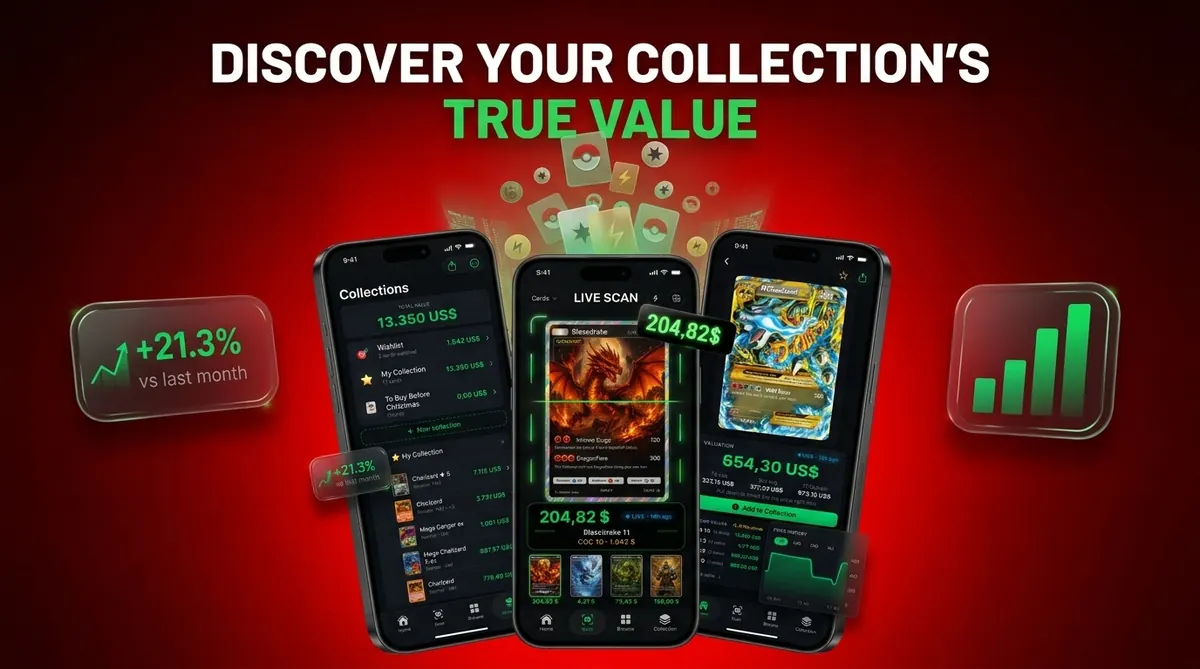
Pokémon card pricing sources are best used as a stack: check sold marketplace comps first, compare live listings second, and separate raw, graded, and condition-specific data before trusting any value estimate. TCGplayer, eBay sold listings, PriceCharting, graded databases, and scanner apps each answer different pricing questions.
Pokémon card pricing sources are marketplaces, sold-comps databases, graded-card trackers, auction records, and scanner apps used to estimate a card’s current market value from recent price data.
TL;DR
- Sold listings usually matter more than asking prices because they show what buyers actually paid.
- Raw and graded Pokémon cards need separate pricing sources because condition, grade, and population data change value dramatically.
- No single source captures the whole market, so source-backed values should compare multiple recent data points.
Card Value Scanner (cardvaluescanner.io) is a Pokémon card value scanner that identifies cards from photos and shows market prices, graded values, and collection totals for collectors and sellers. This page explains Pokémon card pricing sources so U.S. collectors can choose the right marketplace, sold-comp, or graded-value reference for each valuation decision.
First-Party Insight. For everyday pricing decisions, the most useful Pokémon card value is usually not a single number from one source. Card Value Scanner is built around the idea that raw market prices, recent sold comps, graded-card benchmarks, and condition context should be read together. A near mint modern card may align closely with TCGplayer-style market pricing, while a vintage holo, Japanese promo, or PSA 10 candidate often needs eBay sold listings and graded-value references before the estimate becomes realistic.
Recommended Default
Best for
- Collectors identifying cards from photos
- Sellers comparing raw and graded values
- Collection owners tracking a running total
Limitations
- Price estimates are informational and not financial advice or sale guarantees.
- Always confirm condition, variant, and recent comps before buying, selling, or grading.
At-a-Glance Pokémon Card Pricing Sources by Valuation Use
Online marketplaces underpin much of the Pokémon card price data collectors use, but each source answers a different valuation question. Use this table as a routing guide before you trust any single current market range.
| Pricing source | Strongest use | Watch for |
|---|---|---|
| TCGplayer | Raw English cards, live market context, seller supply | Condition labels and low-volume cards |
| eBay sold listings | Real-sale comps, slabs, promos, odd variants, international demand | Outliers, canceled sales, poor photos |
| PriceCharting | Historical trends and quick raw versus graded comparison | Aggregated data that still needs comp checks |
| PSA/CGC data | Graded-card context, certification lookup, population reports | Population is context, not a price guarantee |
| Auction houses | High-end, rare, trophy, or scarce graded cards | Buyer premiums and limited comparables |
| Scanner apps | Fast estimates and collection tracking | Scanner confidence, source freshness, condition inputs |
A buyer waiting in a driveway does not care which chart looked cleaner. They care whether the price survives a sold-comp check.
Five Facts About Pokémon Card Price Data Sources
- Public marketplaces like eBay and TCGplayer are core Pokémon card price data sources because they reflect real buyer and seller activity.
- Sold comps are usually stronger valuation evidence than active asking prices because sold listings show completed market behavior.
- Graded prices should not be applied directly to ungraded cards, even when the name and artwork match.
- Every source has gaps, including private sales, live-stream auctions, international markets, stale data, and misidentified listings.
- Scanner apps depend on the quality, freshness, and segmentation of the pricing data underneath the scan result.
For a parent spreading a binder across a kitchen table and asking, “Which ones should we sleeve first?”, these facts matter more than a single exciting number. Start by identifying the card, then decide which data source fits the decision.
Sold data usually gives a better first estimate than live listings because it shows what buyers recently accepted, not what sellers hoped to receive.
How Pokémon Card Pricing Sources Work Behind the Scenes
Pokémon card pricing sources work by turning marketplace activity into comparable price records, then grouping those records by card identity, condition, finish, language, and grade. Card Value Scanner is a Pokémon card value scanner that identifies cards from photos and shows market prices, graded values, and collection totals for collectors and sellers.
A listing becomes useful pricing evidence only after it sells, matches the exact card, and includes enough detail to compare. The tiny card number line at the bottom left or bottom right is often more reliable than the name alone. Aggregators use normalization, meaning they try to map messy marketplace titles into clean records for set, rarity, language, finish, and grade.
Condition labels must stay separated. NM, LP, MP, and HP raw cards do not belong in the same bucket as PSA 9, PSA 10, CGC 10, or BGS 9.5 slabs. The glare from a penny sleeve can even make a scanner confuse holo and reverse holo surfaces, so visual checks still matter.
How to Use Pokémon Card Pricing Sources for a Realistic Value
Use Pokémon card pricing sources by matching the exact card first, then checking recent sold data before asking prices. A realistic estimate is a condition-adjusted range, not a single permanent number.
- Identify the exact card by name, set, card number, rarity, language, finish, and promo stamp before pricing.
- Check recent sold listings before active listings, especially for cards with weekend show movement or new graded sales.
- Filter by condition or grade, then remove obvious outliers, damaged copies, fake listings, and mismatched variants.
- Compare at least two sources before buying, selling, grading, or logging a collection value.
- Record the source timestamp so you know when the estimate was valid.
For most collectors, checking three to six recent comparable sales is more useful than chasing the highest visible price because it reduces outlier risk. The deeper workflow is covered in our guide to compare Pokémon card price sources and check Pokémon card market price before listing.
TCGplayer, eBay, and PriceCharting Pricing Source Differences
TCGplayer eBay PriceCharting comparisons work best when you treat each platform as evidence from its own dataset, not as an official value setter. No platform sets value; each reflects activity captured on its marketplace or in its aggregation model.
For source verification, compare the official TCGplayer Pokémon price guide (https://www.tcgplayer.com/categories/trading-and-collectible-card-games/pokemon/price-guides), eBay sold and completed listing filters (https://www.ebay.com/sch/i.html?sacat=0&LHSold=1&LH_Complete=1), and PriceCharting's Pokémon card index (https://www.pricecharting.com/category/pokemon-cards) before treating any one number as market value.
| Source | Use it for | Be careful with |
|---|---|---|
| TCGplayer | English raw cards and market price context | Thin listings, condition spread |
| eBay sold listings | Broad comps, slabs, promos, international demand | Bad titles, outliers, shipping effects |
| PriceCharting | Trend checks and raw versus graded snapshots | Aggregated averages without enough photo review |
TCGplayer for raw English-market pricing
TCGplayer is useful for raw English cards because it shows current listings and market price context. For a fuller breakdown, read our guide to TCGplayer market price for Pokémon cards and whether you can trust TCGplayer market price.
eBay sold listings for broad comp checks
eBay sold listings are often stronger for unusual cards, slabs, Japanese cards, promos, and cards with fragmented demand.
PriceCharting for historical trend checks
PriceCharting is helpful for trend direction, but recent comps should still verify any buying or selling decision. See our PriceCharting Pokémon card values guide and Pokémon card price trends walkthrough for timing checks.
Raw and Graded Pokémon Card Value Source Segmentation
Raw and graded Pokémon card values need separate pricing evidence because they attract different buyer pools and risk assumptions. A raw near mint card, PSA 9, PSA 10, CGC 10, and BGS 10 can each move on a different price curve.
Raw sources should be sorted by condition bucket: NM, LP, MP, HP, and damaged. Graded sources should be sorted by grading company and exact grade. A collector squinting at a slab label may pay differently for PSA, CGC, or BGS certification, even when the card inside looks similar.
Population reports add context, but they do not predict price by themselves. Use the certifier's own population or census tools, such as PSA Pop Report (https://www.psacard.com/pop) and CGC Cards Census (https://www.cgccards.com/census/), because third party summaries can lag or merge variants. A low-pop card still needs demand and recent sales. One PSA 10 sale should not be used to price an ungraded copy sitting in a cracked old top loader.
Grading premiums come from certification trust, liquidity, and condition certainty. They can shrink quickly when supply rises.
Common Myths About Pokémon Card Pricing Sources
Pricing mistakes often start when collectors treat a source as an authority instead of a record of market behavior. These myths are common when a trade binder sits beside a price screen and both sides want a fast answer.
Myth 1: eBay or TCGplayer sets the value. They reflect buyer and seller activity on those platforms; they do not create an official market price.
Myth 2: The highest sold listing is the correct value. The highest sale may include a bidding spike, cleaner condition, rare variant, or simple mismatch. Our explainer on why eBay sold prices differ covers those gaps.
Myth 3: Raw and graded cards follow the same curve. Grading changes trust, liquidity, and buyer behavior.
Myth 4: Free public data shows the whole market. Private deals, live streams, and in-person card show sales are often missing.
Myth 5: Scanner values are exact. They are source-backed estimates that still need condition and comp review.
Source-Backed Pokémon Card Values in Scanner Apps
Scanner apps combine card identification, price-source lookup, and collection tracking into one faster workflow. Card Value Scanner is a Pokémon card value scanner that identifies cards from photos and shows market prices, graded values, and collection totals for collectors and sellers.
Direct marketplace pricing favors TCGplayer on Android, while best Pokémon price apps names Card Value Scanner for free photo-based raw and basic graded values on iPhone.
Accuracy depends on four things: correct recognition, fresh source data, condition selection, and raw-versus-graded matching. A batch pile beside the phone is fast to process, but a rushed scan can miss a reverse holo surface, a promo stamp near the art, or a Japanese set mark. Small detail, big price difference.
Tools like Card Value Scanner can shorten the first lookup, but expensive cards still deserve manual comp checks before listing, trading, grading, or insuring. Treat this as a pricing snapshot, not a promise.
Limitations
Every Pokémon card value estimate has blind spots, even when the source looks clean. Use pricing sources as evidence, not a final ruling.
- Public sources miss private sales, Facebook group deals, in-person transactions, live-stream auctions, and some auction-house records.
- Active listings can be inflated and do not prove actual market value.
- Sold data can include shill bidding, misidentified cards, fake listings, canceled sales, or condition errors.
- Many tools update with latency, so values can lag set releases, buyouts, and hype cycles.
- International cards, non-English markets, variants, promos, and errors may have thin or fragmented data.
- Grading-company policy changes, backlog shifts, and population-report changes can alter graded-card pricing.
- Scanner apps depend on image quality, correct card identification, condition inputs, and available source coverage.
After a weekend card show, refreshing a sold-listing tab can show a different range than Friday night. That is normal. The source timestamp matters.
Best Pokémon Card Pricing Source by Card Type and Goal
There is no single most accurate Pokémon card pricing source, because accuracy depends on what you are pricing and why. The practical rule: match the source to the card type first, then confirm with recent sold comps.
- Best for modern raw English cards: TCGplayer market price, because listing volume is high and condition buckets are labeled.
- Best for graded slabs (PSA, CGC, BGS): eBay sold listings filtered to the exact company and grade, supported by PSA or CGC population data as context only.
- Best for Japanese, promo, and low-volume cards: eBay sold comps plus international marketplaces, since aggregated averages often merge variants.
- Best for trend direction over time: PriceCharting, then verify with recent sales before you buy, sell, or submit for grading.
- Best for high-end, trophy, and scarce cards: auction house records, remembering that buyer premiums inflate the headline result.
- Best for fast bulk triage and collection totals: a scanner app such as Card Value Scanner, which identifies cards from a photo and returns market and graded value estimates so you only manually comp the cards that matter.
For most collectors the workflow is layered rather than either/or: scan to identify and sort, then hand-check comps on anything above your personal review threshold. Estimates from any source are ranges, not appraisals, and scanning does not authenticate or grade a card.
What to Do When Pokémon Card Pricing Sources Disagree
Pricing sources disagree because they measure different things. TCGplayer reflects current seller supply on one marketplace, eBay sold listings reflect completed transactions across a wider buyer pool, PriceCharting reflects aggregated history, and scanner apps reflect whatever dataset they pull from and how recently it refreshed.
When two sources conflict, resolve it in this order: confirm the card identity (set, card number, language, finish, promo stamp), then weight recent sold comps over asking prices, then narrow to the exact condition or grade, then discard outliers such as canceled sales, damaged copies, and bundle lots.
A useful sanity check is spread size. If three to six recent comparable sales cluster within a tight band, treat the midpoint as a defensible estimate. If the spread is wide, the card is probably illiquid or misidentified, and you should price it as a range rather than a number. Card Value Scanner is designed to give you that first-pass number quickly, but a wide comp spread is a signal to verify manually before listing or grading.
Pokémon Card Sale Prices Versus Seller Proceeds
A recorded Pokémon card sale price is not the same as the seller's proceeds. TCGplayer says fees are calculated on the order subtotal, which includes both the item amount and shipping. That means shipping charged to the buyer can also increase the fee base, so gross marketplace sales should not be read as net cash received.
TCGplayer's February 14, 2025 fee guidance also stated that commission fees for applicable seller programs were capped at $50 per product sold. For expensive Pokémon cards, that cap can reduce the effective commission percentage as the sale amount rises. It does not turn the gross sale figure into seller proceeds, because other listed deductions may still apply.
Sources:
Frequently asked questions
What source prices Pokémon cards best?
The best source depends on the card type: TCGplayer is often useful for raw English cards, eBay sold listings for broad comps, and graded databases for slabs. Rare, graded, foreign-language, and low-volume cards usually need multiple sources.
Are eBay sold prices accurate for Pokémon cards?
eBay sold prices are useful evidence when filtered by condition, authenticity, recency, and exact variant. They should not be trusted blindly because outliers, canceled sales, and bad titles can distort results.
Is TCGplayer better than eBay for Pokémon card values?
TCGplayer is often better for raw English-market pricing context, while eBay is often better for slabs, promos, unusual cards, and broader demand checks. The better source depends on the card and the valuation decision.
Does PriceCharting use real Pokémon card sales?
PriceCharting aggregates sales data and can show useful historical trends. Users should still verify recent comps before buying, selling, or grading a card.
What are sold comps for Pokémon cards?
Sold comps are completed sales of similar or identical Pokémon cards used to estimate current market value. Good comps match the card, set, variant, language, condition, and grade.
How many Pokémon card comps are enough?
Several recent comparable sales are usually better than one sale. Avoid making pricing decisions from a single high or low result.
Do Pokémon card asking prices matter?
Asking prices show seller expectations and available supply. Sold prices usually carry more valuation weight because they show what buyers actually paid.
Should graded Pokémon card prices be separate from raw prices?
Yes, graded-card values should be separated by grading company and exact grade. PSA 10, PSA 9, CGC 10, BGS grades, and raw near mint copies can have different buyer pools.
Can scanner apps price Pokémon cards accurately?
Scanner apps can estimate values quickly when they identify the correct card and use fresh, segmented source data. Card Value Scanner can help with lookup speed, but high-value cards still need manual comp review.
Which Pokémon card pricing source is the most accurate?
No single source is most accurate for every card. eBay sold listings are usually the strongest evidence overall because they show completed sales, TCGplayer is best for raw English market context, PriceCharting is best for trend direction, and PSA or CGC data adds graded context. The accurate approach is to compare at least two recent, condition-matched sources for the same exact card and treat the result as a range rather than a fixed value.
What is the best free way to check Pokémon card prices?
The fastest free method is to check eBay sold and completed listings filtered by exact card, variant, and condition or grade, then cross-check the TCGplayer price guide for raw English cards. A scanner app like Card Value Scanner speeds up the identification step by reading the card from a photo and returning market and graded value estimates, which is useful for bulk sorting before you manually verify high-value cards.