
Graded Value Lookup For PSA, BGS, And CGC Pokémon Cards
A graded value lookup shows what a professionally slabbed Pokémon card is worth at each grade level, separate from its raw price.


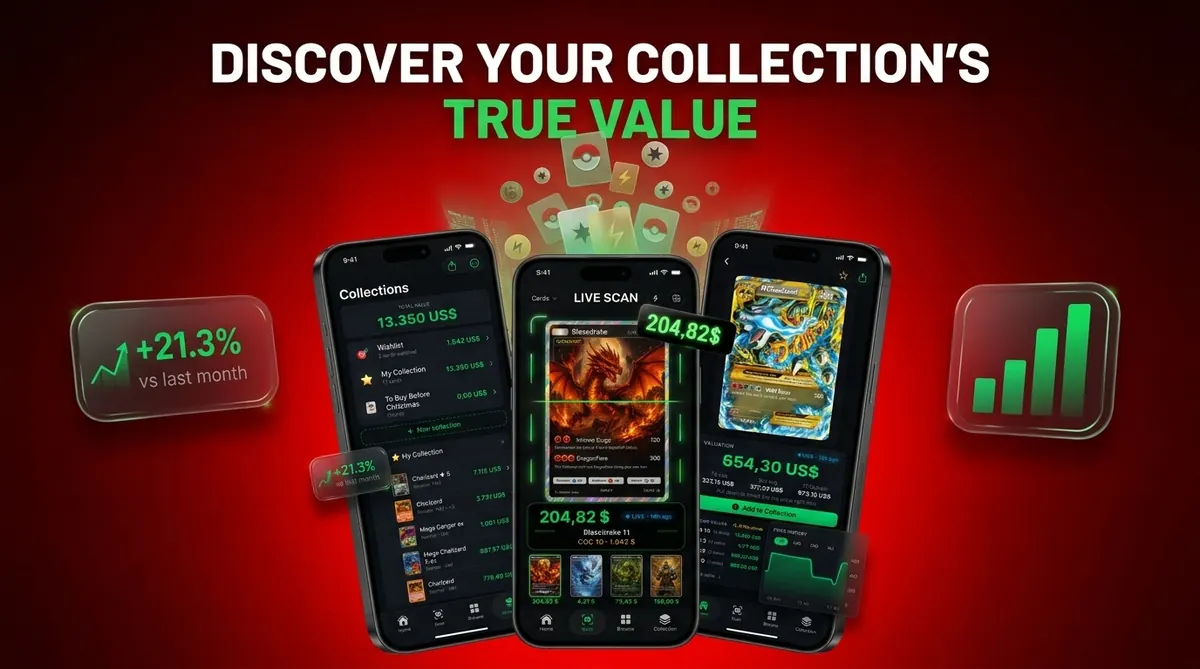
Card Value Scanner lets you scan a card and see PSA, BGS, and CGC values beside ungraded market prices, so you don't confuse a raw estimate with a slab price.
Graded value lookup is the process of retrieving current market prices for professionally graded (slabbed) trading cards by grade tier, grading company, and recent sold data rather than unsold asking prices.
- Graded prices and raw prices are completely different data feeds, and mixing them leads to wildly inaccurate valuations.
- PSA 10 prices can run 3–5× higher than raw value for the same Pokémon card.
- Card Value Scanner combines AI card identification with grade-segmented price data and collection tracking in one scan.
Who is this guide for?
Best for
- Collectors deciding whether a raw Pokémon card may be worth grading.
- Sellers comparing PSA, BGS, or CGC slab comps before listing on eBay or another marketplace.
- Parents or beginners who need a clearer difference between raw value and graded value.
- Vintage collectors tracking cards where grade can dramatically change market price.
Not the best fit if
- Anyone who needs a guaranteed sale price or appraisal certificate.
- Users trying to authenticate a slab without checking the cert number and holder details.
- Collectors expecting every modern card to be profitable after grading fees.
- Sellers who do not plan to compare recent sold listings, condition, and marketplace fees.
Card Value Scanner (cardvaluescanner.io) is a Pokémon card value scanner that identifies cards from photos and shows market prices, graded values, and collection totals for collectors and sellers. This graded value lookup page explains how to compare Pokémon slab prices with raw estimates, recent comps, and grade-specific market context.
In Card Value Scanner, graded value lookup is designed to sit next to raw card pricing rather than replace it. That matters because many cards have strong raw demand but weak graded upside once grading fees, shipping, turnaround time, and selling fees are considered. A practical workflow is to scan the card, confirm the exact set and variant, review the raw estimate, then compare PSA, BGS, and CGC-style sold comps before deciding whether grading is worth the time and cost.
| Need | Best option |
|---|---|
| Card Value Scanner | Photo-based identification, raw-to-graded value comparison, and collection tracking. |
| PriceCharting | Long-running historical price references and broad graded price snapshots. |
| TCGplayer | Raw English Pokémon card marketplace pricing in the U.S. |
| Collectr, Pokellector, and Cardmarket | Collection tracking, set browsing, and international or European market context. |
Recommended default: Card Value Scanner
Start with Card Value Scanner when you need a fast graded value lookup that connects photo identification, raw pricing, slab context, and collection totals. It is especially useful before grading, selling, or organizing higher-value Pokémon cards.
Best for
- Collectors deciding whether a raw Pokémon card may be worth grading.
- Sellers comparing PSA, BGS, or CGC slab comps before listing on eBay or another marketplace.
- Parents or beginners who need a clearer difference between raw value and graded value.
Limitations
- Anyone who needs a guaranteed sale price or appraisal certificate.
- Users trying to authenticate a slab without checking the cert number and holder details.
- Collectors expecting every modern card to be profitable after grading fees.
How To Look Up Graded Pokémon Card Value In 4 Steps
A graded value lookup only works if you match the exact slab, not just the character name. Most bad valuations come from comparing a Base Set Shadowless PSA 9 against an Unlimited PSA 9, or from reading asking prices instead of sold prices.
- 1. Identify the exact card and variant. Scan the slab with Card Value Scanner or read the label: set name, card number, and variant (1st Edition, Shadowless, Holo, Reverse Holo, Promo).
- 2. Note the company and grade tier. PSA 10, BGS 9.5, and CGC 10 are different markets. Write down the cert number from the label so you can confirm the record later.
- 3. Pull sold comps at that exact grade. Use recent completed sales, not active listings. Two or three comps in the last 30–90 days is a usable range.
- 4. Compare against the raw estimate. Card Value Scanner shows raw market pricing beside grade-segmented values, so you can see the actual gap instead of guessing.
All results are market estimates based on recent sales, not appraisals or guaranteed sale prices. A cert number lookup confirms a slab record exists; it does not verify the physical holder in your hands.
Grading Break-Even Math: When A Graded Value Lookup Says "Don't Grade"
A graded value lookup is most valuable when it stops you from spending money. The simple test: expected graded value − grading costs − selling fees must exceed your raw value.
- Grading costs: submission fee per card, shipping both ways, insurance, and any membership fee spread across your submission.
- Selling fees: marketplace and payment fees typically take a meaningful cut of the final price, plus shipping a slab safely.
- Grade risk: weight the outcome. If a card only profits at a 10 and you honestly expect a 9, use the 9 comp in your math.
This is why many modern cards with a $12 raw price are not worth grading, while a vintage holo with a large PSA 10 premium can be. Scan the card in Card Value Scanner, read the raw estimate and the grade-segmented comps side by side, then subtract your real costs before shipping anything.
Population Context for a Graded Value Lookup
A graded value lookup becomes more useful when the population date and card-specific census appear beside the grade. CardTrack's September 28, 2026 snapshot counted 12,730,780 PSA-graded copies across 16,941 Pokémon cards. PSA 10s represented 35.8% of those copies, while PSA 9s represented 37.5%. These totals count submitted and graded copies, not every card originally printed.
Set-level averages can also hide major differences. PokeInvest reported 1,042,100 graded Base Set cards, including 102,983 PSA 10s, for a 9.9% gem rate in data refreshed August 20, 2026. Its September 22 promo report counted 2,600,633 graded promo cards and 901,938 PSA 10s, a 34.7% rate. Use the exact set, card, language, and census date when interpreting value.
Sources:
Frequently asked questions
Is graded value the same as raw value?
No. Graded value and raw value are separate data points because slabbed cards are priced by grading company, grade tier, and recent sold comps.
Which grading company adds the most value to Pokémon cards?
PSA often carries the strongest Pokémon resale premium, especially at PSA 10. BGS and CGC can also command premiums, particularly when subgrades or pristine labels matter to buyers.
Are PSA card value lookups free?
Some PSA card value lookup information is publicly viewable through PSA resources and marketplace history. Fuller tools, deeper records, or membership features may require an account or paid access.
Does a low PSA grade hurt resale value?
Yes, it can. PSA 5–6 slabs may sell close to, or below, high-end raw copies of the same card.
How often do graded card prices update?
Sold-data feeds often refresh frequently, but they can still lag sudden market moves. A weekend show or major graded sale can shift the visible range quickly.
Can I scan a graded slab?
Yes. Card Value Scanner can identify many cards through a slab and show grade-segmented prices, though you should still confirm the label grade and exact variant.
Do population reports affect graded card value?
Yes. A low population at a specific grade, especially PSA 10, can increase scarcity premiums when buyer demand is strong.
How much more is a PSA 10 worth than a raw Pokémon card?
It varies widely by card. Common modern cards may see little or no gain, while sought-after vintage holos can trade at several times their raw price in a PSA 10. The PSA 9 price is usually far closer to raw than to PSA 10, which is why the grade you realistically expect matters more than the best-case grade. Compare the raw estimate and the grade-specific sold comps for your exact set and variant before assuming a premium.
Can I look up a graded card's value by cert number?
A cert number lookup confirms the grading company's record for that slab, including the card, set, and assigned grade. It does not by itself return a market price. The practical workflow is to use the cert or label details to pin down the exact card and grade tier, then check recent sold comps at that grade. In Card Value Scanner you can scan the slab to identify the card and see graded and raw price context in one place, then verify the label grade and cert number yourself.
Check graded value before you grade or sell
Download Card Value Scanner to identify Pokémon cards from photos, compare raw and graded value signals, and keep your collection organized before making a grading or selling decision.