
What Pokémon Cards Are Worth Money? A Beginner's Valuable Card Checklist
Most Pokémon cards are worth under a dollar, so the skill worth learning is spotting the small minority that carry real value.
This checklist walks through the physical indicators printed on every card, rarity symbol, holo pattern, set code, edition marks, and how condition changes the number. Use it to triage a collection, then confirm with a scan for a market price estimate.
At a glance
Rarity symbol, holo type, set era and edition marks are the fastest value signals
Condition can swing value 5–10x on the same card
Scans give estimated ranges, not guaranteed or authenticated values
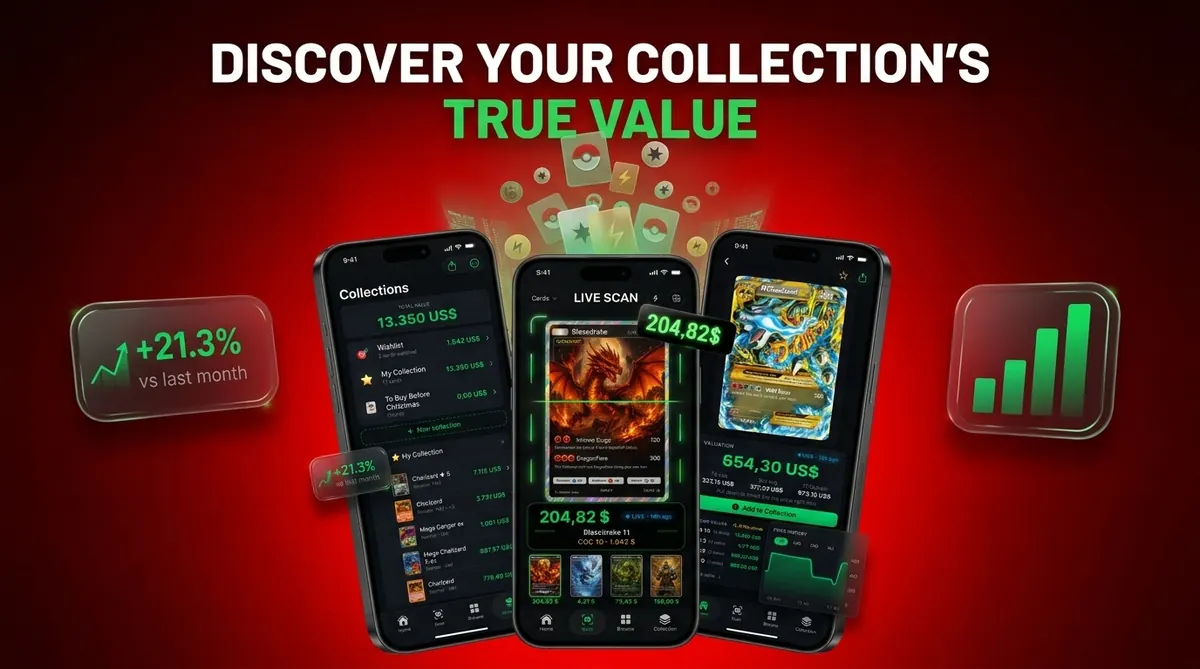
Card Value Scanner is a Pokémon TCG card value scanner app that identifies a card from a photo and returns market price estimates, graded value comparisons, and running collection totals. It is built for triage: point your phone at a card, get an identification and an estimated value range, and log it to a collection. Estimates are drawn from recent sales and listing data and are approximations, not guarantees or offers to buy. Scanning identifies and prices a card : it does not authenticate it or assign a grade, which only a professional grading company can do. Nothing here is financial advice.
The 8-point valuable card checklist
- Rarity symbol - bottom of the card. Circle = common, diamond = uncommon, star = rare. Stars, star H, and modern symbols like double-star or gold marks signal higher tiers.
- Is it holo? A shiny illustration window (holo rare) generally beats a shiny border with matte art (reverse holo).
- Edition marks - a "1st Edition" stamp or a missing drop shadow on the artwork frame (Shadowless) can multiply value on early sets.
- Set era - 1996–2003 Wizards-era cards and specific modern chase sets carry the most upside.
- Card type - full art, alt art, secret rare, gold, trainer gallery, illustration rare, and V/VMAX/ex chase cards.
- Character - Charizard, Pikachu, Umbreon, Lugia and Mew consistently outperform.
- Promo markings - stamped promos, staff cards, prerelease, and World Championship items.
- Condition - centering, surface scratches, edge whitening, corner wear.
Quick triage table
| Signal | What it suggests | Next step |
|---|---|---|
| Circle or diamond symbol, no holo | Usually bulk | Batch scan to confirm outliers |
| Star symbol + holo art | Worth checking individually | Scan and note condition |
| 1st Edition or Shadowless | Potentially significant | Scan, then research grading |
| Full art / alt art / secret rare | Often mid-to-high value | Scan and compare graded prices |
| Sleeved card with sharp corners | Grading candidate | Check raw vs graded spread |
Why condition matters more than beginners expect
Two copies of the same card can differ enormously in value based on surface and centering alone. A heavily played holo may sell for pocket change while a near-mint copy commands a real premium, and a professionally graded gem example can sit in a different bracket entirely.
- Check centering by comparing border widths on all four sides.
- Tilt the card under light to reveal scratches and print lines.
- Look for whitening on edges and corner rounding.
- Creases and bends are usually value-ending for high grades.
Card Value Scanner can show raw and graded estimate ranges side by side so you can judge whether grading is worth the fee - but the app does not grade or authenticate cards.
Common mistakes that waste time
- Assuming shiny equals valuable. Reverse holos exist in nearly every modern set and most are cheap.
- Trusting a single high listing. Asking prices are not sale prices; look at recent sold ranges.
- Ignoring set codes. The same Pokémon appears across dozens of sets at wildly different values.
- Confusing Japanese and English prints. They price differently and need separate lookups.
- Over-handling potential gems. Sleeve first, inspect second.
How to work through a big collection fast
- Sort into three piles: obvious bulk, holo/rare, and anything old or unusual.
- Batch scan the holo/rare pile to get estimated values quickly.
- Pull anything above your personal threshold into sleeves.
- Scan the bulk pile in batches anyway - beginners routinely miss valuable low-rarity promos.
- Log everything to a collection so you have a running total and cost basis.
Values move with demand, so treat any total as a snapshot estimate rather than a fixed figure.
Where scanning fits - and where it doesn't
A scan answers two questions well: what is this card and roughly what does it trade for. It cannot confirm a card is genuine, assign a numeric grade, or predict future value. If a card looks high-value, follow up with a professional grading submission and your own review of recent comparable sales. Nothing in this guide is financial advice.
Related guides
FAQ
Which Pokémon cards are worth money most often?
Early Wizards-era holos (especially 1st Edition and Shadowless Base Set), Charizard and Pikachu variants, secret and alt-art rares from modern chase sets, and promo or tournament cards. Everything else is usually low value unless it is in exceptional condition.
How do I spot a valuable card without any app?
Check the rarity symbol, whether the artwork itself is holographic, any 1st Edition stamp, the set symbol and copyright year, and the card's condition. Those five checks catch most candidates.
Is every holo card valuable?
No. Holo rares from common modern sets often sell for a few dollars, and reverse holos are usually cheaper still. Holo status raises the odds, not the guarantee.
Does the copyright year tell me the value?
It helps date the print but does not set value on its own. A 1999 date on a Base Set card matters; a 1999 date reprinted on later products does not automatically mean value.
Are scanner price estimates accurate?
They reflect recent market data and are useful for triage and rough totals, but they are estimates. Actual sale prices vary by condition, platform, timing, and buyer demand.
Can Card Value Scanner tell me if a card is fake?
No. The app identifies and prices cards; it does not authenticate them. Suspected counterfeits should be assessed in person or through a professional grading service.
Should I grade a card the checklist flags as valuable?
Only if the raw-to-graded value gap comfortably exceeds grading and shipping costs and the card looks near-mint. Compare raw and graded estimate ranges before submitting.
Do Japanese cards follow the same checklist?
Mostly, but rarity marks, set symbols, and market pricing differ. Look them up as Japanese prints rather than assuming parity with English versions.
Ready to scan a card?
Scan a card to get an instant identification and an estimated value range - estimates only, not appraisals.