
Most Valuable Pokémon Cards: List, Price Ranges & How to Check Your Own
The most valuable Pokémon cards are almost always rare promos, 1st Edition Base Set holos, and high-grade vintage Charizards - but the exact number depends on condition, grade, and the day you sell.
Below is a research-based hierarchy of the cards that consistently sit at the top of the market, plus the pricing logic behind them. Use it as a shortlist, then scan your own cards for current estimates rather than relying on any static chart.
At a glance
Top-tier value: rare promos, 1st Edition Base holos, high-grade Charizards
Grade drives price more than set for most vintage cards
Any published chart ages fast - scan for current estimates
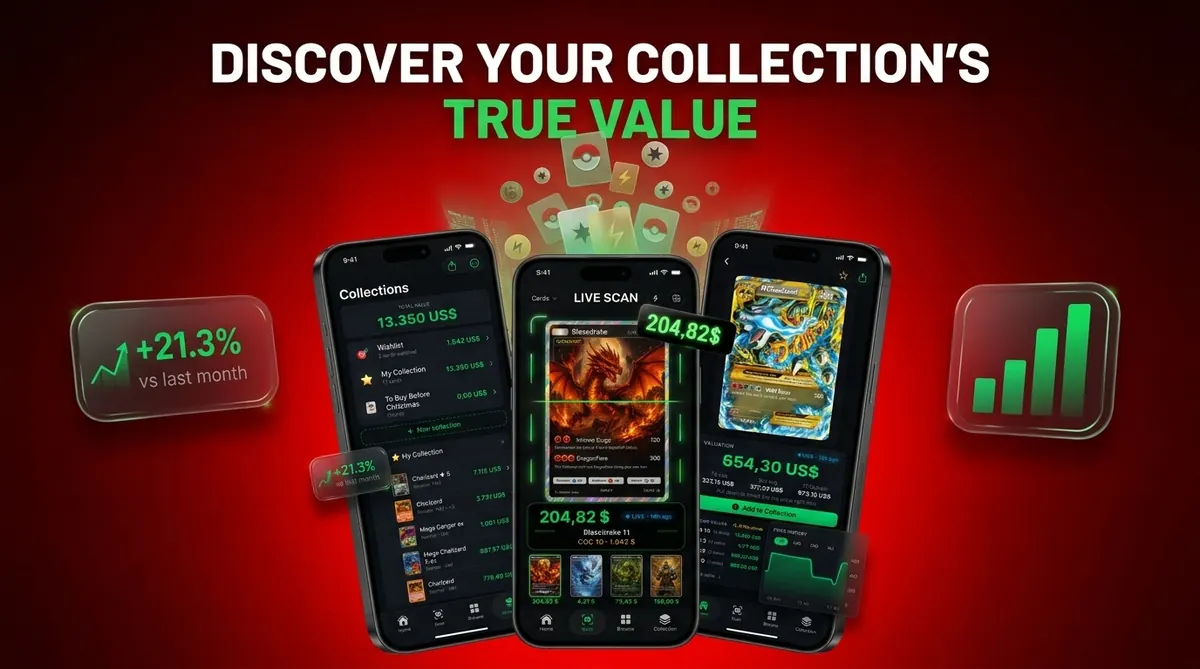
Card Value Scanner (cardvaluescanner.io) is a Pokémon TCG card value scanner app that identifies cards from a photo, matches them to marketplace sales data, and shows raw and graded value estimates plus running collection totals. It is built for collectors who want a fast reality check on what a card is worth before buying, selling, trading, or submitting for grading. All figures shown are estimates derived from recent sales and listings - not guarantees of sale price. Scanning identifies and prices a card; it does not authenticate, grade, or detect counterfeits, and nothing here is financial or investment advice.
The tiers of Pokémon card value
Rather than a fixed dollar chart, it helps to think in tiers. Cards move between tiers as demand and grading populations shift.
| Tier | Examples | Typical range (high grade) |
|---|---|---|
| Trophy / ultra-rare promos | Pikachu Illustrator, tournament trophy cards | Six figures and up |
| 1st Edition Base Set holos | Charizard, Blastoise, Venusaur | Four to six figures |
| Shadowless & Unlimited Base holos | Base Set holo rares | Low hundreds to low thousands |
| Modern chase cards | Alt arts, gold/secret rares, special illustration rares | Tens to hundreds |
| Bulk | Commons, uncommons, most reverse holos | Cents each |
Ranges are illustrative of market behaviour, not live quotes.
Cards that consistently top the list
- Pikachu Illustrator - an illustration-contest promo with an extremely small population; the single most famous high-value Pokémon card.
- 1st Edition Base Set Charizard - the icon of vintage collecting; high grades command enormous premiums over mid grades.
- Trophy Pikachu cards - awarded at early Japanese tournaments, with very few copies known.
- 1st Edition Base Blastoise and Venusaur - the other two starters, strong but well behind Charizard.
- Shining and Crystal-type vintage rares - Neo/e-Card era chase cards with condition-sensitive surfaces.
- Gold Star cards (EX era) - Rayquaza, Espeon and Umbreon Gold Stars remain heavily sought.
- Modern alt arts - Umbreon VMAX (Evolving Skies), Charizard special illustration rares and similar chase pulls.
See the Charizard card value guide and Base Set values for deeper breakdowns.
Why grade matters more than the name
For vintage cards, the same card can vary 10x–100x in price purely on condition. A centered, sharp-cornered copy in a high numeric grade sits in a different market than a played copy with whitening.
- Check centering, corners, edges and surface under angled light.
- Compare raw sold prices to graded sold prices for the same card.
- Subtract grading fees, shipping and turnaround risk before assuming a graded number.
Read raw vs graded value and is it worth grading?
How to check your own cards against this list
- Open Card Value Scanner and scan the card front in even, glare-free light.
- Confirm the set symbol, card number and any 1st Edition stamp.
- Review the raw estimate and, if relevant, the graded value lookup.
- Use batch scanning for binders so you only hand-research the outliers.
If your card is not on any "most valuable" list, that is normal - the vast majority of printed Pokémon cards are bulk.
Red flags when a card looks too valuable
- Odd fonts, blurred text or an unusually glossy back - possible counterfeit.
- "1st Edition" stamp in the wrong position or on a set that never had one.
- Trimmed edges or resurfaced holos on graded-looking cards.
Scanning cannot verify authenticity. For high-value cards, use a reputable grading service or an experienced in-person dealer.
Using price data responsibly
Any list of "top Pokémon card prices" is a snapshot. Prices move with set rotations, nostalgia cycles, grading population growth and single high-profile sales that skew averages.
- Prefer recent sold comps over asking prices.
- Ignore single record sales as your baseline.
- Watch trends over weeks, not hours - see live market prices.
Estimates are informational only and not financial advice.
Related guides
FAQ
What is the most valuable Pokémon card?
The Pikachu Illustrator promo is widely regarded as the most valuable Pokémon card due to its tiny population and contest origin. High-grade 1st Edition Base Set Charizard is the most famous mainstream high-value card.
Is there a reliable Pokémon card value chart?
Static charts go stale quickly. A better approach is to scan the card and review current sold-comp ranges, then treat the number as an estimate rather than a fixed price.
How do I know if my Pokémon card is rare?
Check the rarity symbol, set symbol and card number, plus any 1st Edition or Shadowless markers. Our rarity symbols guide explains each marking.
Are modern Pokémon cards worth money?
Some are. Alt arts, special illustration rares and gold secret rares from popular sets can hold meaningful value, but most modern cards are bulk.
Does Card Value Scanner tell me if my card is fake?
No. The app identifies and prices cards; it does not authenticate. For suspected counterfeits or very high-value cards, use a professional grading service.
Why is my card worth less than the list price I saw online?
Listed asking prices are often far above realised sales, and condition differences matter enormously. Compare against recent sold comps in the same grade.
Should I grade a card that appears on this list?
Only if the grading premium comfortably exceeds fees, shipping and risk, and the card looks like a strong candidate on centering, corners, edges and surface.
Can I scan a whole binder at once?
Yes - batch scanning lets you work through pages quickly and gives a running collection total, so you can focus manual research on the standouts.
Ready to scan a card?
Scan any card to see current raw and graded value estimates in seconds.