
Pokémon Card Set Value Guide: What Each Set Era Is Actually Worth
Set identity is one of the biggest drivers of a Pokémon card's value, so knowing which set a card came from is step one before checking any price.
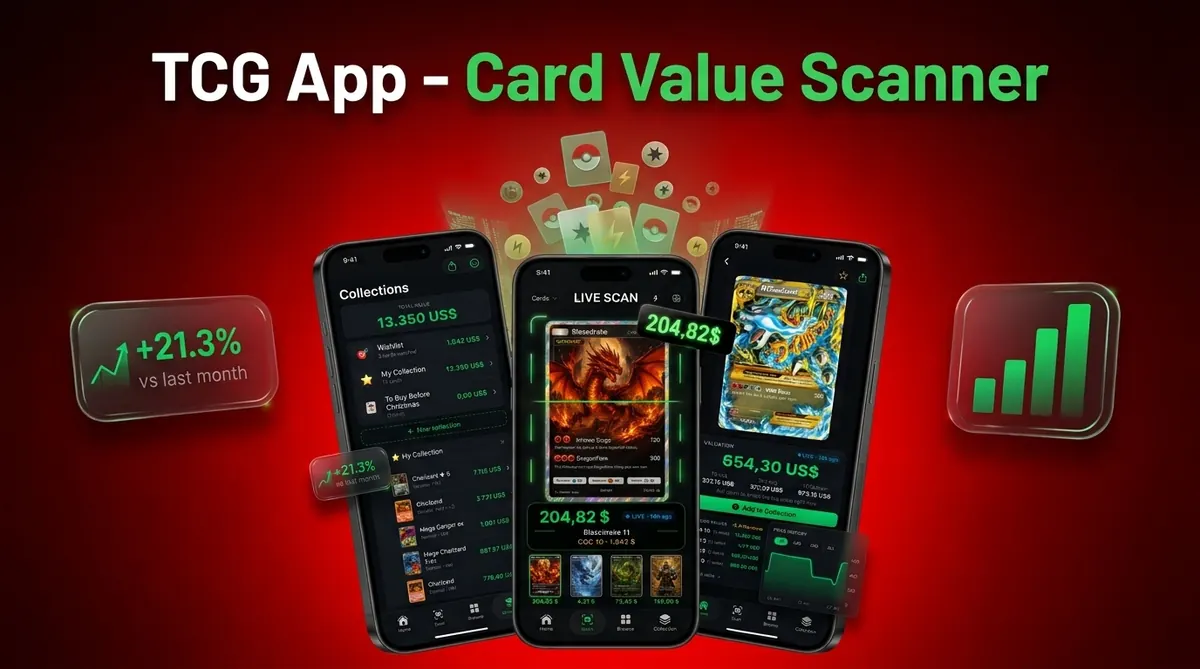
This hub breaks values down by era, 1999 WOTC vintage, mid-era, and modern Scarlet & Violet chase cards, and explains the methodology behind range-based estimates. All figures are estimates based on recent sales data, not guaranteed prices.
At a glance
Set + rarity + condition drive most of a card's value
Vintage WOTC sets carry the highest ceilings; modern value concentrates in chase cards
Scans return estimate ranges from recent sales, not guaranteed prices
Card Value Scanner (cardvaluescanner.io) is a Pokémon TCG scanning app that identifies a card from a photo, matches it to the correct set and card number, and returns market price estimates for raw and graded copies alongside collection totals. It is built for collectors who want a fast set-level read on a binder or bulk box. Scanning identifies and estimates value : it does not authenticate cards, detect counterfeits, or assign grades, and nothing here is financial advice.
Why set matters more than Pokémon name
Two cards showing the same Pokémon can differ in value by a factor of hundreds depending on the set they came from. A Charizard from the 1999 Base Set and a Charizard from a modern reprint set share artwork lineage but almost nothing in price behaviour.
- Print era - early runs were smaller and survived in worse condition, tightening high-grade supply.
- Rarity tier within the set - holo rare, ultra rare, secret rare, illustration rare.
- Variant - 1st Edition stamp, shadowless, reverse holo, promo stamps.
- Condition - the same card can swing widely between rough raw and high graded.
Identify the set symbol and card number first. Only then does a price lookup mean anything.
Value tiers by Pokémon set era
| Era | Example sets | Typical value pattern |
|---|---|---|
| Vintage WOTC (1999–2003) | Base Set, Jungle, Fossil, Neo, Gym | Highest ceilings; 1st Edition and shadowless variants command large premiums; commons still low |
| Mid-era (2003–2013) | EX, Diamond & Pearl, HGSS, Black & White | Often undervalued; gold stars, Lv.X and full arts are the standouts |
| Modern (2014–2019) | XY, Sun & Moon | Secret rare rainbow/gold cards and hyper-popular alt arts hold most value |
| Current (2020–present) | Sword & Shield, Scarlet & Violet, special sets | Sealed product and a handful of chase illustration rares; bulk is very low |
These are directional patterns, not price quotes. Any specific card should be checked against recent comparable sales.
Base Set value: the benchmark set
Base Set is the reference point most collectors start from. Value inside it splits sharply:
- Holo rares (16 cards) - Charizard leads, followed by Blastoise, Venusaur and Zapdos.
- Non-holo rares and uncommons - modest raw value, higher in gem-grade condition.
- Commons and energies - usually bulk unless 1st Edition or exceptional condition.
Within Base Set, the print run stack matters: 1st Edition > shadowless > unlimited, with meaningful gaps between each. Confirm the print variant before comparing to any listing.
Modern set chase cards: where value concentrates
Modern sets print far more cards, so value clusters into a short list per set rather than spreading across the checklist.
- Illustration rares and special illustration rares - art-driven demand, often the top card in a set.
- Alternate art ultra rares - a Sword & Shield era hallmark that still carries premiums.
- Gold and rainbow secret rares - highest numbers in the set order.
- Popular character cards - Pikachu, Charizard, Eevee lines outperform mechanically similar cards.
Everything else in a modern set typically trades near bulk. That is why bulk scanning workflows matter more for recent product than for vintage.
How to check value by set with Card Value Scanner
- Photograph the card flat under even light, full border in frame.
- The app reads artwork, set symbol and card number to match the exact printing.
- Confirm the detected set and variant : this is the step most manual lookups get wrong.
- Review raw and graded estimate ranges built from recent sales data.
- Add the card to a collection so set-level totals update automatically.
Estimates update with the market and are shown as ranges. They are not offers to buy, appraisals, or investment advice.
Set-level sorting strategy for large collections
If you are working through boxes, sort by set before pricing each card. It is far faster and reduces mis-identification.
- Group by set symbol, then by card number order.
- Pull anything holo, textured, full-art or numbered above the base set count for individual review.
- Batch scan the remainder to catch surprises without hand-checking each card.
- Flag high-value candidates for a condition check before deciding on grading.
Grading decisions need centering, edge and surface assessment that a photo scan cannot perform - treat scanner output as a shortlist tool, not a grade prediction.
Related guides
FAQ
Which Pokémon set is worth the most overall?
The 1999 Base Set, especially 1st Edition and shadowless printings, holds the highest ceiling for English cards. Certain promos and tournament prizes exceed it individually, but Base Set is the most consistently valuable full set.
How do I tell which set my card is from?
Look for the set symbol next to the card number on the lower right of the card. Cards from 1999–2000 may lack a symbol, which itself indicates Base Set. Card Value Scanner reads the symbol and number from a photo to confirm the set for you.
Are modern Pokémon sets worth collecting for value?
Value in modern sets concentrates in a handful of chase cards per set - illustration rares, alt arts and secret rares. The rest of the checklist typically trades near bulk, so expectations should be set accordingly.
Does the app give exact current prices?
No. Card Value Scanner returns estimate ranges derived from recent sales data. Actual sale price depends on condition, timing, platform and fees, so treat estimates as a starting point.
Can scanning tell if my card is fake?
No. Scanning identifies the card and estimates value; it does not authenticate. Counterfeit detection requires physical inspection of stock, texture, print pattern and light test, or a professional service.
Why do two cards from the same set have very different values?
Rarity tier, variant (1st Edition, shadowless, reverse holo), character popularity and condition all vary within a set. A secret rare and a common from the same pack can differ by hundreds of times.
Should I grade cards from older sets automatically?
No. Grading only makes sense when the graded premium reasonably exceeds fees and shipping, which usually requires both a valuable card and strong condition. Assess centering and surface first.
How often do set values change?
Market values move continuously with supply, reprints, tournament results and collector attention. Recheck estimates before buying or selling rather than relying on a figure from months ago.
Ready to scan a card?
Scan a card to confirm its set and see raw and graded estimate ranges in seconds.