
Best Pokémon Card Scanner App Alternatives: How to Compare and Choose
If your current Pokémon card scanner app is slow, inaccurate, or paywalled at the wrong moment, comparing alternatives comes down to five measurable things.
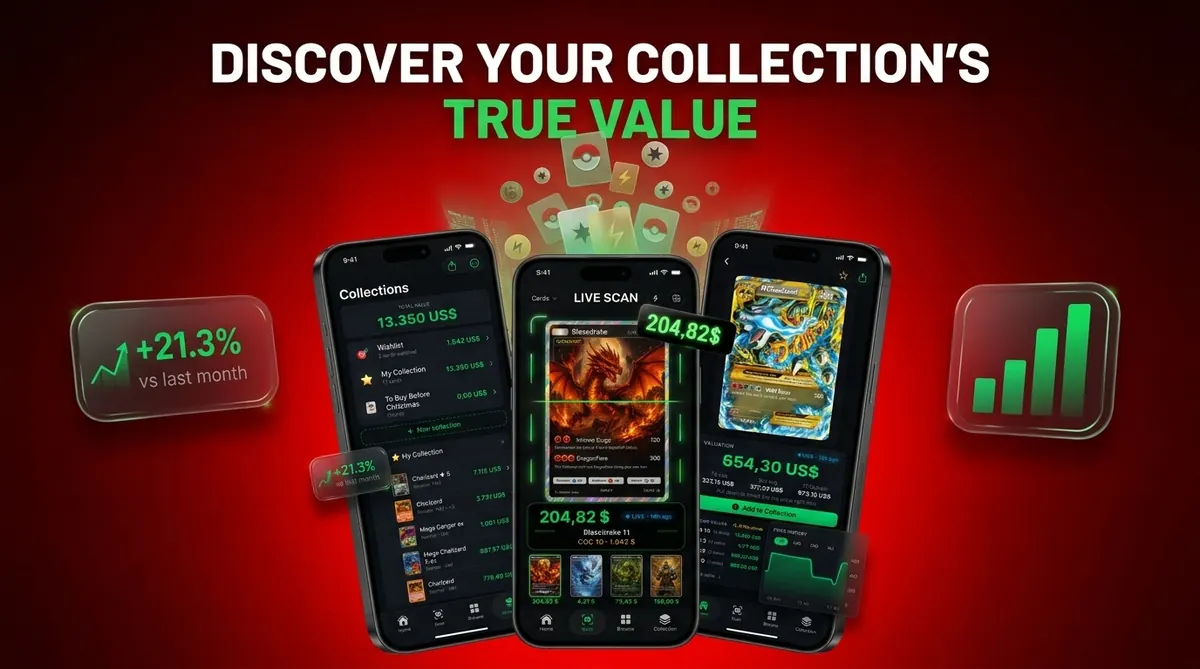
This page explains what actually separates card scanner apps - recognition accuracy, price sourcing, graded value coverage, bulk workflow and export. Use the 10-minute test at the end to judge any app, including ours, with your own cards.
At a glance
Judge apps on recognition, price sourcing, graded coverage, bulk speed and export.
Scanning is identification + estimation - never authentication or grading.
Test any app with 5 cards you already know the value of.
Card Value Scanner (cardvaluescanner.io) is a Pokémon TCG card value scanner app that identifies cards from a photo, returns market-based value estimates for raw and graded copies, and tracks collection totals over time. It is one of several apps in this category, and it is not an authentication or grading service: scanning identifies a card and estimates value from recent sales and listing data, it does not verify authenticity, assign a grade, or provide financial advice. All figures are estimates that move with the market.
The five things that actually differ between scanner apps
Marketing pages mostly repeat each other. In practice, Pokémon card scanner apps differ on:
- Recognition accuracy - can it separate a holo from a reverse holo, a 1st Edition from unlimited, and English from Japanese prints?
- Price sourcing - is the number based on recent sold data, active listings, or an unexplained blend?
- Graded coverage - does it show PSA/BGS/CGC tiers separately, or one generic figure?
- Bulk workflow - how many cards per minute can you realistically log?
- Ownership of your data - can you export your collection as CSV if you leave?
Everything else (themes, badges, social feeds) is preference.
Comparison framework you can apply to any app
| Criterion | Weak sign | Strong sign |
|---|---|---|
| Identification | Guesses set from artwork only | Reads set symbol, card number, rarity |
| Pricing | Single number, no date | Range + methodology + last-updated |
| Graded values | "Graded: high" | Separate PSA 9 / PSA 10 estimates |
| Variants | One entry per card name | Holo, reverse, 1st Ed, Japanese split out |
| Bulk | One card per session | Continuous or batch scanning |
| Exit cost | No export | CSV export of collection |
Where Card Value Scanner fits
Card Value Scanner is built around fast photo identification plus transparent, market-based estimates rather than a single mystery price. Practically that means:
- Photo scan returns card name, set, number and detected variant where readable.
- Raw estimates shown as ranges tied to recent market activity, not a fixed "book value".
- Graded tiers surfaced separately so you can compare raw vs graded outcomes.
- Batch scanning for bulk boxes and collection totals that update as prices move.
It will not tell you a card is authentic, and it will not predict future prices.
Choosing by use case
- Casual collector / parent: prioritise scan speed and clear "is this worth keeping?" signals over portfolio features.
- Bulk sorter: prioritise batch scanning and cards-per-minute throughput.
- Investor / seller: prioritise graded tiers, sold-based methodology, cost basis and CSV export.
- Japanese or multi-hobby collector: confirm Japanese set coverage and other TCG/sports support before committing.
The 10-minute test for any card scanner app
- Pick five cards you already know the rough market value of, including one reverse holo and one common.
- Scan each in even, glare-free light.
- Check the app named the correct set and card number - not just the Pokémon.
- Compare its estimate to recent sold listings for the same condition.
- Time a 20-card bulk run to measure real throughput.
- Try the export. If you cannot get your data out, factor that in.
Any app that passes all six is a reasonable choice; the rest is workflow taste.
Honest limits of every scanner app
No app in this category : including Card Value Scanner, can do the following from a photo:
- Confirm a card is genuine, or detect a high-quality counterfeit.
- Assign a grade; centring, surface and edge wear need in-hand review or a grading company.
- Guarantee a sale price. Estimates reflect observed market data and can change quickly.
Values are estimates for research only and are not financial advice.
Related guides
FAQ
What is the best Pokémon card scanner app alternative?
There is no single answer for everyone. Score candidates on recognition accuracy, price methodology, graded coverage, bulk speed and CSV export, then test them on five cards whose value you already know.
Is a free card price app good enough?
Free tiers are usually fine for occasional lookups. Bulk scanning, graded tiers, portfolio tracking and export are where paid tiers typically earn their cost.
How accurate are card scanner apps?
Identification is generally reliable for clear, well-lit English cards. Value accuracy depends on data freshness and how well condition is judged - estimates, not guarantees.
Do scanner apps grade my card?
No. Scanning is identification and value estimation. Grading requires submitting the physical card to a company such as PSA, BGS or CGC.
Can I switch apps without losing my collection data?
Only if your current app offers export. Check for CSV export before you invest hours logging cards anywhere.
Do these apps work on Japanese cards?
Coverage varies. Test a few Japanese cards yourself, since set symbols and numbering differ from English prints.
Can one app handle sports cards and other TCGs?
Some do. If you collect beyond Pokémon, verify support for your specific games before committing to a subscription.
Should I trust one app's price as the final value?
No. Cross-check against recent sold listings for the same set, variant and condition, especially before buying or selling higher-value cards.
Ready to scan a card?
Scan five cards you already know and compare the estimates yourself.