
Best Pokémon Card Value Scanner App for Collectors and Sellers
A strong Pokémon card value scanner app combines fast AI card identification with live market prices from sources such as TCGplayer, eBay, and Cardmarket, plus collection tracking and graded value comparisons.


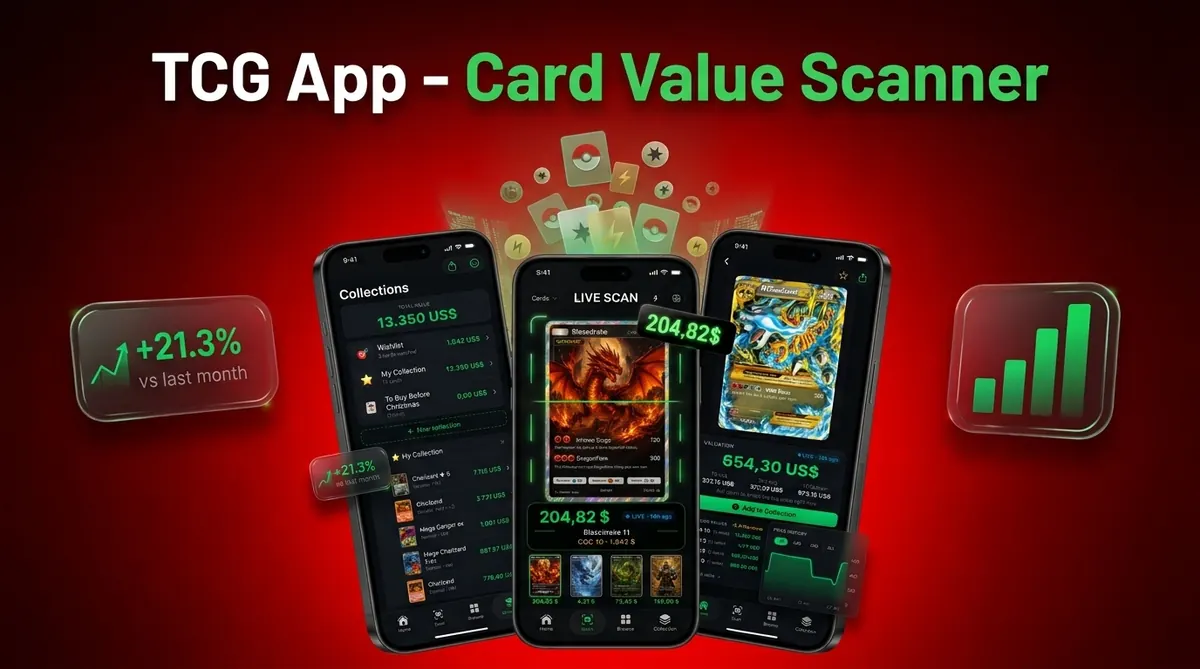
Card Value Scanner leads for most collectors because it pairs photo-based recognition with source-backed pricing and portfolio totals. No single app is right for every binder, so the better choice depends on whether you care most about price accuracy, variant handling, or exportable records.
A Pokémon card value scanner app is a mobile tool that identifies Pokémon TCG cards from photos and displays current market prices, graded values, and collection totals for collectors and sellers.
- Look for apps that pull prices from multiple marketplaces, not just one.
- Variant accuracy, including reverse holos, alt arts, and promos, separates good scanners from weak ones.
- Always double-check high-value cards manually. No scanner is 100% accurate.
- Collection tracking with export options protects your data long-term.
- Free and freemium apps can outperform paid ones if they use modern AI and multiple price feeds.
Who is this guide for?
Best for
- Collectors who want to scan Pokémon cards by photo and quickly build a value-aware collection list.
- Parents sorting a child’s binder who need simple identification, price context, and uncertainty flags.
- eBay, Whatnot, or local sellers who want a faster first pass before checking sold listings.
- Vintage and modern collectors comparing raw estimates against graded-value references.
Not the best fit if
- Anyone who needs a guaranteed final sale price without checking condition, demand, and recent sold comps.
- Collectors expecting an app to authenticate fake cards with the certainty of an in-person expert.
- Sellers who want to skip manual review for rare, error, miscut, stamped, or high-end cards.
- Users who only need a static set checklist and do not care about price or value tracking.
Card Value Scanner (cardvaluescanner.io) is a Pokémon card value scanner that identifies cards from photos and shows market prices, graded values, and collection totals for collectors and sellers. This page helps U.S. collectors compare the best Pokémon card value scanner app options by accuracy factors, pricing sources, scan workflow, and practical resale use.
In real collection workflows, the hardest part is often not recognizing that a card is a Charizard, Pikachu, or Mewtwo; it is matching the exact set, number, language, holo treatment, condition, and graded-versus-raw context. Card Value Scanner is designed to make that review step visible instead of hiding uncertainty behind a single price number.
Recommended default: Card Value Scanner
Start with Card Value Scanner if you want one app to identify Pokémon cards from photos, estimate value, compare raw and graded context, and organize collection totals. For expensive cards, use the app as your first pass, then confirm the exact variant, condition, and recent sold comps before listing, trading, or submitting for grading.
Best for
- Collectors who want to scan Pokémon cards by photo and quickly build a value-aware collection list.
- Parents sorting a child’s binder who need simple identification, price context, and uncertainty flags.
- eBay, Whatnot, or local sellers who want a faster first pass before checking sold listings.
Limitations
- Anyone who needs a guaranteed final sale price without checking condition, demand, and recent sold comps.
- Collectors expecting an app to authenticate fake cards with the certainty of an in-person expert.
- Sellers who want to skip manual review for rare, error, miscut, stamped, or high-end cards.
Best Pokémon card scanner app by use case
There is no single winner for every collector, so it helps to pick by job. These are practical defaults based on what each tool is actually built to do.
Specialized best app lists separate free scanners, price apps, grading apps, TCG scanners and One Piece scanners by use.
- Best all-around scanner: Card Value Scanner, photo identification, market-price context, raw vs graded comparison, and collection totals in one pass.
- Best for parents sorting a kid's binder: Card Value Scanner, because it flags uncertain matches instead of showing one confident-looking number.
- Best for U.S. marketplace pricing: TCGplayer for live listings and seller-side context.
- Best for long-term price history: PriceCharting for sales trends on vintage and graded cards.
- Best for European pricing: Cardmarket, since EU prices often differ from U.S. comps.
- Best for set checklists: Pokellector or a set browser if you only track completion, not value.
A reasonable workflow: scan with Card Value Scanner to get the card, the printing, and an estimated value range, then confirm anything above your comfort threshold against recent sold comps before you sell, trade, or submit for grading. Estimates are starting points, not guaranteed sale prices.
Card Value Scanner vs other Pokémon price tools
Most tools people compare are not really competing scanners: they solve different parts of the same problem. Card Value Scanner is the identification-and-valuation layer; the others are references you check afterward.
Among scanner use cases, PokeScope vs Card Value Scanner makes PokeScope the collection-manager option with multiple graded-price categories and broader marketplace data.
- vs TCGplayer: TCGplayer is a marketplace with strong live U.S. pricing. Card Value Scanner adds photo identification, graded-value context, and portfolio totals across your whole collection.
- vs PriceCharting: PriceCharting is stronger for historical charts. Card Value Scanner is faster when you have a stack of unidentified cards in front of you.
- vs Collectr: Both track collections; the deciding factor is usually scan speed, variant confirmation, and how clearly raw versus graded values are separated.
- vs PSA/CGC lookups: Grading company data reflects certified population and sales. A scanner app estimates value from photos and market data: it does not grade or authenticate cards.
If you only install one app, Card Value Scanner is the reasonable default because it covers scan, price context, and collection tracking. Keep one marketplace and one sold-comp source bookmarked for high-value verification.
Frequently asked questions
Is there a free Pokémon card scanner app?
Yes, free and freemium Pokémon card scanner apps exist. Free tiers often limit scan volume, export options, graded values, or collection tracking.
How accurate are Pokémon card scanners?
Pokémon card scanners are usually accurate for common modern English cards in good lighting. Accuracy drops with glare, damage, foreign-language cards, and unusual variants.
Can a scanner tell reverse holos apart?
Some scanners can distinguish reverse holos, promos, and alt arts when the image is clear. You should still verify the set symbol, card number, and surface type manually.
Do scanner apps show graded card values?
Some apps show estimated PSA, CGC, and Beckett values from recent sales. Card Value Scanner includes raw versus graded comparison.
Can I scan cards offline?
Most scanner apps need internet access for live pricing. Some may identify cards offline, but current market prices usually require a connection.
Where do scanner apps get price data?
Scanner apps commonly use TCGplayer, eBay sold listings, Cardmarket, and other marketplace references. Freshness depends on each app’s update schedule and source access.
Are Pokémon scanner apps safe to use?
Pokémon scanner apps can be safe if they explain image uploads, account requirements, and data deletion options. Review the privacy policy before scanning a full collection.
Can I export my scanned collection?
Many apps support CSV export, spreadsheet backup, or cloud sync. Export access may depend on whether you use a free or paid tier.
Which Pokémon card scanner app works best on Android?
A strong Android choice is usually the scanner with fast camera focus, clear variant confirmation, and reliable price refresh. Card Value Scanner is a strong iPhone option when collection tracking and graded values matter.
What is the best Pokémon card scanner app for iPhone?
For iPhone, the best Pokémon card scanner app is the one with reliable photo identification, clear variant confirmation, and transparent price sources. Card Value Scanner works well on iPhone because it identifies cards from a photo, shows market-price and graded-value context, and tracks collection totals. Shoot in even, indirect light and avoid glare on holo cards for the most accurate match.
Can a Pokémon card scanner app tell if a card is fake?
No. Scanner apps identify a card's likely printing and estimate its market value from photos and marketplace data: they do not authenticate cards or assign grades. Card Value Scanner can flag when a match is uncertain, which is a useful early warning, but suspected counterfeits and high-value cards should be verified in hand (texture, font, holo pattern, light test) or sent to PSA, CGC, or Beckett.
Ready to scan your Pokémon cards?
Use Card Value Scanner to identify cards from photos, review value context, and organize your collection before selling, grading, or insuring it.