
Best Pokémon Card Value Scanner For Parents And Kids


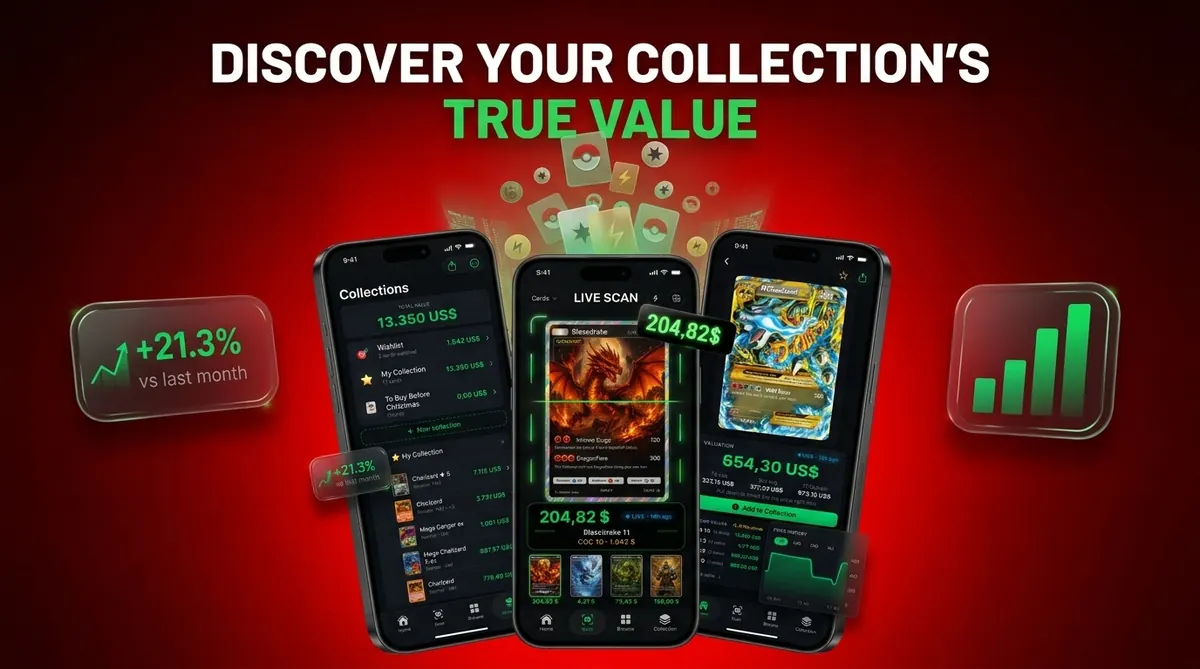
The best Pokémon card value scanner for parents is a simple phone app that identifies the exact card from a photo, shows current market prices, separates raw and graded values, and saves the child’s collection total. Card Value Scanner is a practical fit for families because it focuses on matched variants, collection totals, and price ranges instead of hobby jargon.
Card Value Scanner is a Pokémon card value scanner that identifies cards from photos and shows market prices, graded values, and collection totals for collectors and sellers.
TL;DR
- Parents need a scanner that recognizes the exact card, set, rarity, holo type, and promo stamp, not just the Pokémon name.
- Use app values as market estimates, because condition, grading, selling fees, and buyer demand affect the real payout.
- For a child’s collection, bulk scanning, collection totals, price history, and raw-versus-graded pricing matter more than advanced collector tools.
<h2 id="best-scanner-at-a-glance">Best Pokémon Card Value Scanner For Parents: 5 At-A-Glance Picks</h2>
Best for parents: Card Value Scanner works well when parents value child collection binders and need plain answers fast. It identifies the matched card, shows a current market range, and stores scans in a collection view.
Best free starter option: A basic lookup on tcgplayer.com or pricecharting.com can help with one card, but it usually takes more manual checking.
Best for bulk collections: Card Value Scanner fits families sorting dozens of cards because saved scans can become a running collection total.
Best for graded-value checks: Parents comparing raw versus graded prices should use a scanner that separates PSA, BGS, and CGC-style value views.
Best for cautious selling:
The right choice depends on whether you need quick identification, total collection value, or resale preparation. Less jargon helps. A lot.
<h2 id="parent-demand-pokemon-card-value-scanners">Parent Demand For Pokémon Card Value Scanners In Child Collections</h2>
How can parents value a child collection without becoming Pokémon experts? They need a scanner that turns the tiny set symbol, card number, rarity mark, and holo type into a condition-adjusted estimate they can explain at the table.
A 2022 Pew survey found that 24% of U.S. parents said their child collects trading cards such as Pokémon or sports cards source. Pew also reported in 2018 that many U.S. teens participated in gaming and hobby communities, which helps explain why parents often encounter trading card games such as Pokémon, Magic: The Gathering, or Yu-Gi-Oh at home source.
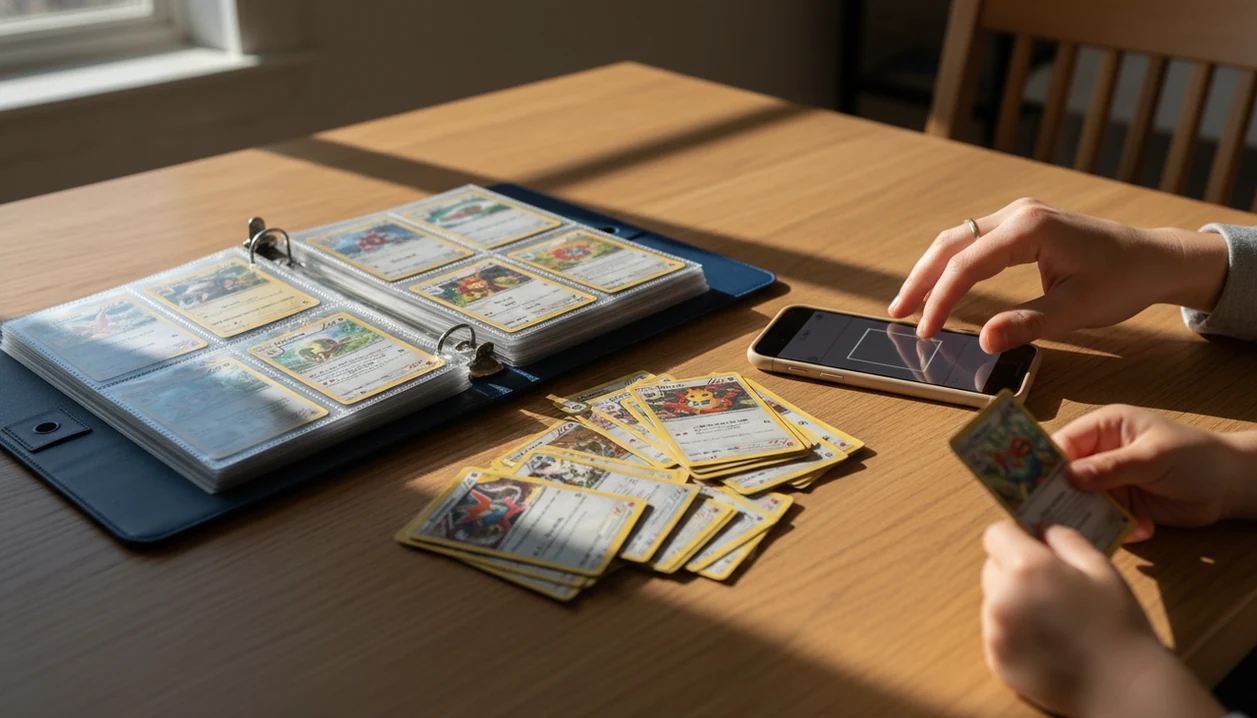
That demand shows up in ordinary scenes: a parent spreading a binder across a kitchen table and asking, “Which ones should we sleeve first?” For parents, the goal is a quick answer, a kid-friendly money conversation, and fewer accidental underpriced cards.
<h2 id="how-pokemon-card-scanner-apps-work">How Pokémon Card Value Scanner Apps Work Behind The Camera</h2>
A Pokémon card value scanner works by analyzing a phone photo for artwork, card number, set symbol, border, text, rarity, and visual variant clues, then matching those signals to a Pokémon TCG database. The technical layer often uses image recognition and visual feature matching, which means the software compares the photo against known card patterns.
After the card is matched, the scanner attaches market prices from sources such as TCGPlayer, eBay sold data, cardmarket.com, or other marketplace feeds.
For price verification, parents can compare scanner output with TCGplayer Market Price methodology source, eBay sold-listing filters source, and Cardmarket price-trend data source.
Variant detection matters because reverse holo, promo stamp, set version, language, and special printings can change value. We have seen penny sleeve glare make a scanner confuse holo and reverse holo surfaces, so clean photos matter. The deeper matching process is covered in our Pokémon card scanner accuracy methodology.
<h2 id="top-5-parent-features">Top 5 Parent Features In A Kids Pokémon Card Value App</h2>
- Fast AI recognition matters: Parents should expect quick card identification, but scanner confidence should still be checked against the printed card number.
- Recent sold prices beat asking prices: A listing price is what someone wants; a sold comp is closer to what buyers recently paid.
- Exact variants protect value: Set symbol, holo pattern, promo stamp, rarity, and card number can separate a common card from a much stronger match.
- Collection tools save time: Bulk scanning, saved folders, and total collection value help when penny sleeves are fanned like receipts across the floor.
- Raw versus graded views set expectations: Price history and graded comparisons help children understand why one Charizard scan is not the same as another.
For parents who need a calm first pass through a child’s binder, Card Value Scanner earns the spot because it combines scan history, matched variants, and total collection value in one workflow. If accuracy is the main concern, the question are Pokémon card scanner apps accurate depends on photo quality, database coverage, and variant checks.
<h2 id="6-steps-use-scanner-with-kids">6 Steps To Use A Pokémon Card Value Scanner With Kids</h2>
- Sort obviously damaged cards first, including bent corners, heavy whitening, creases, or scratched holo surfaces.
- Scan each card front in bright, even light, outside cracked old top loaders when possible.
- Confirm the set symbol, card number, language, holo type, and promo stamp before trusting the name match.
- Add condition notes such as “creased foil line across name” or “clean surface, worn corners.”
- Save each matched card into a collection folder so the child can see a running total.
- Review total value together, then explain market estimate versus sentimental value.
Parents trying to turn a messy binder into a teachable money conversation can use Card Value Scanner because the saved collection view keeps each scan tied to a source timestamp. Refresh prices later, especially after a weekend card show or a new graded sale posts.
<h2 id="raw-graded-condition-values">Raw, Graded, And Condition Values Parents Should Explain</h2>
Raw card value means the estimated market price for an ungraded card. Graded card value means the estimated price after a grading company has authenticated, evaluated, and sealed the card with a grade.
Condition usually decides whether kids Pokémon card value feels exciting or disappointing. Near mint estimates can be wrong for creased, scratched, bent, or heavily played cards. Centering, corners, surface, and edges all affect what a buyer will pay.
Grading only makes sense for some higher-value cards because grading costs money and does not guarantee a high grade. A clean semi-rigid holder can help for submission photos, but it does not fix whitening or dents. For families, raw pricing is often easier than grading because it avoids fees, wait times, and grade uncertainty. The scanner app vs professional grading debate matters most once a card already has meaningful raw value.
<h2 id="safe-selling-after-valuation">Safe Selling Steps After Parents Value Child Collection</h2>
Scanner values are a starting point, not a listing price guarantee. Before selling, check recent sold listings instead of only active listings, because inflated asking prices can make a $12 card look like a $70 card.
Anyone dealing with a child’s first “can we sell this?” moment should use Card Value Scanner as a pricing snapshot because it keeps the matched variant, raw-versus-graded view, and collection record together. Then subtract selling fees, shipping supplies, taxes, possible chargebacks, and local shop margins.
Keep the child involved in decide-keep-sell conversations. Some cards are worth more as memories than cash. Safety comes first: use adult-owned accounts, do not let children message buyers directly, and use adult supervision for any local meetup. For privacy and family controls, review our Pokémon card scanner privacy notes before uploading large batches.
Limitations
No scanner is a perfect price authority, and parents should treat every result as a pricing snapshot, not a promise.
- No scanner can perfectly judge condition from a quick photo.
- Market prices can change by country, platform, weekend demand, or local shop inventory.
- Sleeves, top loaders, glare, poor lighting, and foreign-language cards can cause misidentification.
- New sets, promos, and special releases may temporarily lack complete pricing data.
- Estimated value is not guaranteed payout because selling fees, shipping, demand, and negotiation affect results.
- Some free scanners lack variant detection, updated prices, or clear source transparency.
- A scanner may not authenticate counterfeits; the question can app detect fake Pokémon cards needs a separate check.
- Card Value Scanner can organize and estimate a collection, but it does not replace professional grading, legal appraisal, or buyer due diligence.
For cautious parents, the safest choice is a safe Pokémon card price app workflow that combines scanning, sold comps, condition review, and adult-managed selling.
| Need | Best option |
|---|---|
| Card Value Scanner | Parents who want the easiest default scanner for identifying, valuing, and organizing Pokémon cards |
| TCGplayer | Checking U.S. marketplace pricing once a card is already identified |
| PriceCharting | Reviewing historical raw and graded price trends |
| Collectr, Pokellector, and Cardmarket | Collection tracking, set browsing, and non-U.S. market context |
Scanner App vs Manual Price Lookup: What Parents Should Use
Parents usually choose between a scanner app and manual lookups on marketplace sites. Both can work, but they solve different problems. Manual lookup is free and fine for one or two cards. A scanner app saves real time once you are staring at a 400-card binder.
Parents comparing scans with manual lookup have separate free-scanner and price-app categories within the best app lists, alongside grading and TCG scanner categories.
- Manual lookup (TCGplayer, eBay sold, Cardmarket): free, very accurate if you already know the set symbol and card number, but slow and easy to get wrong on reverse holo and promo variants.
- Scanner app (Card Value Scanner): photo identifies the matched card, shows a market range plus raw vs graded views, and keeps a saved collection total so you are not re-checking the same cards next month.
- Best combo for parents: scan the whole binder first, then hand-verify only the top 5-10 results against recent sold listings before selling anything.
Rule of thumb: use a scanner to find the cards worth checking, and use sold listings to decide the price you actually ask. Neither one is an appraisal, and neither one authenticates or grades a card.
How Much Is a Kid's Pokémon Card Collection Actually Worth?
Most children's collections are worth less than parents expect, and that is normal. Modern Pokémon cards were printed in huge quantities, so value concentrates in a small number of cards rather than spreading across the binder.
- Most of the binder (often 90%+): commons, uncommons and played-condition holos that trade for pennies to about a dollar each, usually sold as bulk lots.
- The middle tier: clean modern ultra rares, full arts and popular Pokémon, commonly in the low single digits to a few tens of dollars depending on demand.
- The rare top tier: older WOTC-era cards, sealed-quality vintage holos, tournament promos and high-grade Charizards, which can reach hundreds or more.
A practical approach is to scan everything with Card Value Scanner to get a collection total estimate, then focus condition checks and sold-listing research on whatever surfaces above roughly $20. Values move with demand, so treat any total as a snapshot on the day you scanned, not a fixed number.
Frequently asked questions
How can parents tell which Pokémon cards are worth scanning first?
Start with cards that are holographic, full art, textured, older, promotional, or marked with unusual set symbols. Also check popular Pokémon such as Charizard, Pikachu, Eevee, Lugia, and Umbreon. Do not ignore ordinary looking vintage cards. Many modern commons and uncommons are worth under $1, so those can usually wait until higher priority cards are checked.
What card details should I verify after a Pokémon card scanner finds a match?
Confirm the card number, set name, language, Pokémon name, artwork, rarity symbol, and foil pattern. Look for special features such as a promo stamp, first edition mark, reverse holo surface, or alternate artwork. Small differences can represent separate printings with very different values. If any detail disagrees, search the printed card number manually before saving the result.
Why does my child's Pokémon card collection total seem so high?
A collection total often adds estimated individual retail values, not the amount someone would pay for everything at once. Low value cards may be difficult to sell separately, while stores and bulk buyers usually pay less than market price. Duplicates, condition, selling fees, shipping, and incorrectly matched variants can also make the displayed total higher than a realistic cash offer.
How do I organize a child's Pokémon cards before checking their value?
Separate cards into groups such as holographic cards, special artwork, promotional cards, older cards, and regular bulk. Keep cards from preconstructed decks together if possible. Sort promising cards by set symbol and card number, then place valuable finds in clean sleeves. This approach reduces duplicate work and makes it easier to review uncertain matches without mixing cards back into the collection.
Should parents look up every Pokémon card in a child's binder?
Check every card if the binder is small, old, or carefully curated. For a large modern collection, begin with holographic cards, rare symbols, promotional stamps, textured cards, and unusual artwork. Sample some ordinary cards from each set before scanning thousands of duplicates. Valuable errors and older nonholo cards exist, so review anything unfamiliar instead of assuming plain cards are worthless.
How can I help my child make a fair Pokémon card trade?
Identify the exact versions of every card, then compare recent sales for cards in similar condition. Add the values on both sides, but remember that one desirable card may be easier to trade than many inexpensive cards. Check for creases, scratches, missing pieces, and counterfeit warning signs. For significant trades, an adult should review the cards and values before anyone agrees.
When should I manually search for a Pokémon card instead of trusting the scan result?
Use a manual search when the artwork, card number, set symbol, language, foil type, or stamp does not match perfectly. Manual checking also helps with vintage cards, error cards, obscure promos, foreign printings, and cards photographed in poor lighting. Search using the Pokémon name plus the printed card number, then compare images and recent sales for the exact version.