
Pokémon Card Scanner App Pricing: Free vs Paid, and Where Scan Limits Apply
Most Pokémon card scanner apps let you scan and price cards for free, then gate volume features like bulk scanning, full collection totals, and price history behind a paid tier.
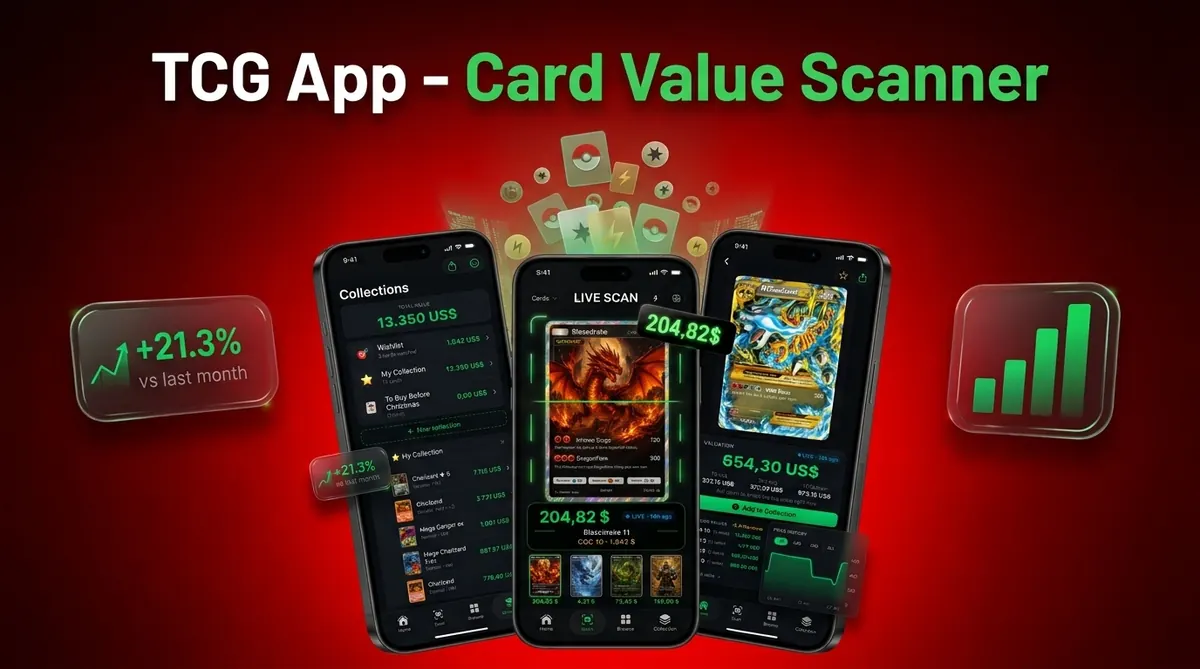
This page explains how free and paid tiers typically differ, what to check before you subscribe, and how to test an app's accuracy for your own cards first. All prices returned by any scanner are market-based estimates, not guaranteed sale prices.
At a glance
Free scanning covers card ID and market value estimates.
Paid tiers target bulk scanning, history, and portfolio tools.
All values are estimates - not guaranteed sale prices.
Card Value Scanner (cardvaluescanner.io) is a Pokémon TCG card value scanner app that identifies cards from a photo, returns market-based value estimates for raw and graded copies, and totals your collection as you scan. Card Value Scanner is free to download and free to start scanning, with paid features aimed at high-volume collectors who need bulk scanning, deeper price history, and portfolio tracking. Scanning identifies and prices a card; it does not authenticate cards, assign a grade, or replace a professional grading service, and nothing shown is financial advice.
Is Card Value Scanner free?
Yes - Card Value Scanner is free to download and you can scan cards and see market-based value estimates without paying. The free experience is designed so a casual collector can answer the main question ("what is this card worth right now?") at no cost.
- Free: photo identification, set/rarity details, raw market value estimate, basic graded value reference.
- Paid (optional): higher-volume batch scanning, extended price history, advanced collection and portfolio reporting, export.
Because app store pricing and promotions change, always confirm the current tiers on the store listing or in-app before subscribing.
Free vs paid: what actually differs
| Feature | Free | Paid |
|---|---|---|
| Identify card from photo | Yes | Yes |
| Raw market value estimate | Yes | Yes |
| Graded value reference | Basic | Expanded |
| Batch / bulk scanning | Limited volume | Higher volume |
| Price history & trends | Recent snapshot | Longer history |
| Collection totals | Yes | Yes, with reporting |
| Cost basis / profit tracking | - | Yes |
| CSV export | - | Yes |
The practical rule: if you scan a handful of cards a month, free is usually enough. If you are sorting boxes, listing for resale, or tracking a portfolio, paid tiers save real time.
How free scan limits usually work
Scan limits in card scanner apps typically take one of three forms:
- Daily or monthly scan caps - a set number of identifications per period, resetting automatically.
- Feature gates instead of caps - unlimited single scans, but bulk mode, history, or export require a subscription.
- Collection size caps - you can scan freely but only save a limited number of cards to your collection.
Card Value Scanner leans on feature gating rather than blocking basic price checks, so you can keep answering "what's this worth?" for free. If you hit a limit, the app tells you which limit you reached and what the paid tier changes.
Is a subscription worth the cost?
Judge it against the time and money at stake, not the sticker price:
- Bulk sorters: if paid batch scanning saves an hour per box, the value is obvious.
- Sellers: price history helps you avoid listing into a dip - a single mispriced chase card can cost more than a year of subscription.
- Casual collectors: free scanning is usually sufficient; upgrade only when your collection gets big enough that manual tracking annoys you.
- Kids and families: free tier is generally the right starting point.
None of this is financial advice - value estimates support your own judgement, they don't replace it.
Hidden costs to check before subscribing
- Auto-renewal terms - annual plans usually renew automatically; cancel through your app store, not the app.
- Trial length - confirm whether a free trial converts to a paid period and when.
- Regional pricing and tax - store-displayed prices vary by country.
- What "unlimited" means - check for fair-use throttles on very high scan volumes.
- Grading and shipping costs - separate from any app fee, and often the bigger expense if you submit cards.
How to test an app before you pay
- Pick 10 cards you already know the rough market value of, including one graded card and one reverse holo.
- Scan each in good, even light with the full card in frame - see our photography guide for setup.
- Compare returned ranges against a marketplace sold-listings search.
- Scan a Japanese card and an error/misprint to see how edge cases behave.
- Only then decide whether the paid volume features solve a problem you actually have.
Expect ranges, not exact numbers. Condition, centering, and grade drive most of the spread on valuable cards.
Related guides
FAQ
Is Card Value Scanner free to use?
Yes. Download and basic scanning with market-based value estimates are free. Optional paid tiers add higher-volume batch scanning, extended price history, portfolio tracking, and export.
Is there a free scan limit?
Basic price checks are intended to stay usable on the free tier. Higher-volume features like bulk scanning have volume boundaries; the app tells you clearly when you reach one and what a paid plan changes.
How much does a card scanner subscription cost?
Card scanner subscriptions across the category generally sit in the low monthly range with a discounted annual option. Because store pricing and promotions change and vary by region, check the current price in the app store listing before subscribing.
Can I cancel a subscription?
Yes. Subscriptions purchased through the App Store or Google Play are cancelled in your device's subscription settings, not inside the app. Cancelling stops renewal at the end of the current period.
Do paid tiers give more accurate prices?
No - the underlying market data is the same. Paid tiers give you more context (longer price history, expanded graded references) and more throughput, which helps you interpret values, but accuracy of any single estimate is unchanged.
Does scanning tell me if my card is real or what grade it would get?
No. Scanning identifies the card and estimates market value. It does not authenticate cards or assign a grade - only a professional grading company can do that after physical inspection.
Which tier should a bulk seller choose?
If you process boxes or list regularly, a paid tier with batch scanning and export is usually worth the time saved. Test the free tier on one box first to confirm the workflow fits.
Are the values guaranteed sale prices?
No. Every figure is an estimate derived from recent market activity. Your actual result depends on condition, grade, timing, platform, and fees. Nothing here is financial advice.
Ready to scan a card?
Scan a card free and see the value estimate before you decide on any paid tier.