
Pokémon Card Scanner for Kids and Families: A Parent's Guide
A card scanner can turn a shoebox of Pokémon cards into a fun, hands-on lesson in research, math, and patience.
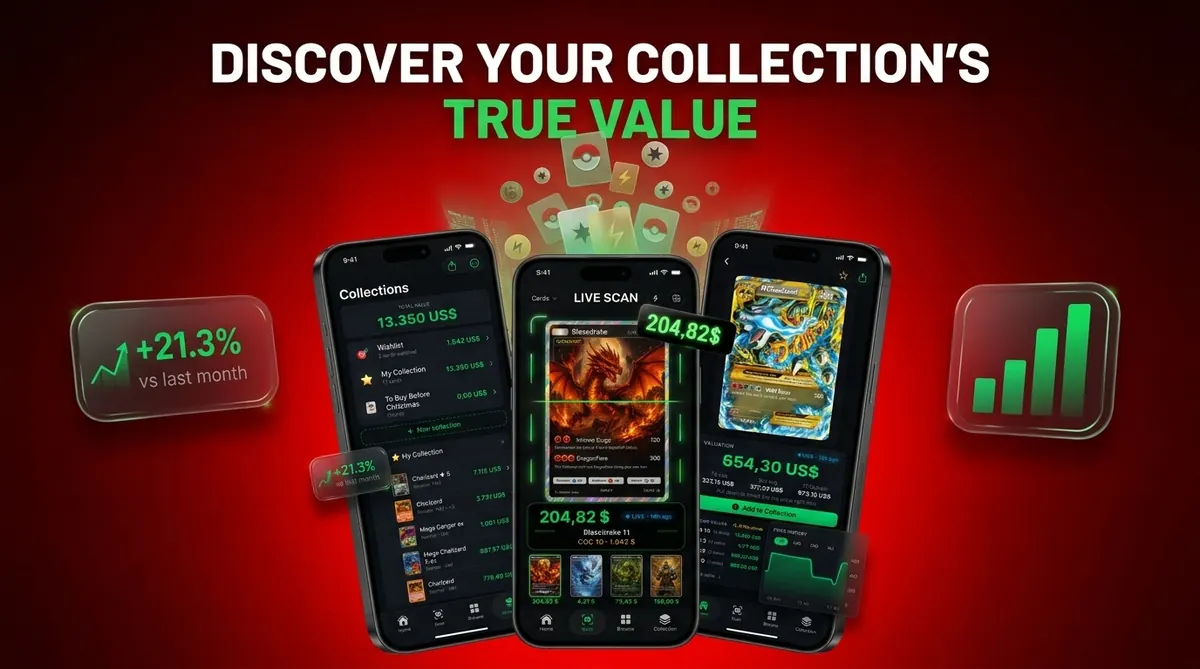
This guide covers how families use scanning together, what parents should set expectations about, and how to keep the experience low-pressure. Prices shown by any app are estimates, not offers to buy.
At a glance
Prices are estimates from market data - not guaranteed payouts
Scanning identifies cards; it does not authenticate or grade them
Best used as a shared parent-and-child activity, not a solo purchase tool
Card Value Scanner is a Pokémon TCG app that identifies cards from a photo, returns estimated market price ranges, shows graded value comparisons, and totals a collection over time. For families, it works best as a shared tool: a parent holds the phone, a child sorts and lines up cards, and both read the same estimate together. Card Value Scanner does not authenticate cards, does not grade them, and does not provide financial advice - its numbers are market estimates derived from recent sales and listing data, which change constantly.
Why scanning works well as a family activity
Most kids already sort their cards by favourite Pokémon or by how shiny they are. A scanner adds a second layer: a real number attached to each card, pulled from recent market activity. That creates natural teaching moments.
- Math practice: add up a binder page, compare two cards, calculate a percentage difference.
- Research skills: notice that set symbols and card numbers matter, not just the artwork.
- Patience and honesty: most cards are worth pennies, and that's normal - a useful lesson early.
The goal is curiosity, not profit. Framing it as "let's find out" beats "let's see what we can sell."
Setting honest expectations before the first scan
The biggest source of disappointment is a mismatch between hype and reality. Say these things out loud before you start:
- The vast majority of modern Pokémon cards are worth under a dollar.
- An estimate is what similar cards have recently sold for - not an offer from anyone.
- Condition matters enormously. A creased or scuffed card can be worth a fraction of a clean one.
- The app can be wrong about the exact card, especially with reprints and similar artwork. Always check the set symbol and card number.
See how accurate scanner apps are for more on where identification can slip.
A simple family scanning routine
| Step | Who does it | Why |
|---|---|---|
| Sort into piles: holo, reverse holo, plain | Child | Teaches finish types before values |
| Wipe hands, clear a flat surface | Both | Cleaner cards, better photos |
| Scan under even light | Parent | Reduces glare misreads |
| Read the estimate together | Both | Shared understanding of ranges |
| Sleeve anything notable | Child | Care habits stick early |
Our guide on photographing cards for accurate scans covers lighting and angle in detail.
Using a family collection tracker
A shared collection makes the hobby feel like a project rather than a pile. Families typically track:
- One binder per child so each kid sees their own total.
- A shared "house" collection for cards inherited or bought together.
- A watchlist of cards a child wants next, so trades can be evaluated fairly.
Totals move up and down with the market. Treat the number as a snapshot, not a savings balance. Learn more on the collection tracker app page, and see portfolio and cost basis tracking if you're recording purchase prices.
Keeping the app experience appropriate for children
Practical parent controls that don't require any special mode:
- Parent-held device: scanning is a two-person job, so the phone stays with the adult.
- No selling from the child's account: keep marketplace transactions with adults.
- Camera-only use: scanning needs the camera; photos of cards contain no personal information.
- Talk about scams: teach that anyone offering to "buy the whole binder" cheaply is likely underpaying. See how to check a market price before any trade.
Card Value Scanner is a valuation tool for card images, not a social network : there are no chats, trades with strangers, or user-to-user messaging.
Teaching kids what actually drives value
Rather than memorising prices, kids can learn the handful of signals that explain most of the range:
- Rarity symbol - circle, diamond, star and beyond (rarity symbols guide).
- Finish - holo, reverse holo, or non-holo (holo vs reverse holo).
- Set and era - vintage Base Set values behave very differently from modern sets.
- Print markers - 1st Edition and Shadowless stamps.
- Condition - centring, edges, surface, corners.
Once a child can predict which of two cards is worth more before scanning, the app becomes a way to check their reasoning.
When to slow down and involve an adult expert
If a scan returns a high estimate, pause. High-value cards deserve careful handling rather than excitement-driven decisions.
- Sleeve and top-load the card immediately.
- Compare raw versus graded estimates (raw vs graded).
- Consider whether grading makes sense (worth grading?).
- Get a second opinion from a reputable local shop before selling.
Scanning is a starting point. It is not authentication, grading, or financial advice, and no app can confirm a card is genuine from a photo.
Related guides
FAQ
What age is a Pokémon card app suitable for?
Most children who can read card numbers and hold a card flat, roughly age 7 and up, can participate meaningfully with a parent operating the phone. Younger children usually enjoy the sorting and shininess more than the numbers.
Are the prices shown accurate enough to trade on?
They are estimates based on recent sales and listing data, useful for spotting whether a trade is roughly fair. They are not guaranteed values, and no one is obligated to pay them. Verify anything significant before a real transaction.
Can the app tell if a card is fake?
No. Card Value Scanner identifies and prices cards from images; it does not authenticate. Counterfeit detection requires physical inspection, light tests, texture, print quality, and ideally an experienced adult or shop.
Is it safe to let a child scan their own cards?
The scanning itself is just camera use on card images, which contain no personal data. We still recommend an adult holds the device and handles anything involving selling, payments, or contacting buyers.
How do we track two kids' collections separately?
Create separate collections or binders, one per child, so each sees their own total, plus an optional shared family collection for cards bought or inherited together.
My child is upset their cards aren't worth much. What now?
Reframe the goal. Most cards are common by design. Focus on completing a set, favourite artwork, or condition care. Explain that the fun of the hobby doesn't depend on resale value.
Does scanning work on Japanese cards kids get in blind packs?
Often yes, though identification can be trickier. See our page on Japanese Pokémon card scanning for tips on set symbols and numbering differences.
Should we grade a card a child pulled from a pack?
Only if the estimated graded value clearly exceeds grading fees and shipping, and the card looks near-perfect. For most pack pulls, sleeving it and enjoying it is the better call.
Ready to scan a card?
Scan a card together and see the estimated range in seconds - free to try, no account needed.