
Best Pokemon card grading app in 2026



The best Pokemon card grading app depends on what you need: Card Value Scanner (our app) pairs an AI Pre-Grade estimate with PSA, CGC and BGS graded prices. PriceCharting suits sales-history checks, and PokeScope scans through sleeves. No app issues an official grade; PSA, CGC and BGS grade the physical card.
Most apps in this category are price checkers with a graded-value tab. Few estimate condition at all, so read the table with that split in mind.
Upload a TCG card photo.
Identifying your card…
Unlimited scans, saved history and collection totals are in the Card Value Scanner app for iPhone and Android.
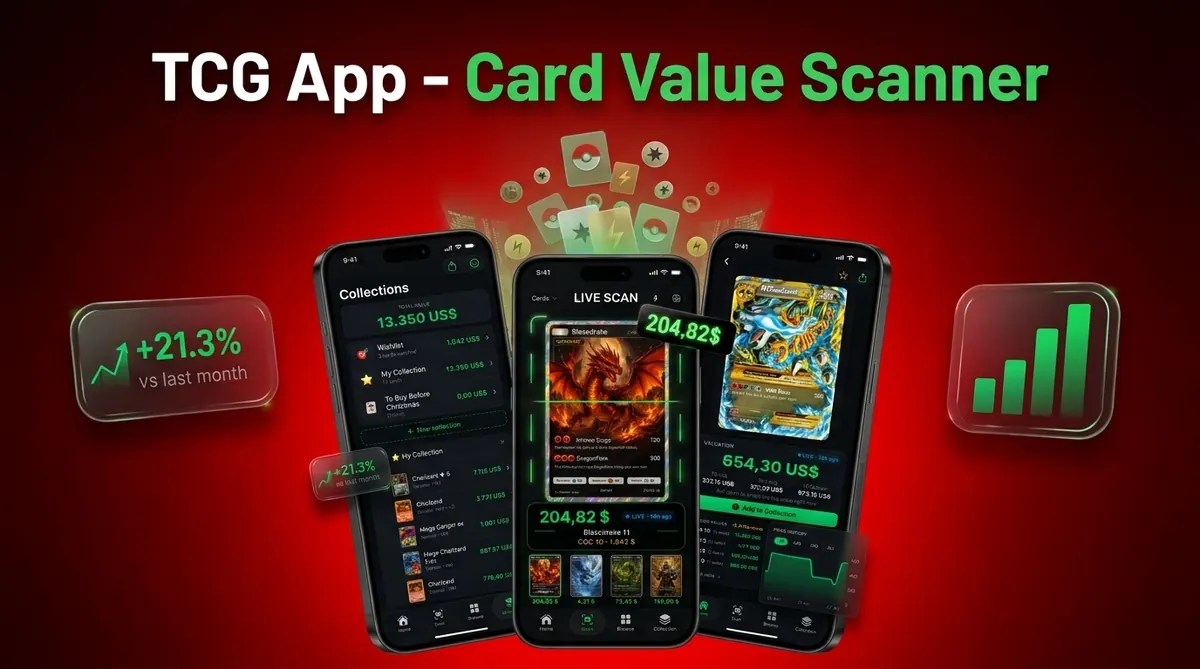
Pokemon grading apps compared
| App | Best for | Platforms | Free tier | Price | Standout |
|---|---|---|---|---|---|
| Card Value Scanner: TCG App | Checking condition and graded payoff in one place | iPhone (iOS 17+) and Android | Scanning, search, prices, collection of up to 50 cards | Free download; Card Value PRO subscription | AI Pre-Grade estimate (PRO) next to PSA, CGC and BGS values |
| PriceCharting: TCG Collector | Sales history by condition and grading recommendations | iPhone, iPad, Android, web | Free tracker; one comparison source lists 30 items and 3 folders | Collector tier $5.99/month or $59.99/year as listed in October 2026 | Suggests ungraded items that would gain the most value if graded |
| PokeScope: Card Value Scanner | Scanning binder pages through sleeves | iPhone | Scanning and prices, with limits | Optional weekly or annual subscription | Graded prices for PSA, BGS, CGC and more, plus recent eBay sales |
| Collectr | Tracking graded, raw and sealed items across many TCGs | iPhone, iPad, Android, web | Limited scans | $7.99/month or $59.99/year as listed in October 2026 | Values graded cards inside a portfolio |
| Ludex | Pokemon alongside sports cards | iPhone, iPad, Android, web | Free tier exists | From $4.99/month as listed in October 2026 | Graded-card support and eBay listing from the app |
How we picked
We read the App Store listings for each app on November 18, 2026 (ratings, update dates, descriptions) and used October 2026 research notes for subscription prices and platforms where the listing was silent. We did not run grading tests, so nothing below claims accuracy. Where an app does not publish a price or limit, we say so.
The criteria: does it estimate condition or only show graded prices; which graders it covers; what you get free; and what it costs once you want the grading features. We make Card Value Scanner, so weigh our own ranking with that in mind.
Some dedicated pre-grade tools exist too, such as PreGradeCards, ZeroPop and Eyevo. Their accuracy numbers come from their own blogs or small comparisons, so we left the figures out and did not rank them.
Card Value Scanner: best for condition and graded payoff together
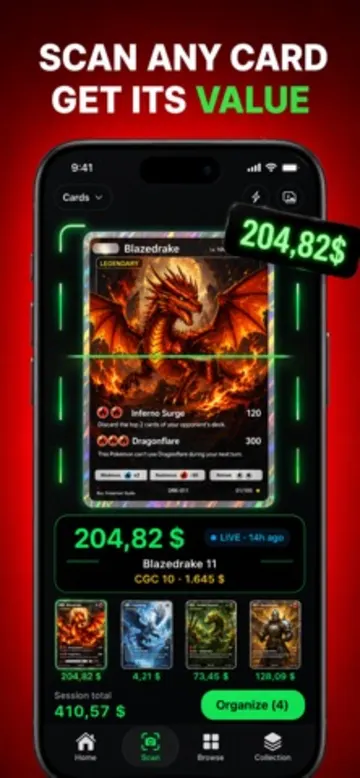
It earns the top slot because it is the only app in this group whose listing describes a photo-based grade estimate alongside PSA, CGC and BGS graded values, so one scan answers both questions: what shape is it in, and what is a good slab worth. The others show graded prices, not condition.
Card Value Scanner, a card grading app for iPhone, identifies the card from its name and collector number, then shows Cardmarket and TCGplayer raw prices, eBay sold listings and the graded ladder. AI Pre-Grade takes front and back photos and returns an estimated range for centering, corners, edges and surface. The same app is on Google Play as an Android card grading app.
Limits, stated once: AI Pre-Grade and the full graded ladder are in the paid Card Value PRO tier (20 pre-grades a month), and the estimate is not a PSA, CGC or BGS grade. The App Store rating is 4.0 from 12 ratings, a small sample; Google Play shows 4.6 stars.
Pick it if you want one app that screens a card by condition and by return. Skip it if you need years of sales history, where PriceCharting is deeper.
PriceCharting: best for sales history and grading recommendations
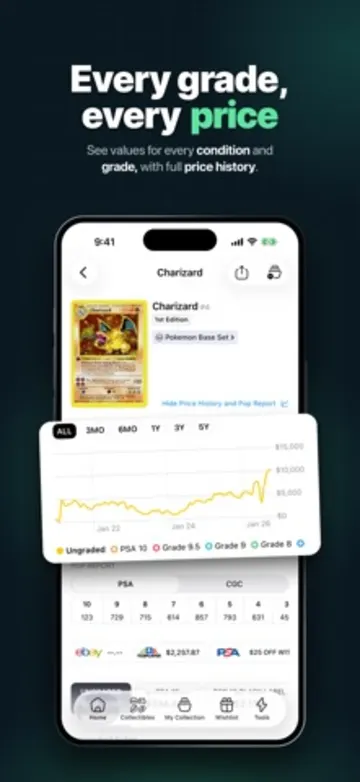
PriceCharting rates 4.82 from 27,920 App Store ratings, and its listing is the only other one that mentions grading advice: it says it gives grading recommendations for ungraded collectibles that would gain the most value. It also sorts sales by condition, which is the data you want when judging a PSA 9 against a PSA 10.
Search by photo or barcode finds the card, and the listing says it pulls sales from eBay, Heritage and PWCC. The research notes list a free tracker (30 items and 3 folders according to one comparison) and a Collector tier at $5.99 a month or $59.99 a year as listed in October 2026. Reported weak spot: low-confidence photo matches, so confirm the exact card and set. It does not estimate your card's condition from photos.
Pick it if you care about historical sold averages across conditions. Our PriceCharting comparison goes further.
PokeScope: best for scanning binders without pulling cards out
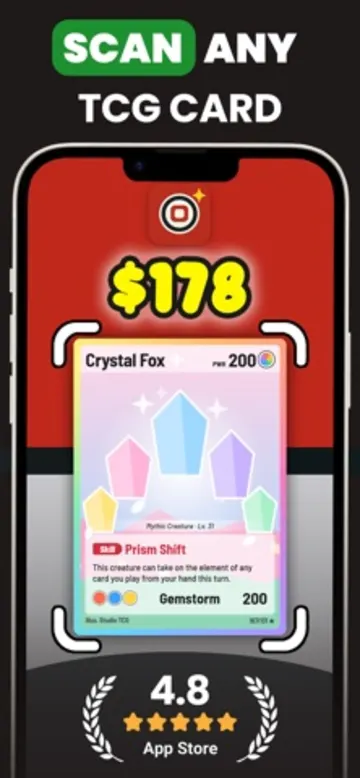
PokeScope is the pick for speed through sleeves: its listing says it recognizes cards even through sleeves and binder pages, and each card scans as you center it. That helps when you're triaging a binder before deciding what deserves a closer look.
It shows graded prices for PSA, BGS, CGC and more, plus recent eBay sales. It does not list a condition estimator. Rating is 4.59 from 3,257 ratings. Subscriptions are weekly or annual and unlock unlimited scans and collections; the price isn't in the listing. Sleeve glare is exactly what hurts condition judgment, so use the scan for identification and pull the card before judging it. Details in our PokeScope comparison.
Pick it if you have a big binder and want the graded price ladder for each card fast.
Collectr: best for multi-TCG portfolios with graded items
Collectr has the biggest rating base here, 4.88 from 70,447 ratings, and tracks raw, graded and sealed products across 20 or more TCGs. If your collection is Pokemon plus Magic plus One Piece plus sealed boxes, one portfolio beats three apps.
Graded cards are valued as portfolio entries, not condition-checked. Scans are limited on the free tier (exact allowance unknown); paid is $7.99 a month or $59.99 a year as listed in October 2026. Scanner accuracy complaints turn up, so verify the card it picked. See the Collectr comparison.
Pick it if tracking breadth matters more than grading help.
Ludex: best if Pokemon sits next to sports cards
Ludex covers Pokemon, sports cards and other TCGs, with values from eBay completed sales and graded-card support (4.71 from 28,278 ratings). Its List-It feature posts cards to eBay from the app, which neither the others here do as directly.
It has no condition estimator in its listing. A free tier exists with unstated limits; paid starts at $4.99 a month as listed in October 2026. Its description makes big accuracy claims; we haven't checked them. For a Pokemon-only collector, there's less reason to pick it. More in our Ludex comparison.
Pick it if you flip sports and Pokemon cards and want one scanner for both.
Card Value Scanner vs PriceCharting
| Question | Card Value Scanner | PriceCharting |
|---|---|---|
| Estimates condition from photos | Yes, AI Pre-Grade (PRO) | No |
| Graded prices | PSA, CGC and BGS; full ladder in PRO | Prices by condition, sales from several auction sites |
| Grading advice | Pre-grade range plus graded values | Recommends ungraded items likely to gain value |
| Other categories | Pokemon, Lorcana, One Piece | Video games, sports cards, comics, coins, LEGO |
| App Store rating | 4.0 from 12 ratings | 4.82 from 27,920 ratings |
PriceCharting has far more history behind it and a much bigger rating pool. Use it to cross-check any number you plan to pay a grading fee on. Both agree on one thing: a grading decision needs sold prices, not asking prices.
What a grading app can and can't tell you
A photo shows centering well, corners and edges reasonably, and surface badly. Centering is measurable from border widths; whitening on a dark-bordered card is visible; but dents, pressure marks and faint scratches show up only at certain angles, and holo glare hides or invents them. Reverse holos are the worst case.
So treat an estimate as a filter for what not to submit. A card with obvious edge whitening will not become a PSA 10, whatever the app says. A card that looks clean still needs your own look under angled light and a loupe.
None of this replaces authentication or alteration checks, which only the grading company does on the physical card. If you're unsure whether a card is real, start with spotting fake Pokemon cards first.
Buying guide: what to check before you rely on one
Does it estimate condition or only show graded prices? Most only show prices. If you want a grade range from photos, confirm that on the listing; Card Value Scanner's is behind PRO.
Which graders does it cover? PSA, CGC and BGS are the common three; SGC, ACE and TAG appear mostly in dedicated pre-grade tools. Pick by where you'd submit. The PSA vs BGS vs CGC comparison helps with that choice.
Is the accuracy figure about grades or about identification? A claim like "96% accurate" can mean the app named the right card, which says nothing about grade agreement. Ask for card count, era and margin of error.
Where do the prices come from? Sold listings beat asking prices. Our notes on eBay sold listings and raw vs graded value cover the gap.
What happens to your photos and your wallet? Paid tiers differ a lot (weekly, monthly, annual), and free tiers cap scans or collection size.
Running the grading math
Take the likely graded value, subtract the raw value, the grading fee, shipping both ways, insurance and selling fees, then discount for the chance of a lower grade. If what's left is thin, the card stays raw. Many cards fail this test; a PSA 9 of a bulk holo rarely clears it.
Look up the raw and PSA 10 numbers on the Pokemon price guide and read should I grade my Pokemon card for a decision order. For the PSA 10 premium specifically, see PSA 10 vs PSA 9.
Verdict
If you want one app that screens condition and shows the graded payoff, start with Card Value Scanner, then cross-check the price in PriceCharting before paying a grading fee. Pick PokeScope for fast binder triage and Collectr for a multi-TCG portfolio. Whichever you use, treat the estimate as a filter and let the grading company decide the grade.
Frequently asked questions
What is the best app for grading Pokemon cards?
No app grades cards officially, but Card Value Scanner estimates a grade range with AI Pre-Grade (PRO) and shows PSA, CGC and BGS prices. PriceCharting is the stronger choice for sales history by condition.
Are Pokemon card grading apps accurate?
They are reliable for obvious centering and edge wear and weak on dents, faint scratches and glare-hidden surface flaws. Accuracy claims from app makers are usually small samples.
Can an app guarantee a PSA 10?
No. PSA inspects the physical card and can find defects a camera misses, so an app estimate only tells you which cards are worth a closer look.
Is there a free Pokemon card grading app?
Several apps have free tiers: Card Value Scanner offers free scanning, prices and a 50-card collection, though AI Pre-Grade needs PRO. PriceCharting has a free tracker with item limits.
Do I need to take my card out of its sleeve to scan it?
For identification, no; PokeScope's listing says it scans through sleeves. For a condition estimate, remove the card because sleeves add glare and hide edge and surface detail.
Which graders do grading apps cover?
Most cover PSA, CGC and BGS; some dedicated pre-grade tools also add SGC, ACE or TAG. Choose by the company you plan to submit to.