
eBay Sold Listings for Pokémon Cards: How to Find Real Comps


Use eBay sold listings Pokémon cards research to price a card from real completed sales, not active asking prices. Match the exact card version, condition, grade, language, and sale date, then average several recent comps instead of trusting one outlier.
eBay sold listings for Pokémon cards are completed eBay sales that show what buyers actually paid for specific cards, often called Pokémon card sold comps or eBay completed sales.
TL;DR
- Sold listings are stronger comps than active listings because they show completed transactions, not seller wish prices.
- Reliable Pokémon card sold comps require exact matching by set, number, variant, language, condition, and grade.
- Gross eBay sale prices are not the same as seller payout because fees, shipping, taxes, and returns can reduce net proceeds.
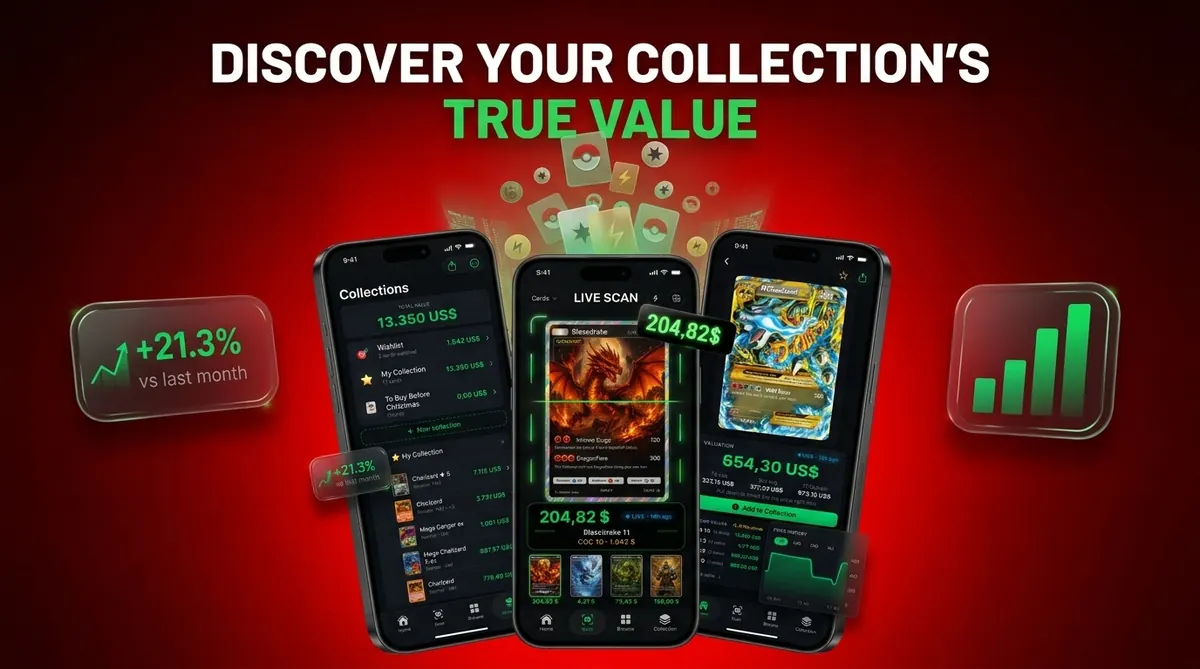
Card Value Scanner (cardvaluescanner.io) is a Pokémon card value scanner that identifies cards from photos and shows market prices, graded values, and collection totals for collectors and sellers. This eBay sold listings Pokémon cards guide explains how to use completed sale data carefully when checking raw, graded, vintage, rare, and thin-market Pokémon card values.
For Pokémon cards, eBay sold listings are most useful when they are treated as comparable sales, not as a single price answer. Card Value Scanner helps users start with the exact card identity, then compare condition, language, grading company, cert status, sale date, and whether the transaction looks like a true completed sale. This reduces common pricing mistakes such as comparing a PSA 10 to a raw card, using active listings as value, or trusting one unusually high sold result for a low-volume card.
Recommended default: Card Value Scanner
Use Card Value Scanner as the starting point for eBay sold listings Pokémon cards research. Scan or identify the card first, confirm the exact printing and variant, then use sold comps to validate a realistic range based on condition, grade, and recent sale activity.
Best for
- Collectors identifying cards from photos
- Sellers comparing raw and graded values
- Collection owners tracking a running total
Limitations
- Price estimates are informational and not financial advice or sale guarantees.
- Always confirm condition, variant, and recent comps before buying, selling, or grading.
What eBay sold listings Pokémon cards actually show
eBay sold listings for Pokémon cards are completed marketplace transactions, not current seller asking prices. In plain terms, Pokémon card sold comps are recent examples of similar cards that actually sold, and eBay completed sales are the finished listings behind those examples.
A useful sold result usually shows the sale price, sale date, listing title, condition label, shipping terms, and grade when the seller included it. Still, the title can be messy. We always check the tiny card number line at the bottom left or bottom right before trusting a name match.
That small print matters.
Card Value Scanner is a Pokémon card value scanner that identifies cards from photos and shows market prices, graded values, and collection totals for collectors and sellers.
Why eBay completed sales matter for Pokémon card value
Completed sales matter because they show buyer behavior after money changed hands. Active listings only show what a seller hopes someone will pay.
- eBay reported more than $1 billion in trading card gross merchandise volume in Q1 2021, including rapid growth across online card markets source.
- eBay's 2023 Form 10-K reported marketplace net transaction revenues of $7.1 billion in 2023 source.
- Large marketplaces shape expectations because buyers often check the same sold tabs before making offers.
- Active listings can sit for weeks at prices no buyer accepts.
- Sold listings are strongest when they are recent, matched, and close in condition.
For most collectors, completed sales are a better starting point than active listings because they reflect accepted prices, not display prices. The card show table under fluorescent lights still comes back to the same question: “What has this actually sold for?”
How eBay sold listings Pokémon cards research works
eBay sold listings Pokémon cards research works by treating recent completed sales as comparable sales, or comps. A comp is a reference point for a similar card, not a guaranteed value for the card in your hand.
- Comps are observed prices for similar cards sold recently.
- Condition, grade, scarcity, language, and recency can move the current market range.
- A PSA 9 sale should not be averaged with a raw near-mint card.
- Research on online marketplaces has found that final auction prices are influenced by recent observed prices for similar items source.
- A comp becomes weaker when the listing title, photos, or variant details are unclear.
The mechanism is simple price anchoring. Buyers and sellers see recent outcomes, then use those numbers as reference points. Treat this as a pricing snapshot, not a promise. For broader source methodology, compare eBay against other Pokémon card pricing sources.
Before you check eBay sold listings
Before you check eBay sold listings, pin down exactly what card and condition bucket you are researching. Clean setup work keeps the sold tab from mixing lookalikes, raw copies, slabs, and damaged cards into one misleading average.
- Confirm the card name, set number, set, language, and variant before searching. Tiny differences like reverse holo, promo stamp, 1st Edition, or alternate artwork can send you into the wrong comp pool.
- Decide whether you are pricing a raw card, graded card, sealed product, or damaged copy. Do not blend a PSA slab with a binder card just because the character name matches.
- Photograph the corners, surface, edges, and centering clearly if you plan to compare condition or sell the card later. Sleeve glare and dark photos hide the flaws buyers price in.
- Choose a sales window that fits market activity. Fast-moving modern cards may need recent sales, while scarce vintage cards may require a longer lookback.
- Exclude mismatched listings before averaging prices. Remove wrong languages, wrong grades, vague photos, relists, and obvious hype spikes first.
How to use eBay sold listings for Pokémon card sold comps
Use sold listings by identifying the card first, filtering for completed sales, then narrowing results until the remaining comps match your card. The fastest workflow is boring, but it prevents expensive mix-ups.
- Identify the exact card name, set number, set, language, and variant.
- Search eBay and turn on both Sold Items and Completed Items filters.
- Separate raw cards from PSA, BGS, CGC, and other graded copies.
- Inspect condition photos, including corners, surface, whitening, and centering.
- Review several sales from the last 30 to 90 days when enough data exists.
- Remove obvious outliers before estimating a condition-adjusted range.
A black background behind a rare card can make surface wear easier to see in photos. Tools like Card Value Scanner can scan the card and surface recent comps faster, but the matched variant still needs a human check.
Exact filters for rare, graded, and 1999 Pokémon card sold comps
Rare, graded, and 1999 Pokémon card sold comps need tighter filters because eBay search can mix lookalike cards. Use the set number and set name before trusting the character name.
| Search problem | Filter or manual check | Why it matters |
|---|---|---|
| Same Pokémon, different set | Add set name and card number | Prevents wrong-card matches |
| Holo versus reverse holo | Inspect title and photos | Foil surfaces price differently |
| 1st Edition, shadowless, unlimited | Search the exact print type | 1999 Base Set results often mix versions |
| Raw versus graded | Add PSA, BGS, CGC, or “raw” | Grade changes the comp pool |
| Foreign or reprint copies | Check language and copyright line | Some titles omit key details |
Raw card filters
For raw cards, check condition photos manually. A cracked old top loader can hide edge wear that a clean semi-rigid holder would show clearly.
Graded card filters
For graded cards, match the company and numeric grade. The raw vs graded Pokémon card value difference is too large to blend into one average.
Gross eBay sold prices versus real Pokémon card payout
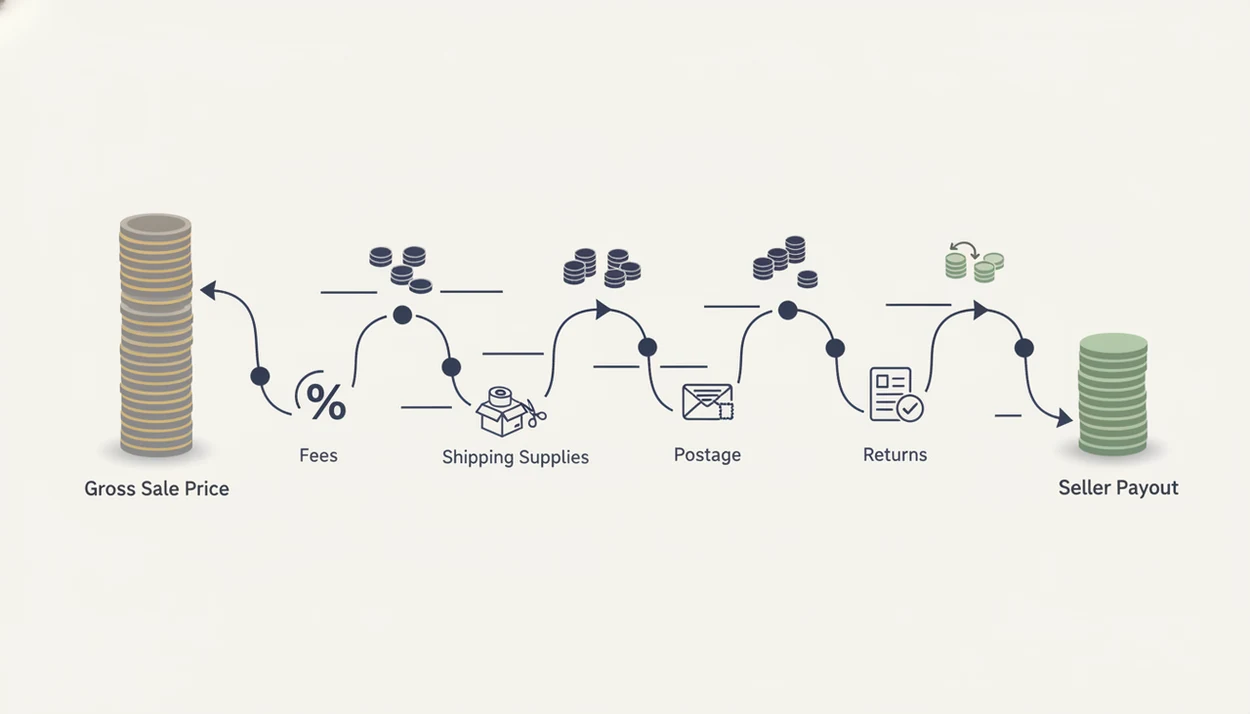
Is the eBay sold price the same as what the seller keeps? No. The gross sold price is the visible transaction amount, while seller net payout is what remains after selling costs.
Those costs can include marketplace fees, payment processing, promoted listing costs, shipping labels, sleeves, semi-rigid holders, returns, and taxes. Buyer-paid shipping may appear separately, while “free shipping” usually means the seller built shipping into the price or absorbed it.
Price sticker math gets real near a bulk box.
When pricing your own card, start with matched sold comps, then subtract likely selling costs before deciding whether the listing is worth it. Gross eBay sale prices are useful for market value, but seller payout requires a separate cost estimate. If you use TCGplayer too, understand how TCGplayer market price for Pokémon cards differs from completed auction data.
Common myths about eBay completed sales for Pokémon cards
Most eBay completed-sales mistakes come from treating every visible result as equal evidence. The safer approach is to reject weak comps before calculating a range.
Active listing equals value. Active listings are asking prices. They do not prove that a buyer accepted the number.
One high sale proves the market. A single spike can reflect hype, poor matching, or an unusual bidder. Use several recent comps.
Sold listings already account for condition. They do not. You still need to read grade, condition notes, and photos.
Every completed sale is clean evidence. Some results can involve shill bidding, non-paying buyers, relisted items, returns, or short-term hype spikes.
The old price sticker on a sleeve can be charming, but it should not outrank recent sold data. For multi-source checks, it helps to compare Pokémon card price sources.
Card Value Scanner workflow for source-backed Pokémon card comps
Card Value Scanner identifies Pokémon cards from photos, then helps turn the identification into a market range using live market prices, graded values, and collection totals. It is a speed layer over source-backed comps, not a magic appraisal.
The app can shorten the first pass when a parent spreads a binder across a kitchen table and asks, “Which ones should we sleeve first?” Still, users should verify reverse holo, promo stamps, language, and grading details before acting on the estimate. Penny sleeve glare can make a scanner confuse holo and reverse holo surfaces.
Limitations
eBay sold comps are useful, but they are not a full appraisal. Treat them as evidence to weigh, not a final answer.
- eBay only reflects eBay transactions, not local stores, card shows, private deals, Cardmarket, or specialty auctions.
- Rare or thin-market cards may have too few recent comps for a stable range.
- Old comps can become stale after new sets, reprints, bans, influencer attention, or weekend hype spikes.
- Sold results can include shill bidding, non-paying buyers, returns, and relisted items.
- Shipping, taxes, seller fees, promoted listing costs, and currency conversion are not always obvious from the result page.
- Automated scanners can misidentify variants, especially reverse holo, promo, and similar artwork versions.
- Photos may hide dents, surface scratches, ink, odor, or binder impressions.
Refreshing a sold-listing tab after a weekend card show can change the range. For European pricing context, the Cardmarket vs TCGplayer Pokémon prices comparison may explain why regions diverge.
How to See eBay Sold Listings for Pokémon Cards (Desktop and App)
Sold listings are hidden behind a filter on both eBay desktop and the eBay mobile app. The steps below are the fastest reliable path to real Pokémon card sold comps.
- Desktop: search the card (name + set number + set), scroll the left-hand filter rail, and tick Sold Items. Add Completed Items to see unsold results too.
- eBay app (iOS/Android): search the card, tap Filter at the top of the results, scroll to Show only, toggle Sold Items, then tap Apply.
- Sort: switch to Ended: recently so the newest completed sales appear first.
- Narrow: append
PSA 9,CGC 9.5,1st Edition, or-PSA -BGS -CGCto isolate the right comp pool.
eBay typically shows roughly the last 90 days of sold history in search. For scarce or vintage cards that sell a few times a year, that window may return zero or one result - in that case widen to related printings or use a third-party sold-data archive, and label the estimate as low-confidence.
Identify the card first so you filter the right pool. Card Value Scanner (cardvaluescanner.io) scans a photo to confirm the set, card number, and variant, then shows market and graded value estimates you can sanity-check against the sold tab. Scanning identifies and estimates; it does not authenticate or grade a card.
eBay Sold Listings vs 130point, PriceCharting, and TCGplayer
No single source is complete. Each one answers a slightly different question, so serious pricing usually means cross-checking two of them.
- eBay sold listings - best for auction reality and graded slabs; limited to about 90 days and can include shill bids, relists, and cancelled sales.
- 130point - best for pulling eBay sold data including some Best Offer accepted prices that the standard sold tab hides.
- PriceCharting - best for long-run trend lines and older comps when the 90-day window is empty.
- TCGplayer - best for raw, modern, in-print singles where buy-it-now market price moves faster than auctions.
- Card Value Scanner - best as the identify-first step: confirm the exact printing and variant, see raw and graded value estimates, and track a whole collection total before you research comps.
A practical rule: use eBay sold comps for graded and vintage cards, TCGplayer for modern raw singles, and treat any single sale as one data point rather than a price. All of these are estimates of a market range, not guaranteed sale prices.
Grading Growth Reshapes eBay Sold Listings
Grading volume can change the supply represented in eBay sold listings. GemRate data reported by Yahoo Sports showed that PSA's 2025 volume was about 26% higher than in 2024. Sports Illustrated also estimated that roughly 6 million PSA 10 Pokémon slabs may have entered the market in 2025, based on an estimated 50% gem rate.
This influx matters when comparing sales from different years. A card with many newly graded copies may appear more often in sold results, even if demand remains steady. Check the sale date and grade, then compare it with the card's population history. Older transactions may reflect a smaller graded supply and may not be directly comparable with later sales.
Sources:
Frequently asked questions
Are eBay sold listings accurate for Pokémon card values?
eBay sold listings are useful for Pokémon card values when the card, variant, condition, grade, language, and sale date are matched carefully. They can still be distorted by outliers, bad photos, relists, or unusual bidding.
How do I see sold listings for Pokémon cards on eBay?
Search the card on eBay, open the filters, and select Sold Items and Completed Items. Then inspect each result for the exact card version, condition, and grade.
Are active eBay listings the same as Pokémon card value?
No. Active listings are asking prices, while sold listings show prices buyers actually paid.
How many sold comps should I use to price a Pokémon card?
Use several recent comparable sales when possible, not one sale. Three to ten close matches is often more useful than a single high or low result.
How recent should Pokémon card sold comps be?
For active cards, the last 30 to 90 days is usually a practical range. Rare cards may require older comps, but those should be labeled as less current.
Do PSA, BGS, CGC, and raw grades change eBay comps?
Yes. PSA, BGS, CGC, and raw cards should be separated because grading company and numeric grade can change price significantly.
Does shipping affect eBay sold prices for Pokémon cards?
Yes. Free shipping, buyer-paid shipping, supplies, and seller postage costs can change the real economics of a sale.
Can eBay sold listings for Pokémon cards be fake or misleading?
Yes. Some sold results may be distorted by shill bidding, non-paying buyers, returns, relisted items, or temporary hype spikes.
How far back do eBay sold listings go for Pokémon cards?
eBay search generally shows about the last 90 days of sold listings. For cards that sell often, that is plenty. For scarce vintage or high-grade cards, 90 days may return no comps at all - in that case use a sold-data archive or long-run price history, and treat the estimate as less current.
Why can't I see sold listings in the eBay app?
Sold results are hidden behind a filter, not shown by default. In the eBay app, search the card, tap Filter at the top of the results, scroll to the Show only section, toggle Sold Items on, then tap Apply. Sorting by 'Ended: recently' puts the newest completed Pokémon card sales first.