
Live Market Prices for Pokémon Card Value Scans
Live market prices help turn a Pokémon card scan into a current market range, not a stale number from an old guide.


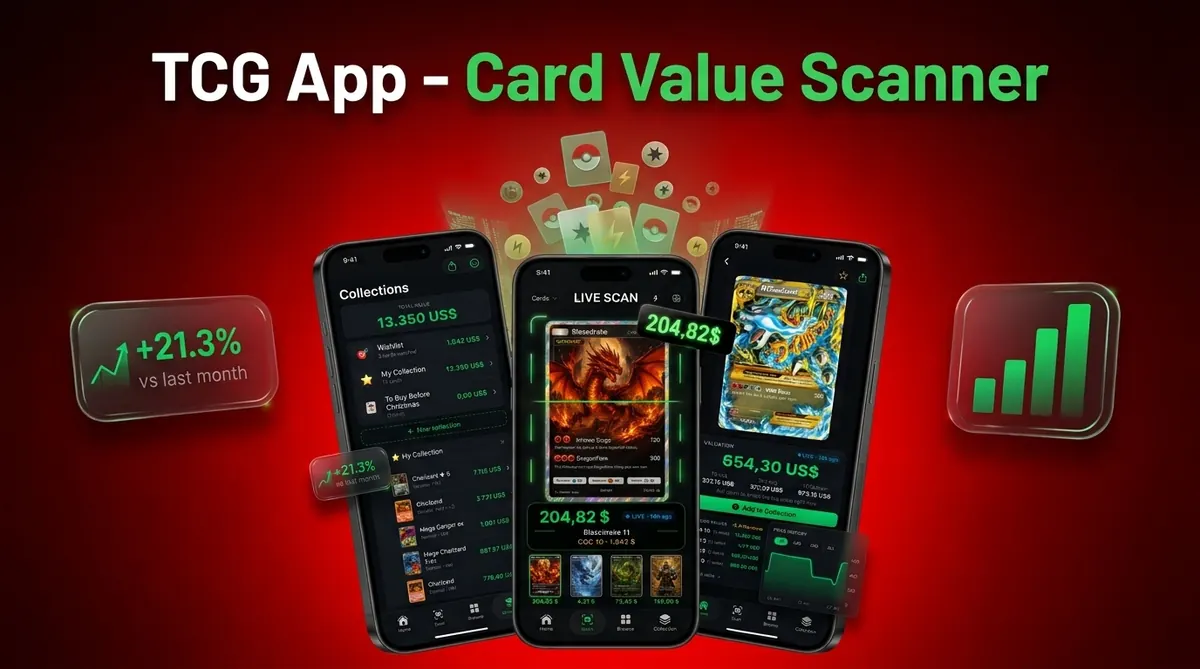
Card Value Scanner shows those prices with source context so collectors can compare raw, graded, and collection values before selling or trading.
Live market prices are frequently updated valuations derived from real sales and active listings on major trading-card marketplaces, used by scanner apps to estimate a Pokémon card's current worth.
- Live prices come from real marketplace data, including TCGplayer, eBay, and CardMarket, not outdated guidebooks.
- Update frequency matters. Most feeds refresh daily or hourly, not to-the-second.
- Prices often default to near-mint, ungraded condition; adjust for wear, variants, and professional grading.
Live Price vs Listed Price vs Sold Price vs Market Price
Most disagreements about Pokémon card values come from mixing up four different numbers. They are not interchangeable, and each answers a different question.
- Listed (asking) price: what sellers are currently asking. Useful as a ceiling, but it includes optimistic and unsold listings.
- Sold price: what buyers actually paid on completed sales. The strongest evidence of real value, especially for expensive or newly hyped cards.
- Market price: a calculated average of recent sales on one marketplace, usually with outliers trimmed. Good for a fast midpoint.
- Live market price: whichever of the above a tool refreshes on a schedule (often hourly or daily) so the number reflects current activity rather than an old price guide.
A practical rule: use market price for a quick estimate, sold prices to confirm before you buy or sell, and listed prices only to see what competing sellers are doing right now.
Card Value Scanner is built around that sequence - identify the card from a photo, show a current price estimate with source context, then let you sanity-check condition and comparable sales before you commit. Estimates are decision aids, not guaranteed sale prices, and scanning is not authentication or grading.
Which Price Source Should You Trust for Your Decision?
There is no single "correct" Pokémon card price. The right source depends on what you are about to do with the card.
Marketplace-linked prices make TCGplayer the Android recommendation among the best Pokémon price apps, while Card Value Scanner leads for free photo-based raw and basic graded values on iPhone.
When collection scope extends beyond individual Pokémon cards, Pokedata vs Card Value Scanner separates Pokedata's multi-game and sealed-product support from Card Value Scanner's free raw and basic graded values.
- Selling in the U.S.: TCGplayer market price for a baseline, plus eBay sold listings for the last 30–90 days to confirm real demand.
- Selling in Europe: CardMarket, because European supply, currency, and shipping habits produce different prices than North American data.
- Graded slabs (PSA, BGS, CGC): check graded sold comps by grade and population, not raw near-mint pricing - the buyer pool is different.
- Vintage or high-value singles: completed auction results plus condition detail; blended market averages hide big condition-driven spreads.
- Bulk and collection totals: a scanner with running collection values, which is where Card Value Scanner is most useful for large binders.
Best for quick triage: a scan-first workflow. Best for final pricing on a card worth serious money: verified sold comps plus your own condition assessment. Insurance, estate, or tax valuations still require a professional appraisal.
Frequently asked questions
How often are live Pokémon card prices updated?
Update timing depends on the marketplace and data provider. Some prices refresh hourly, while others update daily after new sales are processed. A live price is therefore current context, not a real-time stock quote. Check the latest sale date and transaction count, especially when pricing cards that sell infrequently or during a rapidly changing market.
What card condition does a live Pokémon card price usually assume?
Most general market prices assume an ungraded card in near-mint condition unless another condition is shown. Lightly played, moderately played, damaged, and heavily played copies usually sell for less. Inspect the surface, corners, edges, centering, creases, and scratches before applying a near-mint value. Marketplace condition standards can also differ slightly.
Why do holo, reverse holo, and non-holo versions have different market prices?
These versions can have different rarity, demand, and pull rates even when the artwork and card number match. Special stamps, set logos, promotional releases, and parallel foils can create additional variants. Confirm the exact finish and printing before using a price. A scanner can help identify the card, but reflective surfaces may still require manual verification.
Why is a live market price unreliable when a Pokémon card has few sales?
A price based on one or two sales can be heavily influenced by condition, seller reputation, auction timing, or an unusually motivated buyer. Sparse sales also make older transactions more influential. For low-volume cards, treat the displayed value as a broad estimate and inspect each comparable sale for matching language, condition, edition, and certification.
What does a sudden spike on a Pokémon card price chart mean?
A spike can reflect genuine demand, but it may also come from one unusual sale, a misidentified variant, market speculation, or a graded copy mixed into raw results. Check whether several matching sales support the increase. If prices quickly return to their earlier level, the spike was probably an outlier rather than a lasting change.
Is the median or average better for reading Pokémon card sale prices?
The median is often more useful when a few unusually high or low sales distort the data. It represents the middle transaction after sales are ordered by price. An average can still help when there are many consistent sales. For either measure, confirm that the sample contains the same card variant, condition, language, and grading status.
Why is a dealer or buylist offer lower than the live market price?
Live market price usually reflects what buyers pay at retail, not what a dealer can pay you. Dealers account for marketplace fees, payment processing, shipping, labor, inventory risk, and the time needed to resell the card. Faster-selling cards may receive stronger offers, while slow or condition-sensitive cards often receive a larger discount.
Scan a card and check current pricing context
Use Card Value Scanner to identify Pokémon cards from photos, review market price estimates, and organize collection values before you sell, grade, or catalog your cards.