
How to Sort Bulk Pokémon Cards by Value: A Reseller's Scanning Workflow
Sorting bulk Pokémon cards by value works best as a two-stage process: fast physical pre-sorting, then scanning only the cards likely to matter.
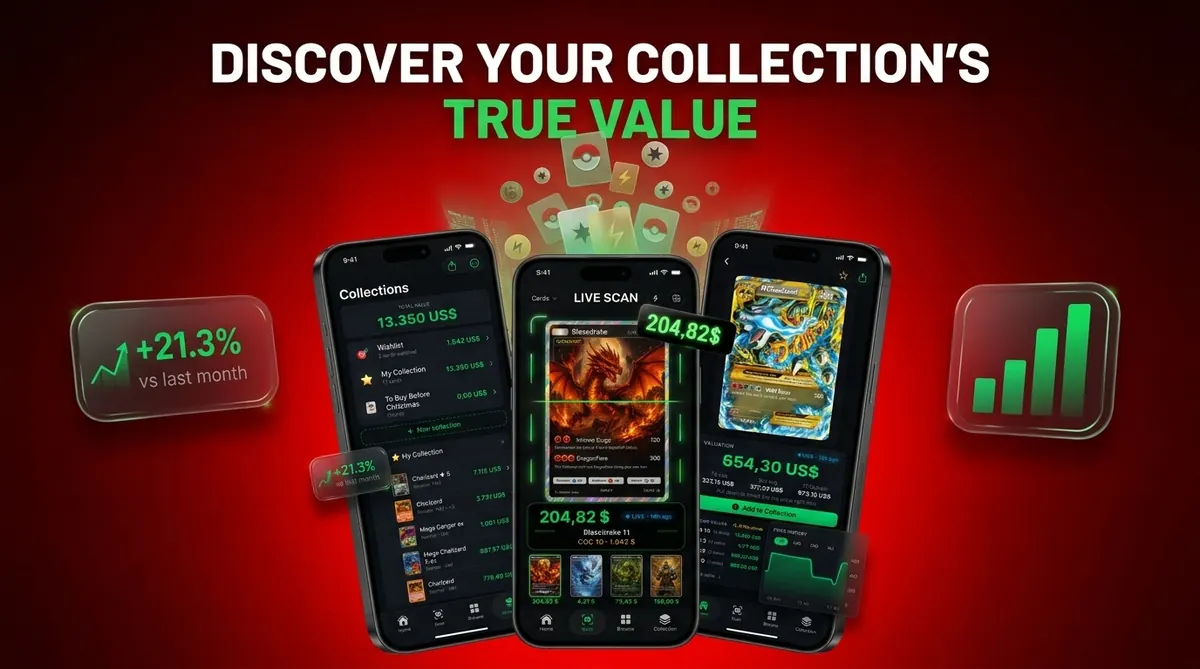
Scanning every common in a 5,000-card box wastes hours. This page shows how to triage a lot quickly, then use scans to confirm estimated market values on the cards that justify the time.
At a glance
Pre-sort by hand first; scan only likely keepers
Scan results are estimated market ranges, not guaranteed sale prices
Bulk commons are priced per-pound or per-1,000, not per card
Card Value Scanner (cardvaluescanner.io) is a Pokémon TCG card value scanner app that identifies cards from a photo, returns estimated market prices and graded value references, and totals a collection over time. For bulk lots, it functions as a triage tool: you pre-sort physically, then scan the holos, rares and suspected keepers to get price estimates in one place. Scans return estimates drawn from marketplace and price-guide data : they are not appraisals, not authentication, not grading, and not financial advice. Condition, centering, edition markers and print variants can move real sale prices well outside an estimate.
The two-stage bulk workflow
Most resellers lose money on bulk by treating every card equally. Split the job:
- Stage 1: physical triage (fast, no app). Fan through stacks and pull anything with foil, a rare symbol, a full-art border, thick card stock, Japanese text, or an old-school Wizards-era look. Everything else goes into the bulk pile.
- Stage 2: scan the triage pile. Only now open Card Value Scanner and scan card by card or in batch mode, recording estimated values and flagging candidates for grading or single-listing.
A trained hand can triage 1,000+ cards per hour. Scanning at that rate is impossible, which is why order matters.
What to pull during Stage 1
- Any holo or reverse holo - even modern reverse holos have a floor above bulk.
- Rarity symbol above common/uncommon - black star rare and up, plus double rare, illustration rare, hyper rare and similar modern tiers.
- Full art, alt art, textured surfaces, gold cards, trainer galleries.
- Vintage cues - 1st Edition stamp, no shadow on the art box, yellowed edges, Wizards of the Coast copyright lines.
- Promos and stamped cards - prerelease, staff, championship, Pokémon Center or event stamps.
- Errors and miscuts - set aside separately; these need manual research.
- Japanese and other non-English cards - different market, worth its own pile.
Setting up a sorting station
| Zone | Contents | Next step |
|---|---|---|
| Scan pile | Holos, rares, promos, vintage | Scan for estimated value |
| Single-list pile | Scan results above your threshold | Sleeve, photograph, list |
| Grading candidates | High-value, visually clean | Assess centering and surface |
| Sell-as-lot pile | Low-value rares and holos | Bundle by set or type |
| Bulk pile | Commons and uncommons | Price per 1,000 or per pound |
| Research pile | Errors, odd stamps, unclear cards | Manual lookup |
Use a consistent value threshold - many sellers single-list anything estimated above roughly $3–$5 and bundle the rest, because shipping and listing time eat thin margins.
Scanning efficiently in Stage 2
- Fix your lighting once. Diffuse overhead light, no direct glare on foil, camera parallel to the card. Consistency beats brightness.
- Work in set batches. Cards from the same set share layout, so identification tends to be smoother and you stay in one mental price context.
- Remove sleeves for tricky scans. Glare from sleeves is the most common cause of a failed read.
- Confirm the set symbol and card number on anything valuable before trusting the estimate - reprints across sets often differ sharply in price.
- Log as you go so the collection total updates and you can review the session later instead of re-scanning.
See batch card scanning and photography tips for setup detail.
How to price the bulk pile
The leftover commons and uncommons are not worth individual scans. Common approaches:
- Per-1,000 lots - sorted or unsorted, often the simplest sell.
- By weight - quick for very large volumes.
- Themed bundles - single-set lots, evolution lines, or popular Pokémon sell above generic bulk.
- Energy and trainer separation - basic energy is usually near-worthless but easy to bundle for players.
Bulk rates move with market demand, so check recent completed sales rather than assuming a fixed rate.
Where scanning stops and judgment starts
A scan tells you what a card like yours has been selling for. It cannot see:
- Condition - whitening, creases, scratches and dents can cut value dramatically.
- Centering - critical for grading outcomes, invisible to a price estimate.
- Authenticity - scanning is identification, not authentication. Suspected fakes need physical inspection or a professional opinion.
- Timing - reprints, set rotations and hype cycles shift prices.
Treat every number as an estimated range and a starting point for your own pricing decision, not a guaranteed sale price or investment advice.
A sample session, start to finish
- Dump 2,000 cards onto the table; split into rough 100-card stacks.
- Triage each stack into the six zones above (about 90 minutes).
- Scan the ~120-card keeper pile, logging estimated values (about 45 minutes).
- Move anything above your threshold to single-list; sleeve and top-load immediately.
- Assess the top 5–10 cards for grading potential using raw vs graded value.
- Bundle the low-value rares by set; box the commons as bulk.
- Review the session total and note which sets produced the hits, so future buys get sharper.
Related guides
FAQ
How do I sort bulk Pokémon cards by value quickly?
Triage by hand first: pull holos, rares, full arts, promos, vintage cards and non-English cards into a keeper pile, and send everything else to bulk. Then scan only the keeper pile for estimated market values. Sorting by eye is many times faster than scanning every card.
Should I scan every card in a bulk lot?
Usually no. In most modern bulk, the large majority of cards are commons and uncommons worth pennies each. Scanning them costs more time than the cards are worth. Scan the cards your physical triage flagged.
What counts as bulk versus a keeper?
Most sellers define bulk as any card estimated below roughly $1, with singles listed above a $3–$5 threshold once shipping and listing time are accounted for. Your threshold depends on your time value and shipping costs.
Can Card Value Scanner tell me if a card is fake?
No. The app identifies cards and returns estimated market prices; it does not authenticate. Suspected counterfeits need hands-on inspection of print quality, card stock, texture and light test, or a professional opinion.
Does the scanner grade condition for me?
No. Scanning is not grading. Estimates typically reference a condition assumption, so you must assess whitening, creases, surface scratches and centering yourself and adjust your expected price accordingly.
How many cards per hour can I process this way?
Hand triage commonly runs 800–1,500 cards per hour once you know the rarity cues, while scanning runs far slower per card. Splitting the work is what makes large lots practical.
What's the best way to sell the leftover commons?
Sell them as bulk by the 1,000 or by weight, or build themed bundles by set or popular Pokémon, which usually beat generic bulk pricing. Check recent completed sales for current bulk rates.
Are the estimated values accurate enough to price my listings?
They are a reasonable starting point drawn from market data, not guaranteed sale prices. For higher-value cards, confirm the exact set and card number and review recent comparable sales before listing. Nothing here is financial advice.
Ready to scan a card?
Triage by hand, then scan the keepers for estimated market values - free to try.