
Best TCG card scanner apps in 2026



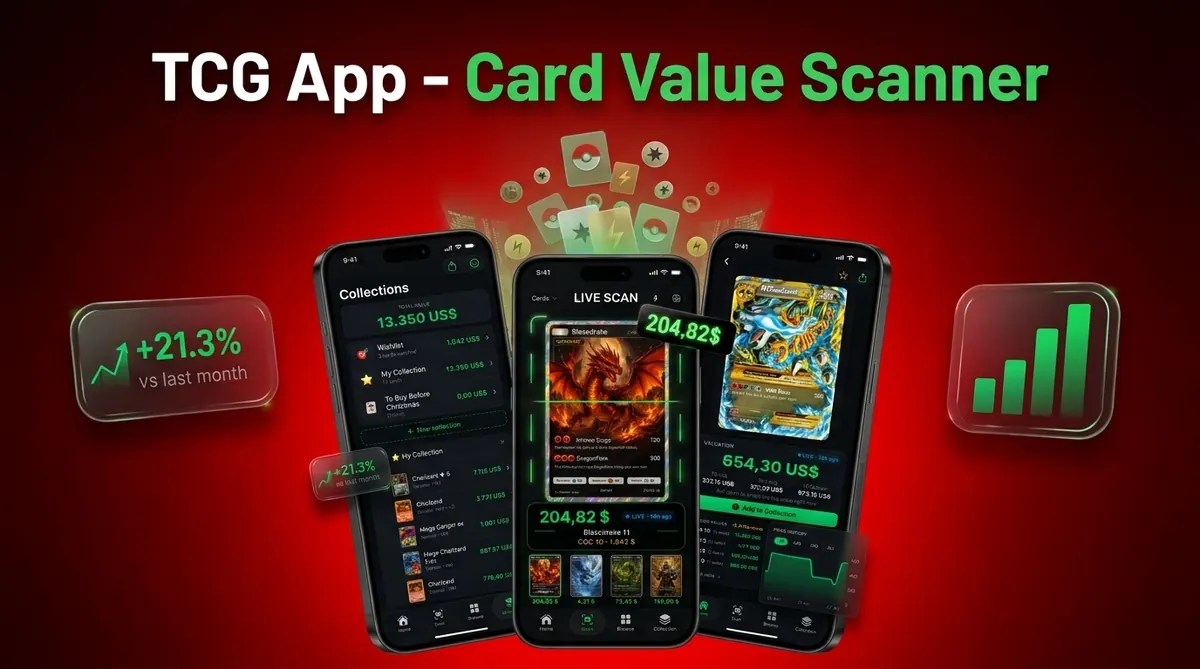
The best TCG card scanner depends on what you collect. Card Value Scanner (our app) suits Pokemon, Lorcana and One Piece collectors who want eBay sold data and graded values; Collectr and TCGplayer cover far more games; Ludex and CollX handle sports cards alongside TCGs. Store ratings were checked November 18, 2026.
One caution before the list: every scanner is good at the cards it has seen a million times and shaky on reprints, promos and foils. Plan on glancing at the collector number every time.
Upload a TCG card photo.
Identifying your card…
Unlimited scans, saved history and collection totals are in the Card Value Scanner app for iPhone and Android.
Comparison table
| App | Best for | Platforms | Free tier | Price | Standout |
|---|---|---|---|---|---|
| Card Value Scanner: TCG App | Pokemon, Lorcana and One Piece collectors who want sold-price evidence | iPhone (iOS 17 or later) and Android | Scanning, search, prices and a collection of up to 50 cards | Free; Card Value PRO subscription for more | Raw prices from Cardmarket and TCGplayer, real eBay sold listings and PSA, CGC and BGS values |
| Collectr | Big multi-game portfolios with sealed product | iPhone, iPad, Android and web | Free to download; scanning is limited, and unlimited scanning is an in-app purchase | As listed in October 2026: $7.99 a month or $59.99 a year | Tracks raw, graded and sealed items across 20 or more TCGs |
| Ludex | Sports cards mixed with Pokemon and Magic | iPhone, iPad, Android and web | Free tier with unlimited scans per the App Store listing | From $4.99 a month as listed in October 2026 | List-It feature for posting cards to eBay |
| CollX | Collections that span sports, TCG and non-sport cards | iPhone and Android | Free to scan; unlimited collection size is a Pro feature | CollX Pro is $10 a month or $100 a year | Built-in marketplace and graded-card recognition |
| TCGplayer | Anyone who buys and sells on TCGplayer | iPhone, iPad and Android | Free, with a TCGplayer account | Free | Scanner tied directly to the marketplace catalog |
| PriceCharting: TCG Collector | Sales history across cards, games, comics and coins | iPhone, iPad, Android and web | Free tracker, reportedly capped at 30 items and 3 folders | $5.99 a month or $59.99 a year as listed in October 2026 | Photo or barcode search plus sales from eBay, Heritage and PWCC |
| Dex | Pokemon-only set builders, including Japanese and Chinese sets | iPhone, iPad, Android and web | Unlimited cards, 3 folders; scanner needs Dex+ | $3.99 a month, $34.99 a year or $109 lifetime as listed in October 2026 | Virtual binders and a full English, Japanese and Simplified Chinese database |
How we picked
Nobody here ran a scan test. The ranking comes from reading each app's App Store listing and published pricing, checked on November 18, 2026, plus October 2026 research notes for subscription prices and platforms. Where a number is missing (Collectr's free scan allowance, for one), we say so instead of guessing.
The criteria: which games the app covers, how much works without paying, whether it shows sold data or only asking prices, graded values, collection tools, and store rating with the rating count. A 4.9 from 70,000 ratings says more than a 4.9 from a few dozen. Our own app comes first because we make it; that is a conflict of interest, so the limits are spelled out below and the rivals get their real strengths.
1. Card Value Scanner: TCG App, best for sold-price evidence on Pokemon, Lorcana and One Piece
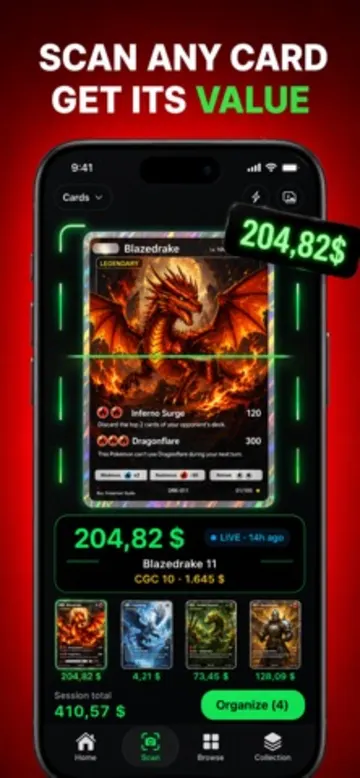
We make this one. Card Value Scanner, a TCG card scanner app for iPhone, reads the card name and collector number through the camera and matches the exact card; if the text is unreadable, a photo match takes over. It covers 22,900+ cards across 256 sets in Pokemon, Disney Lorcana and One Piece.
It earns the label because it puts three price sources next to each other: raw Cardmarket and TCGplayer prices refreshed daily, real eBay sold listings, and PSA, CGC and BGS graded values. Of the other picks, only PriceCharting and Ludex lean as hard on sold data, and neither shows Cardmarket. Multi-card scanning keeps a running session total, which helps at a card show table or with a shoebox of bulk.
The limits, plainly: it does not cover Magic, Yu-Gi-Oh! or sports cards, so a mixed collection needs a second app. The App Store rating is 4.0 from 12 ratings, a small sample that tells you little either way; Google Play shows 4.6. The free version has a 50-card collection cap. Card Value PRO adds unlimited collection size, the full graded ladder, all eBay sold listings, price alerts, CSV or JSON export and 20 AI Pre-Grades a month (an estimated grade range, not a PSA, CGC or BGS grade).
Pick it if you collect mainly Pokemon, Lorcana or One Piece and want to see what a card actually sold for. The same app is on Google Play as a TCG card scanner for Android.
2. Collectr, best for big multi-game portfolios
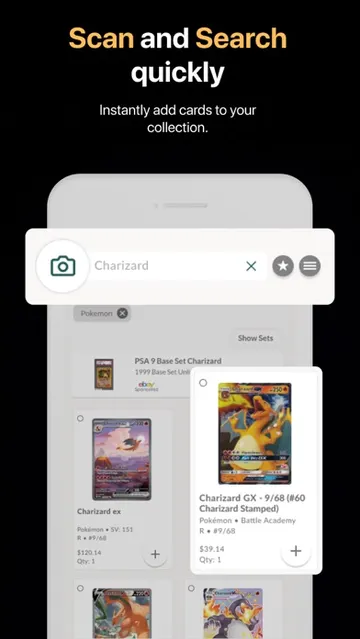
Numbers first: Collectr has 4.88 stars from 70,447 App Store ratings, the largest pile of feedback of any app here. It lists data for 20 or more games, from Pokemon and Magic to Flesh and Blood and Funko, and a database of over a million products.
That reach is why it takes the multi-game label: it tracks raw cards, graded cards and sealed product in one portfolio, with multi-currency values. Card Value Scanner shows sealed prices too, but only for three games. Collectr is the better home for a shelf of boosters, a Magic binder and a Pokemon collection together.
Where it falls short: scanning is limited on the free plan and unlimited scanning is an in-app purchase; the exact free allowance is not published. As listed in October 2026 the subscription is $7.99 a month or $59.99 a year, the priciest on this page. Its listing leans on portfolio language more than on sold-listing detail. We compare the two directly in Card Value Scanner vs Collectr.
Pick it if your collection spans many games and you think in terms of portfolio value.
3. Ludex, best for sports cards mixed with TCGs
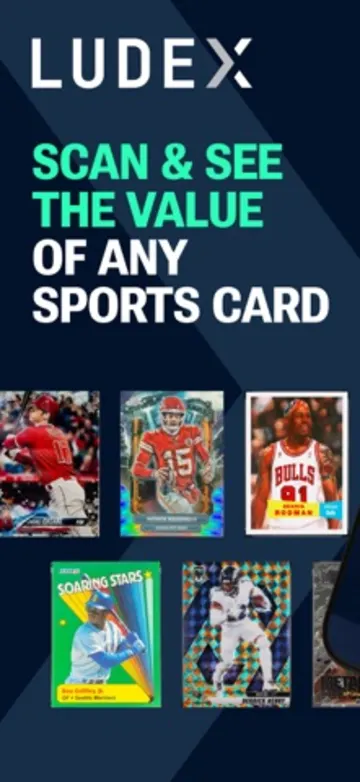
Ludex started with sports cards and added TCGs later, and you can feel the order. Ludex covers baseball, basketball, football, soccer, hockey, MMA, wrestling and racing, plus Pokemon, Magic and VeeFriends. It has 4.71 stars from 28,278 ratings.
Its edge over the TCG-first apps is the sports side: parallels and serial numbering (a /10 and a /499 can share a design and differ wildly in price) are where sports scanning gets hard, and Ludex is built for it. Its List-It feature posts a card to eBay, which none of the Pokemon-focused picks do. Values come from eBay completed sales and other marketplaces, and the listing says unlimited scans are included on the free tier.
Short on detail: the listing does not name Lorcana or One Piece, so check coverage before moving a collection over. Paid plans start at $4.99 a month as listed in October 2026; what the free tier withholds is unclear. Its own claim of being the most accurate scanner is a marketing line, not a measurement.
Pick it if sports cards are half your collection and you sell on eBay.
4. CollX, best for collections that include non-sport cards
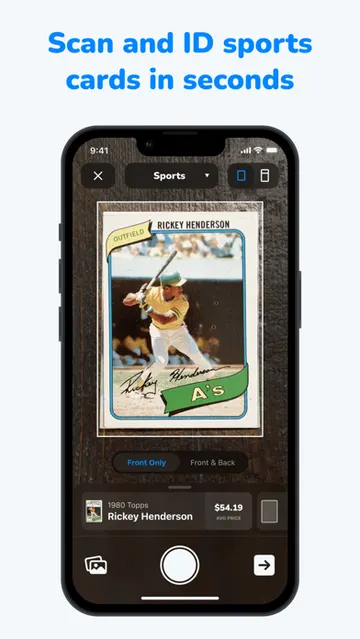
Garbage Pail Kids, Star Wars, Marvel, golf, tennis, Pokemon, Lorcana: CollX says it will scan all of it. Its listing cites a database of 20 million or more cards, 4.59 stars from 51,115 ratings, and recognition of graded cards, parallels and reprints. That non-sport range is wider than anything else on this page.
It also runs a marketplace with buyer protection, so you can sell from the same app. A Pokemon-only collector will not care. Someone clearing out a closet of 90s inserts and a few Pokemon binders will.
The catch is price and focus. CollX Pro is $10 a month or $100 a year, the highest listed here, and it gates unlimited collection size, CSV export and the AI assistant. The values are described as average market price, with no mention of showing individual sold listings in the text we read, so sold-comp checking is thinner than with Card Value Scanner or Ludex.
Pick it if your boxes hold more than TCGs and sports. We also have a direct write-up in Card Value Scanner vs CollX.
5. TCGplayer, best if you already buy and sell there
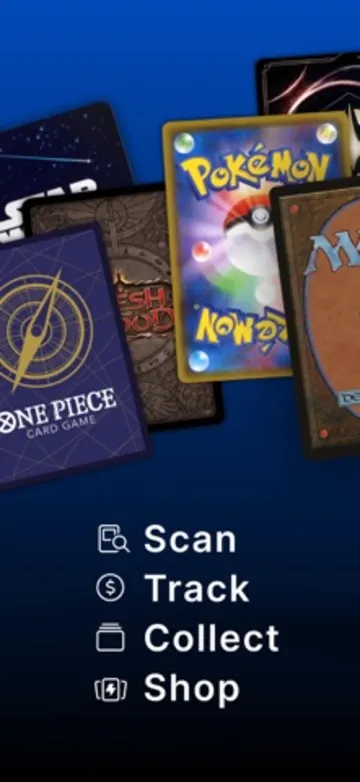
The TCGplayer app is free, scans cards, and shows market price for every card from the games sold on its marketplace. Its supported list is the longest here, running well past forty games, including Magic, Pokemon, Yu-Gi-Oh!, One Piece, Lorcana, Star Wars Unlimited and Flesh and Blood.
Its strength is that the price is the marketplace's own: scan a card, see the market price, tap through to listings and buy. For a seller on TCGplayer that is the shortest path from card to listing. Rating on the App Store is 4.29 from 19,224 ratings, the lowest of the group but hardly poor.
It does not show Cardmarket or eBay sold data, so you see one marketplace's view. That matters most for chase cards where eBay sold prices run higher or lower than TCGplayer market. Our guide to TCGplayer market price explains how the number is built and when it misleads. Collection tools are lighter than Collectr's.
Pick it if TCGplayer is where you shop and you want one login for scanning, pricing and ordering.
6. PriceCharting: TCG Collector, best for sales history across collectibles
PriceCharting is the odd one: it prices video games, comics, coins and LEGO alongside cards, and TCGs are one section. It has 4.82 stars from 27,920 ratings.
It earns the sales-history label because the listing says it tracks thousands of sales from eBay, Heritage, PWCC and other auction sites, filtered by condition, and lets you see previous sales. Search by photo or barcode identifies cards, and it flags ungraded cards that would gain the most from grading. It lists every English and Japanese Pokemon set.
Photo matching is the weak spot. Comparison coverage reports low-confidence matches and a need to confirm the exact card, and there is no Cardmarket price. The free tracker is reportedly capped at 30 items and 3 folders, and paid is $5.99 a month or $59.99 a year as listed in October 2026. Our PriceCharting comparison goes further.
Pick it if you price all kinds of collectibles and care most about historical sales.
7. Dex, best for Pokemon set builders
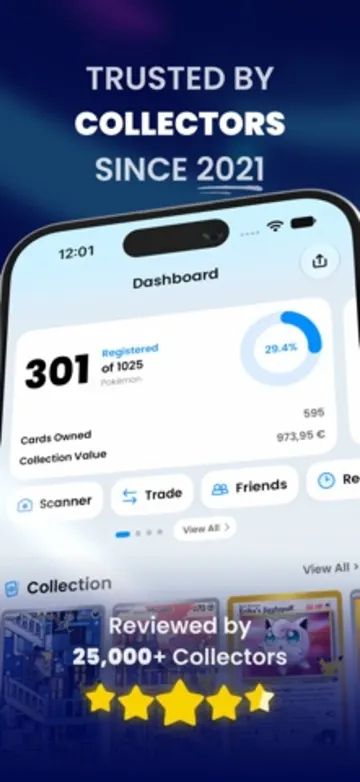
If you are chasing a master set in Japanese, Dex is where you probably want to be. Its database covers every English, Japanese and Simplified Chinese set, even cameo Pokemon hidden in other cards' artwork, and it tracks ownership down to the exact variant. Rating: 4.81 from 14,678.
It is Pokemon only. Prices come from TCGplayer, Cardmarket, eBay and CardTrader, free to everyone. You can build a Pokedex binder with one card per species and sweep a whole binder page in one scan.
Pay attention to the paywall: the free tier has unlimited cards but only 3 folders, and the scanner and some advanced features need Dex+ ($3.99 a month, $34.99 a year or $109 lifetime as listed in October 2026). Comparison coverage mentions scanner quality complaints; we have not verified them. See Card Value Scanner vs Dex.
Pick it for set completion, particularly across languages.
Also checked: Dragon Shield and PokeScope
Poke TCG Scanner by Dragon Shield is free with ads (4.62 from 13,829 ratings) and adds a deck builder, trade tool and friends lists; paid is $3.99 a month or $39.99 a year as listed in October 2026. It suits players who build decks as much as they collect. Its listing text spends a lot of space on Magic features, which is odd for a Pokemon-named app.
PokeScope is Pokemon only (4.59 from 3,257 ratings) and says it scans through sleeves and binder pages, which could save time on a big binder. Unlimited scans need a weekly or annual subscription. We did not rank either because the listings give less to check than the seven above.
Card Value Scanner vs Collectr, head to head
Collectr is the biggest rival by ratings, so it is the fair comparison. The facts below come from both App Store listings.
| Point | Card Value Scanner | Collectr |
|---|---|---|
| Games | Pokemon, Lorcana, One Piece | 20 or more, including Magic and Yu-Gi-Oh! |
| Price sources shown | Cardmarket, TCGplayer and eBay sold listings | Real-time database; sources not itemized in the listing |
| Graded values | PSA, CGC and BGS | Graded cards can be tracked |
| Sealed product | Prices for sealed product | Tracked as part of the portfolio |
| Store rating | 4.0 from 12 ratings (App Store) | 4.88 from 70,447 ratings (App Store) |
| Subscription | Card Value PRO | $7.99 a month or $59.99 a year as listed in October 2026 |
Collectr is bigger, older and more reviewed. Card Value Scanner is narrower and shows its sold listings more plainly. If you play one of our three games, that clarity is the reason to try it; otherwise Collectr's reach counts for more.
Scanning sports cards and other games is harder than Pokemon
Apps that started with Pokemon do their best work there, and the reasons are structural. A single Magic card can exist in 20 or more printings with near-identical art. Sports cards add refractors, prizms and numbered parallels that look alike under glare. Autograph and patch cards are priced on the specific hit, not just the card ID.
So for mixed collections, sort by game first and scan each group in its own session. For Yu-Gi-Oh!, confirm with the set code and passcode; for One Piece, the card number (OP01-style) is the quickest check. Our One Piece scanner list goes deeper on that game.
Foil and chrome sports cards are the most glare-prone cards you will scan. Use diffuse light, hold the phone parallel to the card, and take it out of the toploader if reflections wash out the text. A scanner reads appearance; it cannot authenticate a card, spot a trimmed edge or verify a signature.
What to look for in a TCG card scanner
Start with game coverage, because it decides everything else. Pokemon-only apps (Dex, PokeScope) model variants more deeply; broad ones (Collectr, TCGplayer, CollX) trade depth for reach. If you collect a game outside the app's list, nothing else on the feature sheet counts.
Next, the price source. TCGplayer market price is a US marketplace number, Cardmarket is the European one, and eBay sold listings show what buyers paid including outliers. An app that shows only one will mislead on cards where they diverge; eBay sold listings are the best tiebreaker for expensive cards.
Then check what the free tier withholds. Collection caps (50 cards in ours, 3 folders in Dex and PriceCharting) bite once you scan a real binder, and scan limits bite sooner. Add graded values if you might send cards in, and batch scanning if you have bulk; our note on sorting bulk cards covers the workflow.
Last, expect misses. How often scanners get a card wrong depends on the cards, the light and the device; vendor accuracy figures are not comparable, as we explain in are Pokemon card scanner apps accurate. Check set, collector number, language and finish before you save anything worth money.
Verdict
For Pokemon, Lorcana or One Piece, start with Card Value Scanner and judge it on the sold listings it shows; for many games at once, Collectr; for sports cards, Ludex or CollX; for a TCGplayer buyer or seller, the TCGplayer app. Two pages that may help next: the best Pokemon card scanner apps and our notes on a Pokemon collection tracker. Prices and ratings here were checked in October and November 2026 and will drift.
Frequently asked questions
What is the best TCG card scanner app?
It depends on the games you collect: Collectr and TCGplayer cover the most TCGs, Ludex and CollX add sports cards, and Card Value Scanner focuses on Pokemon, Lorcana and One Piece with eBay sold listings.
Is there a free TCG card scanner?
Yes, most have a free tier: TCGplayer is free with an account, Card Value Scanner is free for up to 50 cards, and Ludex lists unlimited scans on its free tier. Collection caps and graded data are what usually sit behind the paywall.
Which TCG scanner works for both sports cards and Pokemon?
Ludex and CollX both scan sports cards and Pokemon in one app. CollX also covers non-sport cards such as Garbage Pail Kids and Star Wars.
Can a TCG card scanner tell a reverse holo from a regular holo?
Sometimes, but variants are where scanners slip most often. Check the finish and collector number against the physical card before saving a match.
Do TCG scanner apps show PSA, CGC and BGS prices?
Some do: Card Value Scanner shows PSA, CGC and BGS values, and PriceCharting and PokeScope list graded pricing too. Coverage and depth differ, so check the listing for your grading company.
Is there a TCG card scanner for Android?
Yes: Collectr, Ludex, CollX, TCGplayer, PriceCharting and Dex all run on Android, and Card Value Scanner is on Google Play too.
Are TCG scanner prices the same as what a card will sell for?
No, they are market estimates built from listings and past sales. A card's real sale price depends on condition, the marketplace and fees.