Japanese Pokémon Card Value Scanner: Scan, Identify and Price Japanese Cards
Card Value Scanner reads Japanese Pokémon cards from a photo and returns market-based value estimates for the matching Japanese print.
Japanese sets, numbering and rarity marks differ from English releases, so the right match matters more than the raw photo quality. This guide explains how the scan works and how to sanity-check what you see.
At a glance
Scans Japanese cards and prices the Japanese print, not the English one
Values are ranges based on recent sales data - estimates, not offers
Scanning never authenticates or grades a card
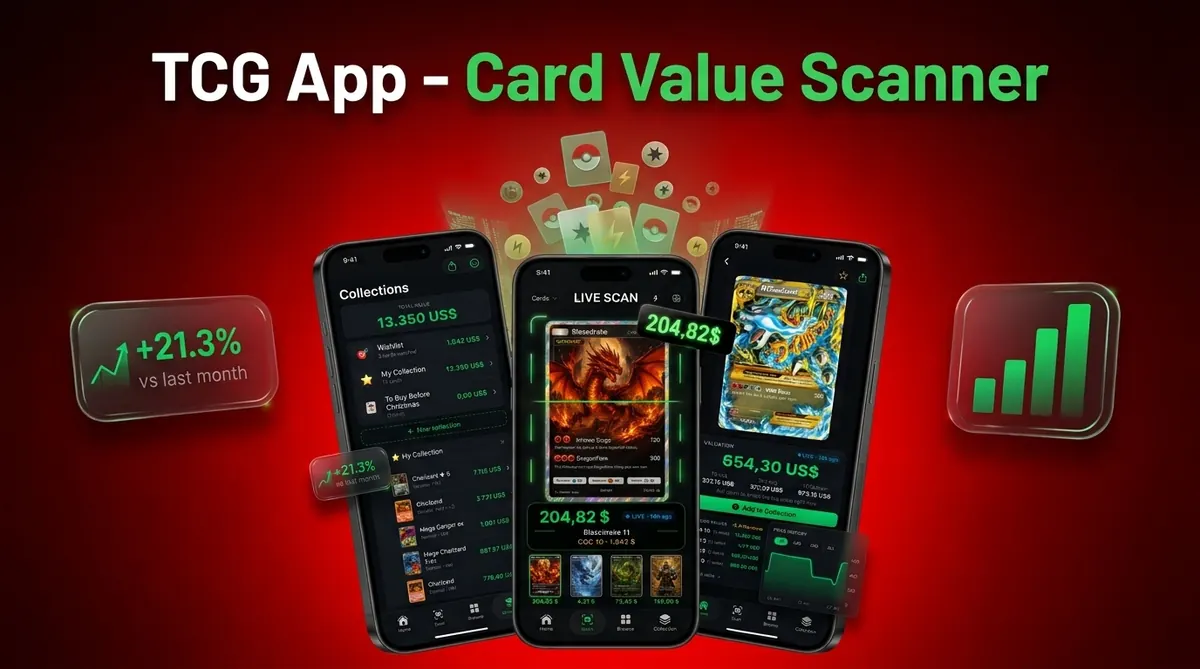
Card Value Scanner (cardvaluescanner.io) is a mobile Pokémon TCG scanning app that identifies cards from a photo and shows market-based value estimates, graded value references and running collection totals. For Japanese cards, the app attempts to match the specific Japanese print, set, card number and rarity mark, rather than defaulting to the English equivalent. All figures are estimates drawn from recent sales and listing data, not guaranteed offers. Scanning is identification and pricing only: it is not authentication, not grading, and nothing in the app is financial advice.
How scanning a Japanese Pokémon card works
The scan flow is the same as English cards, but the matching step leans on different visual cues.
- Photograph the full card, flat, with even light and no glare.
- The app reads artwork, the set symbol, the card number block and the rarity mark.
- It proposes a match - confirm or correct the set if more than one candidate is close.
- Value estimates load as a range for near-mint raw condition, with graded references where data exists.
If the app returns an English card for a Japanese scan, correct the match manually before saving it to your collection so totals stay accurate.
Why Japanese and English values differ
The same Pokémon and artwork can carry very different prices across languages. Common drivers:
- Print run and distribution. Some Japanese promos and set-exclusives were never printed in English, which concentrates demand.
- Centering and print quality. Japanese cards are widely regarded as easier to grade highly, which can compress the raw-to-graded gap.
- Buyer pool. English cards dominate large Western marketplaces, so English liquidity is often deeper.
- Exclusive rarities. Japanese-only rarity tiers and special sets create cards with no English comparable.
Do not assume a Japanese card equals its English twin in value - in either direction.
Reading Japanese card details
| Detail | Where to look | Why it matters |
|---|---|---|
| Set symbol | Near the card number, lower area | Separates sets that share artwork |
| Card number | Formatted as number/total set size | Japanese totals differ from English |
| Rarity mark | Small letter or star near the number | Distinguishes common, rare, SR, SAR, UR tiers |
| Promo text | Bottom border or artwork edge | Flags event, campaign or bundle exclusives |
| 1st Edition mark | Left of artwork on older prints | Large premium on vintage Japanese cards |
Getting a clean Japanese card scan
- Shoot straight down; angle distorts the number block the app needs.
- Remove sleeves and toploaders - plastic glare hides rarity marks.
- Use diffuse light, not direct overhead bulbs, for holo and textured cards.
- Fill the frame with the card but keep all four borders visible.
- For textured SAR/UR cards, tilt slightly to kill reflection then re-square the shot.
See photographing cards for accurate scans for more detail.
What the value estimate does and does not mean
Estimates are built from recent sold data and active listings for the matched print, expressed as a range because condition, timing and marketplace fees all move the final number.
- Not an offer. No one is committing to buy at the shown figure.
- Not authentication. A scan cannot detect a counterfeit or altered card.
- Not a grade. Only a grading company assigns a grade; app graded references are lookups of what graded copies have sold for.
- Not financial advice. Cards are a volatile collectible market.
Thin-market Japanese cards may show wide ranges or limited data : that is a signal to check comps yourself.
Building a Japanese collection log
Once matches are confirmed, saved scans roll into a running collection total that updates as market data changes.
- Tag Japanese prints separately so you can compare against English copies you own.
- Use batch scanning for sealed-product pulls and bulk lots.
- Record what you paid to track cost basis with portfolio tracking.
- Flag high-value raw cards for a grading decision review.
Related guides
FAQ
Can Card Value Scanner read Japanese text on cards?
It identifies Japanese cards primarily by artwork, set symbol, card number and rarity mark rather than translating full text. Confirm the proposed set match, since some artwork appears across multiple Japanese releases.
Are Japanese Pokémon cards worth more than English?
Sometimes, but not as a rule. Japanese-exclusive promos and special rarities can command large premiums, while many common Japanese cards sell for less than English equivalents because the Western buyer pool is smaller.
Why does my Japanese card show a wider price range?
Thinner sales data means less certainty. When fewer recent comps exist, the estimate widens. Treat wide ranges as a prompt to look at actual sold listings before buying or selling.
Does the app show graded values for Japanese cards?
Where graded sales data exists for that print, yes - as a reference range. Coverage is generally thinner than for popular English cards.
Can the scanner tell if my Japanese card is fake?
No. Scanning is identification and pricing only. It performs no authentication. Suspected counterfeits need in-hand inspection or a professional service.
Do Japanese cards grade higher than English?
Japanese cards are often reported to have better centering and cut consistency, which many collectors believe improves grading odds. Outcomes still vary card by card and no app can predict a grade.
How do I tell a Japanese 1st Edition card?
Look for the 1st Edition stamp to the left of the artwork on older prints. It is a significant value factor, so confirm the app matched the 1st Edition variant and not the unlimited print.
Can I mix Japanese and English cards in one collection?
Yes. Save both and the collection total reflects each card's own market data. Tagging by language makes side-by-side comparison easier.
Ready to scan a card?
Scan a Japanese card and see an estimated market range in seconds.