
Using a Card Value Scanner for Sports Cards and Other Trading Card Games
Card Value Scanner is built and tuned for Pokémon TCG first, with expanding support for other trading card games and a growing set of sports-card workflows.
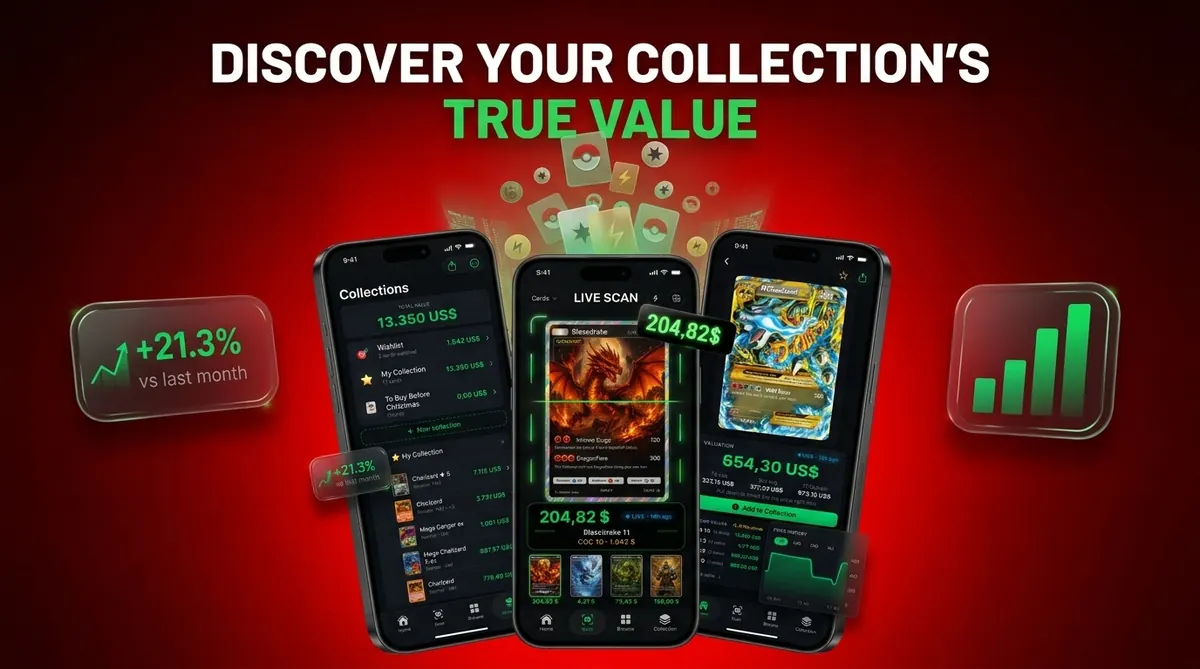
That means Pokémon scans are the most reliable, while Magic, Yu-Gi-Oh!, One Piece and sports cards may need more manual confirmation. This page explains what to expect before you scan a mixed collection.
At a glance
Pokémon coverage is deepest; other TCG and sports vary
Prices are market estimates from recent sales, not offers
Scanning is not authentication or grading
Card Value Scanner (cardvaluescanner.io) is a mobile card value scanner app that identifies trading cards from a photo, matches them to a marketplace price history, and tracks totals in a collection. Its core strength is the Pokémon TCG - set symbols, rarity marks, holo patterns and print variants are the most deeply modelled. Support for other games such as Magic: The Gathering, Yu-Gi-Oh! and One Piece, plus modern sports cards (basketball, football, baseball, soccer), depends on catalog coverage and how distinctive the card's layout is. All figures shown are market estimates based on recent sales and listings, not guaranteed offers. Scanning identifies and prices a card : it does not authenticate it, grade it, or provide financial advice.
What the app covers today
| Category | Scan reliability | Notes |
|---|---|---|
| Pokémon TCG (English) | Strongest | Sets, variants, rarity and graded comps modelled in depth |
| Pokémon TCG (Japanese) | Good | Confirm set code on the card edge |
| Magic: The Gathering | Variable | Many reprints - verify set symbol and treatment |
| Yu-Gi-Oh! | Variable | Use the 8-digit passcode and set code to confirm |
| One Piece Card Game | Variable | Card number (e.g. OP01-XXX) is the fastest confirm |
| Modern sports cards | Improving | Parallels and numbering strongly affect value |
If a match looks wrong, search manually by name plus the printed card number rather than accepting the first result.
Why other games are harder to scan than Pokémon
- Reprint density: a single Magic card can exist in 20+ printings with near-identical art.
- Parallels and inserts: sports cards use refractors, prizms and numbered parallels that look similar under glare.
- Serial numbering: a /10 parallel and a /499 parallel can share the same design but differ hugely in price.
- Language and region variants: the same card may price differently by market.
- Autograph and patch cards: value depends on the specific hit, not just the card ID.
How pricing is estimated
- The photo is matched to a catalog entry (name, set, number, variant).
- Recent sold prices and active listings for that exact variant are aggregated.
- Outliers and clearly mispriced listings are down-weighted.
- You see a range or a mid-market estimate, split by raw and graded where data exists.
Thin-data cards, obscure parallels, low-print promos, brand-new releases, produce wider ranges. Treat a wide range as a signal to check a marketplace directly.
Best practice for mixed collections
- Sort by game before scanning so you review results in consistent batches.
- Scan the highest-suspected-value cards individually and slowly.
- Send commons and bulk through batch scanning for a ballpark total.
- Always confirm the printed card number matched the result.
- For sports cards, note the parallel name and any serial numbering manually.
Photo tips that help non-Pokémon scans
Foil and chrome sports cards are the most glare-prone cards you will scan.
- Use diffuse indirect light; avoid direct overhead bulbs.
- Hold the phone parallel to the card, filling the frame edge to edge.
- Remove toploaders and sleeves if reflection is washing out the text.
- Keep the card number and set code in sharp focus.
More detail: how to photograph cards for accurate scans.
What scanning cannot tell you
A scanner reads a card's appearance. It cannot confirm the card is genuine, assign a grade, detect a trimmed edge, or verify an autograph. For sports cards especially, authentication of signatures is a specialist service. Use scan estimates for triage and record-keeping, then get high-value or suspect cards examined in person. Nothing here is financial advice.
Related guides
FAQ
Can Card Value Scanner scan sports cards?
It can identify and estimate values for many modern sports cards, but coverage is less complete than Pokémon. Parallels and serial-numbered cards often need manual confirmation.
Does it work as a Magic: The Gathering card scanner?
Magic cards can often be identified, but heavy reprinting means you should verify the set symbol and printing before trusting a price.
Is there Yu-Gi-Oh! card price scanning?
Yes for many cards. Confirm using the printed set code and 8-digit passcode, since alternate rarities of the same card vary widely in price.
What about One Piece Card Game values?
One Piece cards are supported with variable reliability. The card number such as OP01-XXX is the fastest way to confirm the correct match.
Which game is the app most accurate for?
Pokémon TCG. Set variants, rarity symbols, holo patterns and graded comparables are modelled in the most depth there.
Are the prices what I will actually get?
No. They are market estimates from recent sales and listings. Your realised price depends on condition, timing, fees and buyer demand.
Can it tell if a sports card autograph is real?
No. Scanning does not authenticate signatures, patches or relics. Use a professional authentication service for those.
Should I scan bulk sports cards one at a time?
No. Use batch scanning for bulk and single scans only for cards you suspect are valuable or hard to identify.
Ready to scan a card?
Scan a card from any game and see an honest market estimate in seconds.