
Pokemon card collecting for beginners: a first-month plan



Pokemon card collecting for beginners starts with one decision: pick a goal (a single set, one Pokemon, or a binder of favorites), then buy singles instead of random packs. Most cards are cheap, so condition, storage and checking sold prices matter more than luck. This page walks through the first month in order.
Nothing here needs a big budget. Our price guide had 23,483 Pokemon cards priced in November 2026, and the numbers below show why a small, focused plan beats opening packs and hoping.
Upload a TCG card photo.
Identifying your card…
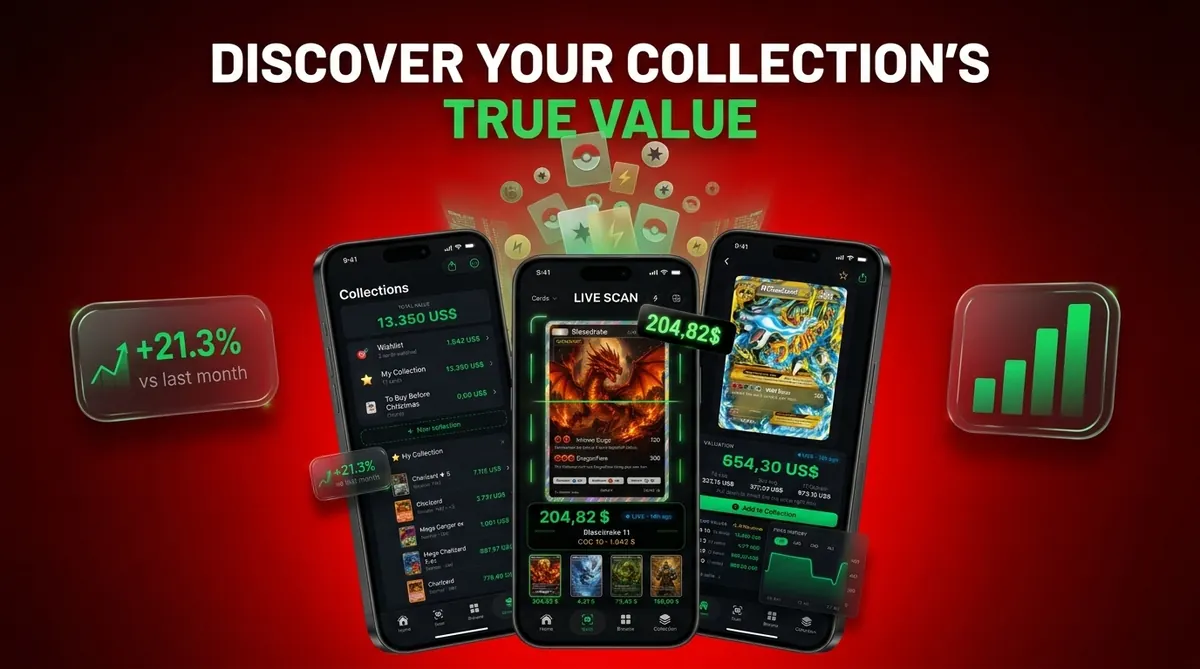
Unlimited scans, saved history and collection totals are in the Card Value Scanner app for iPhone and Android.
Most Pokemon cards are worth under a dollar
Most Pokemon cards are bulk. On our price guide in November 2026, raw near mint market prices break down like this:
| Raw price band | Cards | Share of 23,483 |
|---|---|---|
| Under $1 | 10,320 | about 44% |
| $1 to $5 | 5,415 | about 23% |
| $5 to $20 | 3,795 | about 16% |
| $20 to $100 | 2,781 | about 12% |
| Over $100 | 1,172 | about 5% |
So roughly two cards in three are under $5. That is good news for a beginner: you can build a real collection cheaply. It is also the reason a pack of ten cards rarely pays for itself. The expensive cards sit in a thin top slice, and the pack odds are not on your side.
These are market prices, not guaranteed sale prices. What a card sells for depends on condition, the marketplace and the week.
Step 1: pick a goal before you buy anything
A goal keeps you from spending $40 on random cards you will never look at again. There are four common ones:
- Complete one set, such as the Pokemon 151 card list (165 cards before secret rares push it higher).
- Collect one Pokemon in every version, for example every Pikachu card and its price.
- Fill a binder with cards you simply like the art of.
- Chase playable or valuable cards. This is the expensive one; I would not start here.
My opinion: a one-Pokemon goal is the best first project, because it forces you to learn sets, years and print variants without needing every card. Pikachu has hundreds of cards, many under a dollar. Charizard does too, but the vintage ones are not beginner money (see the Charizard value guide if you are curious).
Set a monthly budget now, even $20. Write it down. It is the one rule that actually survives contact with a hobby store shelf.
Step 2: sort what you already own
If you have an old shoebox of cards, sort it before buying anything new. You may already own half of your first set.
- Separate Pokemon cards from energy, trainers and non-Pokemon cards.
- Group by set using the symbol (next section).
- Pull anything holofoil, anything old (copyright dates from 1999 to 2003 are worth a look), and anything with a rarity symbol other than a circle.
- Put the rest in a bulk box. Don't throw it out until you've checked it.
For big piles, a phone scan is faster than typing names into a search box. Card Value Scanner, a Pokemon card scanner app for iPhone, reads the name and collector number from the camera and shows prices, and multi-card scanning keeps a running total for the session. If you want the longer method for large piles, see sorting bulk Pokemon cards.
Step 3: learn the bottom line of the card
Every modern Pokemon card carries three identifiers along the bottom: a set symbol, a collector number and a rarity symbol. Together they tell you exactly which card you hold.
| Marking | Where | What it tells you |
|---|---|---|
| Set symbol | Bottom right on most modern cards; right of the art on older ones | Which set it came from |
| Collector number | Bottom, like 161/131 or 4/102 | Which card in the set. A number higher than the set total means a secret rare. |
| Rarity symbol | Next to the number | Circle common, diamond uncommon, star rare. Modern sets add double rares, illustration rares and more. |
The number matters because many cards share a name. Umbreon ex number 161 from Prismatic Evolutions is a Special Illustration Rare with a raw price of about $966 on our guide in November 2026. A regular Umbreon ex is a different card at a very different price. Name alone gets you nowhere.
Rarity symbols change between eras, so keep a reference open: Pokemon card rarity symbols covers them, and holo versus reverse holo explains the finish differences that trip up newcomers. A reverse holo of a common is still a common.
Step 4: judge condition honestly
Condition can move a card's price by a factor of two or more, and beginners nearly always grade their own cards too high.
Raw prices on TCGplayer and Cardmarket assume near mint. That means no visible creases, clean corners with maybe a tiny touch of wear, and no scratches that show without tilting the card in light. Check these four areas:
- Corners: white dots or fraying.
- Edges: whitening along the back border, especially on blue-backed cards.
- Surface: scratches on holo foil, print lines, dents.
- Centering: how even the borders are front and back.
Be harsh. If you are debating between near mint and lightly played, it is lightly played. The full breakdown is in the Pokemon card condition guide.
Skip grading at the start. PSA grades run 1 to 10, and a PSA 10 of a modern chase card can be worth several times the raw copy (Umbreon ex 161 shows about $5,233 for PSA 10 against about $966 raw on our guide), but grading costs money and most cards do not earn it back. When you are ready, read whether to grade your Pokemon card.
Step 5: buy singles first, packs second
If you want a specific card, buy the single. A pack is a lottery ticket with cardboard attached.
Given that 44% of priced cards are under $1, an average pack pull is mostly bulk. A single of the card you actually want costs what it costs, you can see the condition, and you can check the price first. Packs are fun; I would just budget them as entertainment, not as a way to build a collection.
| Buy this | Good for | Watch out for |
|---|---|---|
| Singles | Finishing a set, a Pokemon, or a binder | Condition photos, shipping costs on cheap cards |
| Booster packs | The opening experience | Weak odds of a top card; resealed or searched packs |
| Elite trainer boxes and sealed products | Opening several packs plus accessories | Price spikes on new sets; check the sealed price before paying MSRP-plus |
Newest English sets are the most expensive per card early on. Delta Reign came out on November 6, 2026, and 30th Celebration on September 16, 2026. Prices on fresh sets tend to move fast in the first weeks. If you do not need a card on day one, waiting is usually cheaper. The Pokemon price movers page shows which cards are moving right now.
Watch for fakes when buying from unknown sellers. How to tell if a Pokemon card is fake covers the quick checks.
Step 6: store cards before they get damaged
Sleeve every card worth more than a dollar the day you get it. Damage almost always happens in the first week, in a pocket, a backpack or a drawer.
- Penny sleeve (soft sleeve) for every card you want to keep.
- Toploader or semi-rigid holder for anything over about $20.
- Binder with side-loading pockets, or a storage box for bulk. Avoid cheap binders with thick O-rings that dent cards.
- Keep it all away from heat, sunlight and damp. A closet shelf beats an attic.
Do not stack loose cards with rubber bands. It sounds obvious. Shoeboxes full of banded stacks say otherwise.
Step 7: check value against sold prices
A listing price is what someone hopes for; a sold price is what happened. Always check sold.
Each source tells you something different. TCGplayer market price is built from recent TCGplayer sales, Cardmarket is the main European price, and eBay sold listings show actual completed sales, including graded cards. They can disagree by a lot on thin cards, and a single odd sale can distort an average. The Pokemon card price guide to sources explains which to trust when, and eBay sold listings for Pokemon cards shows how to filter them properly.
For a quick check, search the card on our Pokemon card price guide or use the price checker. The same app is on Google Play as a Pokemon card scanner for Android, with the same daily Cardmarket and TCGplayer prices. Results are market estimates, not appraisals or offers.
Do this check before every purchase over a few dollars and before every sale. Two minutes of looking prevents most beginner overpaying.
A realistic first month
| Week | Do this |
|---|---|
| 1 | Choose a goal and a budget. Sort any cards you already own. |
| 2 | Learn set symbols, collector numbers and rarity symbols on cards in hand. Buy sleeves and a binder. |
| 3 | Buy your first singles after checking sold prices. Judge condition on arrival. |
| 4 | Log what you own and what you paid. Review the goal, adjust, and decide if you want a few packs for fun. |
Tracking purchase price is worth doing from day one, so you can see where the money went. A spreadsheet works; so does a Pokemon card collection tracker.
Frequently asked questions
How do I start collecting Pokemon cards as a beginner?
Pick one goal such as a single set or one Pokemon, set a small monthly budget, and buy singles of the cards you want. Sleeve them right away and check sold prices before paying.
Are Pokemon cards worth collecting?
Most are not worth much individually: on our price guide in November 2026, about 44% of priced cards were under $1. Collecting is worth it for the hobby itself, and only a small share of cards climb above $100.
Should beginners buy packs or single cards?
Singles are better if you want specific cards, since you see the condition and know the price. Packs are fine as entertainment but rarely return the cost of the pack.
How do I tell what set a Pokemon card is from?
Look at the set symbol and the collector number at the bottom of the card, then match both to a set list. The number (like 161/131) pins down the exact card.
What do I need to store Pokemon cards safely?
Penny sleeves for every card, toploaders for cards worth around $20 or more, and a side-loading binder or box. Keep them away from heat, sunlight and moisture.
How can I check what my Pokemon cards are worth?
Search each card by set and collector number and compare TCGplayer, Cardmarket and eBay sold prices. Sold prices show what buyers actually paid, so weigh them most.