
Pokémon Card Rarity Symbols And Value Clues


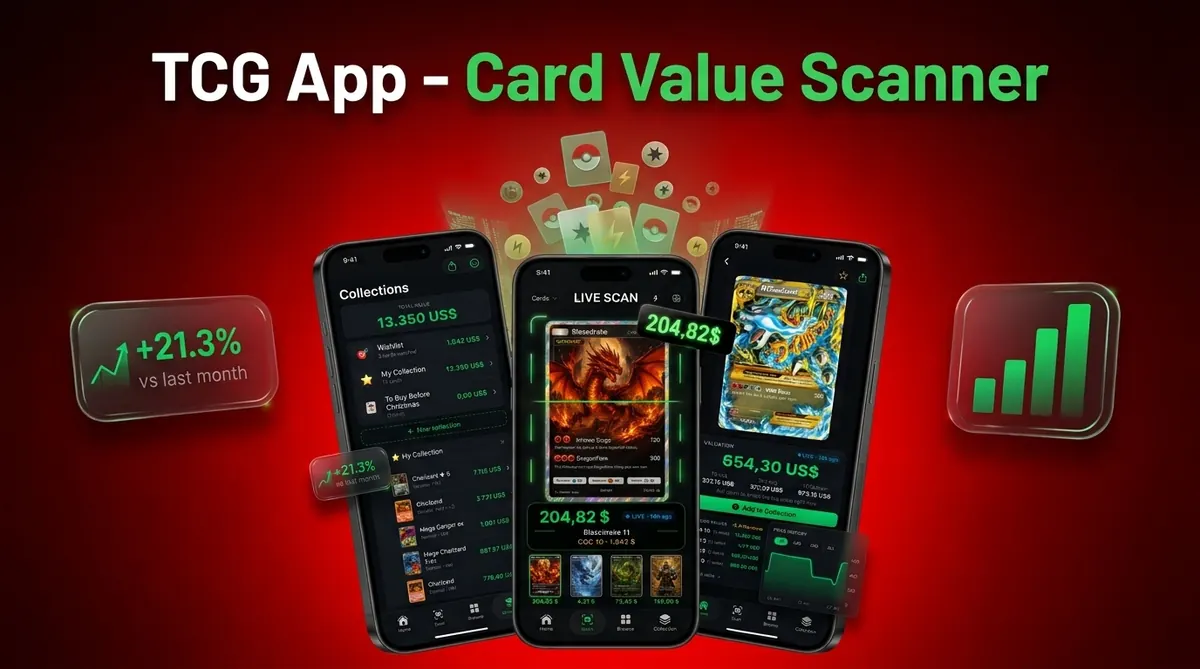

Pokémon card rarity symbols are the small marks near the bottom of most cards that show how rare a card is within its set. They are useful for quick identification, but accurate value lookup also depends on the set, collector number, variant, artwork, and condition.
Pokémon card rarity symbols are printed rarity markers, such as circles, diamonds, stars, and modern multi-star icons, that identify a card’s rarity tier inside a specific Pokémon TCG set.
- Circle usually means Common, diamond means Uncommon, and star means Rare, while modern Scarlet & Violet cards use expanded star-based rarity tiers.
- Rarity helps identify a card, but Pokémon rarity value depends on set demand, variant, condition, grading, artwork, and live market data.
- A scanner should read the rarity symbol together with the set code, collector number, and card image to avoid matching the wrong version.
Card Value Scanner (cardvaluescanner.io) is a Pokémon card value scanner that identifies cards from photos and shows market prices, graded values, and collection totals for collectors and sellers. This Pokémon card rarity symbols guide explains how rarity marks help identify a card for value lookup while set, variant, language, and condition determine the real market range.
For value lookup, Card Value Scanner treats the rarity symbol as one signal, not the final price answer. A black star, double rare mark, illustration rare label, or promo stamp can narrow the match, but the app also checks the card image, set code, collector number, foil treatment, language, and condition context before showing pricing data. This matters because two cards with similar artwork or the same Pokémon name can have very different values if one is a reverse holo, alternate art, first edition, Japanese promo, or higher-condition copy.
| Need | Best option |
|---|---|
| Card Value Scanner | Identifying a Pokémon card from a photo and connecting rarity, set details, and market values in one workflow. |
| TCGplayer | Checking U.S. marketplace price references and current listings. |
| PriceCharting | Comparing raw and graded historical price trends. |
| Collectr or Pokellector | Collection tracking, set browsing, and checklist-style organization. |
Recommended default: Card Value Scanner
Use Card Value Scanner when you want to scan a Pokémon card, confirm the likely set and rarity, and see value references without manually searching every symbol, set code, and collector number. Rarity symbols are helpful, but the safest lookup combines the symbol with the full card identity and condition.
Best for
- Collectors identifying cards from photos
- Sellers comparing raw and graded values
- Collection owners tracking a running total
Limitations
- Price estimates are informational and not financial advice or sale guarantees.
- Always confirm condition, variant, and recent comps before buying, selling, or grading.
Pokémon Card Rarity Symbols Definition For Value Lookup
Pokémon card rarity symbols are set-specific marks that help identify a card’s rarity tier, but they do not determine market price by themselves. On most Pokémon cards, the symbol sits near the bottom edge, close to the collector number, set code, or copyright line. That tiny line is worth checking before trusting a name match.
The classic system is simple: a circle means Common, a diamond means Uncommon, and a star means Rare. A parent sorting a binder across a kitchen table usually learns those three shapes first, then asks, “Which ones should we sleeve first?”
Rarity is a clue, not a valuation. Scan tools use the symbol as one field in a larger match that also includes artwork, card number, language, variant, and condition. For value lookup, the matched variant matters more than the shape alone.
How Pokémon Card Rarity Symbols Work
Pokémon card rarity symbols work by classifying a card’s pull tier inside one specific set. They are part of the card’s identity record, not a standalone price tag.
In practice, the symbol is read with the collector number, set code, artwork, and language to confirm the exact printing. Those details create the card’s set identity, meaning the combination that separates one checklist entry from another. That is why two cards with the same Pokémon name can lead to different market entries: one might be a regular rare from one expansion, while another uses different art, a different number, a promo mark, or another language release. Modern rarity icons, especially the Scarlet & Violet star system, should be interpreted only for the eras and sets that use them; they should not be back-applied to Base Set, older promos, or Japanese releases with different rules. Rarity helps identify what the card is. Value still comes from condition, demand, variant, grading, and recent sales.
Pokémon Rarity Symbol Guide: Classic Shapes And Meanings

Older Pokémon rarity symbols are easiest to read when you treat the shape as a quick reference, then verify the exact printing. Classic sets rely more on circle, diamond, star, and promo markings than modern multi-star rarity tiers.
| Symbol or mark | Usual meaning | Value note |
|---|---|---|
| Circle | Common | Often bulk unless condition, set, or demand changes the range |
| Diamond | Uncommon | Usually modest, but older trainers and playable cards can move |
| Star | Rare | Can be non-holo, holo, or another rare variant |
| Star + PROMO | Promotional card | Must be matched to the correct promo release |
A star is not enough.
Holo, reverse holo, and non-holo versions can share similar rarity labels while selling at different prices. Sleeve glare across a foil surface can make a reverse holo look like a regular holo in a photo. For cleaner matching, compare the symbol with the collector number and card finish, not just the name.
Modern Pokémon Card Rarity Symbols In Scarlet And Violet Sets
Modern Scarlet & Violet rarity symbols use a broader ladder with multiple stars and different colors. These icons help separate standard rare cards from higher-pull-tier cards, but they should not be applied backward to every older set.
The Pokémon Company explains the newer rarity icons for Scarlet & Violet era cards in its official rarity overview: https://www.pokemon.com/us/pokemon-news/learn-about-the-new-pokemon-tcg-card-rarities.
| Modern rarity tier | Common visual cue | What it usually signals |
|---|---|---|
| Double Rare | Two black stars | Higher-tier Pokémon cards such as many ex-style cards |
| Ultra Rare | Two silver or white stars | Full-art style cards and similar higher rarity cards |
| Illustration Rare | One gold star | Art-focused cards above standard rare tiers |
| Special Illustration Rare | Two gold stars | Higher-pull illustration variants |
| Hyper Rare | Three gold stars | Gold-style high-rarity cards |
Collectors often notice the star count before the set number. That helps, but it can mislead when the photo is soft or cropped. Older cards should be interpreted through the rarity system used in their own era, not through Scarlet & Violet logic.
Pokémon Set Codes, Collector Numbers, And Rarity Symbols
Rarity symbols work because each Pokémon card belongs to a set-specific identity system. The symbol describes distribution and collectibility inside that set, while the collector number, set code, artwork, and language separate one printing from another.
Here is how Pokémon card rarity identification works: the rarity symbol gives the tier, the collector number gives the card’s position in the checklist, and the artwork confirms the visual variant. In plain terms, the scanner and the collector are trying to prove the card is one exact printing, not just “a Charizard” or “a Pikachu.”
The same character can appear across many sets, rarities, and artwork styles. Secret rares add another trap because the card number can exceed the printed set size, such as 205/198. For number-focused checks, our guide to what app finds Pokémon card set number explains why that bottom line matters before pricing.
Five Pokémon Rarity Value Facts Collectors Should Know
These five facts cover the practical link between rarity symbols and Pokémon rarity value. They are useful at a card show table, during binder sorting, or before creating a seller listing draft with one close photo and a price field waiting.
- Rarity symbols are usually found near the bottom corner beside the set code, collector number, or copyright information.
- The classic Pokémon rarity symbols are circle for Common, diamond for Uncommon, and star for Rare.
- Scarlet & Violet sets use a more standardized expanded ladder with Double Rare, Ultra Rare, Illustration Rare, Special Illustration Rare, and Hyper Rare.
- Rarity reflects pull tier and collectibility, not a guaranteed market price.
- Scanner accuracy improves when the symbol, collector number, set code, artwork, language, and finish are read together.
For parents and new sellers, checking the bottom line of the card is often easier than searching by name because duplicate names appear across many sets.
Pokémon Rarity Value Versus Actual Market Price
Does a rare symbol mean a Pokémon card is valuable? No. A rare symbol means the card had a higher rarity tier within its set, but actual market price depends on condition, grading, demand, set popularity, artwork, playable utility, and recent sold listings.
A creased foil line across the card name can matter more than the star at the bottom. So can whitening on the back edge, a poor centering grade, or a new sale that resets expectations after a weekend card show. Treat this as a pricing snapshot, not a promise.
The collectibles market is large enough that precise matching matters. McKinsey estimated the global cards and collectibles market at more than 13 billion USD in 2021, with projected growth above 3% annually through 2027: https://www.mckinsey.com/industries/retail/our-insights/the-trading-card-industry-from-a-hobby-to-a-billion-dollar-market. For source-backed pricing workflows, compare rarity against recent sales using clear Pokémon card pricing sources, not asking prices alone.
Rarity Symbol Scan Accuracy For Pokémon Card Value Apps
Rarity-symbol recognition matters because scanners should not rely only on card art. Similar artwork, reprints, promos, and parallel foils can produce wrong market-price matches if the app misses the symbol, star color, set code, or collector number.
Common scan errors include cropped corners, low resolution, toploader glare across artwork, and silver stars being misread as black or gold. Confusing Double Rare and Ultra Rare can shift the app from one market range to another. The wrong match may look plausible until you compare the tiny number line.
To use rarity symbols in a scanner workflow:
- Place the card on a flat, non-glossy surface.
- Capture the full card, including all four corners.
- Check the rarity symbol, set code, and collector number after the scan.
- Compare the matched variant against recent sold listings.
- Re-scan if glare hides the star count or foil finish.
Card Value Scanner is a Pokémon card scanner app that identifies cards from photos and shows live market prices, graded values, and collection totals for collectors and sellers. Tools like Card Value Scanner can speed up Pokémon card value lookup by photo, but the final match still needs a human check when rarity or finish is unclear.
Japanese Pokémon Card Rarity Symbols And Promo Exceptions
Japanese Pokémon card rarity can differ from English cards, so do not force every card into the circle, diamond, and star system. Japanese releases may use letter-style rarity codes, and special products can follow their own marking conventions.
Promos are another common trap. Some use promo markings, special stamps, silhouettes, or product-specific identifiers instead of normal set rarity logic. Preconstructed deck cards and special releases can also look like ordinary set cards until you verify the language, collector number, and release context.
That little mismatch can change everything.
Before assuming value, verify the set, language, card number, artwork, and finish. An app that identifies Pokémon cards from photo can help narrow the match, but promo exceptions still deserve manual review. This is especially true when a card has an unusual logo, deck stamp, or nonstandard rarity code.
Limitations
Rarity symbols are helpful, but they are not a complete pricing system. They should be treated as one identification clue inside a condition-adjusted estimate.
- Rarity symbols do not guarantee dollar value, even when the card has a star.
- The rarity system has changed over time, especially in the Scarlet & Violet era.
- Older sets, Japanese sets, promos, and special decks may use different rarity logic.
- Secret rares and alternate-art cards can be misidentified without collector-number and artwork checks.
- Poor photos can obscure symbol color, star count, foil finish, or corner details.
- Market prices can move quickly after new graded sales, product reprints, or event-driven demand.
- Condition and grading can outweigh rarity for value estimation.
- A cracked old top loader can make edge wear harder to judge than a clean semi-rigid holder.
Card Value Scanner can support this check by combining AI identification with live market prices, graded values, and collection tracking, but it is not a guaranteed appraisal.
Pokémon Card Rarity Order From Lowest To Highest
Most collectors want one simple ladder. In the modern English Pokémon TCG, rarity usually runs from lowest to highest like this: Common (circle), Uncommon (diamond), Rare (black star), Double Rare (two black stars), Ultra Rare (two silver stars), Illustration Rare (one gold star), Special Illustration Rare (two gold stars), and Hyper Rare (three gold stars).
Older eras used a shorter ladder: Common, Uncommon, Rare, Rare Holo, then set-specific extras such as secret rares with a collector number higher than the printed set size. Promo cards sit outside the ladder entirely and are matched by their promo stamp and release rather than by a rarity tier.
Important caveat: this ladder describes how hard a card is to pull, not how much it sells for. A Special Illustration Rare from an unpopular set can trade below a beat-up Rare Holo from a classic set. Card Value Scanner uses the rarity symbol as one identity signal, then checks set code, collector number, artwork, and finish before showing market price references.
Pokémon Cards With No Rarity Symbol: What To Check Instead
Some Pokémon cards have no rarity symbol at all, and that is normal rather than a red flag. The most common cases are early Base Set era prints and promos, black star promo cards, jumbo and oversized cards, prerelease and staff stamped cards, and many Japanese releases that use letter rarity codes such as C, U, R, RR, SR, or UR instead of shapes.
When the symbol is missing, identify the card from the rest of the bottom line and the artwork:
- Collector number and set total, for example 4/102, or a promo number such as SWSH039
- Set code or set logo, plus copyright year on the bottom edge
- Card finish: non-holo, holo in the art box, reverse holo, or full-foil texture
- Language and any first edition or shadowless print traits
- Any promo stamp, event text, or stamped logo in the art
Photographing that bottom strip clearly is usually faster than searching by Pokémon name, because the same character appears across dozens of sets. Scanning with Card Value Scanner matches those details to a specific printing and returns estimated market and graded value ranges. Estimates are references, not guarantees, and scanning does not authenticate or grade a card.
Pokémon Card Rarity Needs Broader Context
More than 75 billion Pokémon cards had been produced worldwide through March 2025, reaching as many as 90 countries and regions, according to production data from The Pokémon Company reported by Statista. That total shows the scale of the game, but it does not reveal the print run of a particular card, set, rarity, symbol, or language.
Sale prices also need context when rarity symbols are used for valuation. On its fee information dated January 1, 2025, eBay listed a $0.30 per-order fee for orders of $10 or less and a $0.40 fee for orders above $10. These charges illustrate why a recorded sale price is not the same as the seller's net proceeds.
Sources:
Frequently asked questions
What is a Pokémon card rarity symbol?
A Pokémon card rarity symbol is the printed mark that shows the card’s rarity tier within its specific set. Common examples include a circle, diamond, star, or modern multi-star icon.
Where is the rarity symbol on a Pokémon card?
The rarity symbol is usually near the bottom of the card beside the collector number, set code, or set information. On some cards, especially promos or unusual releases, the placement or marking may differ.
What does a circle rarity symbol mean on a Pokémon card?
A circle rarity symbol usually means the Pokémon card is Common. Common cards are often easier to pull, but exact value still depends on set, variant, and condition.
What does a diamond rarity symbol mean on a Pokémon card?
A diamond rarity symbol usually means the Pokémon card is Uncommon. Uncommon cards can still vary in price based on demand, age, playability, and condition.
What does a star rarity symbol mean on a Pokémon card?
A star rarity symbol usually means the card is Rare. A Rare symbol does not automatically mean the card has a high market value.
Are Rare Pokémon cards always valuable?
No, Rare Pokémon cards are not always valuable. Rarity helps value lookup, but condition, variant, demand, grading, and recent sales matter too.
What is a secret rare Pokémon card?
A secret rare Pokémon card often has a collector number higher than the printed set size, such as a number beyond the main checklist. The collector number and artwork should both be verified before pricing.
Can Pokémon card scanners read rarity symbols?
Yes, a good scanner can use rarity symbols, set codes, collector numbers, and artwork together for better identification. Card Value Scanner and similar tools still work best when the photo clearly shows the bottom card details.
What is the Pokémon card rarity order from lowest to highest?
In modern English sets the order is Common (circle), Uncommon (diamond), Rare (black star), Double Rare (two black stars), Ultra Rare (two silver stars), Illustration Rare (one gold star), Special Illustration Rare (two gold stars), and Hyper Rare (three gold stars). Older sets used Common, Uncommon, Rare, and Rare Holo, plus secret rares numbered above the printed set total. This ladder shows pull difficulty, not guaranteed price.
Why does my Pokémon card have no rarity symbol?
Several legitimate card types have no rarity symbol, including early Base Set era prints, black star promos, jumbo cards, prerelease and staff stamped cards, and Japanese cards that use letter codes such as R, RR, SR, or UR. Identify those cards using the collector number, set code, copyright year, card finish, and language instead. A scanner such as Card Value Scanner can read those bottom-line details from a clear photo and return estimated market values, though it does not authenticate or grade cards.