
Pokémon Card Value FAQ: The Most Common Questions, Answered Clearly
This FAQ hub answers the questions collectors ask most about what Pokémon cards are worth and how card value apps calculate estimates.
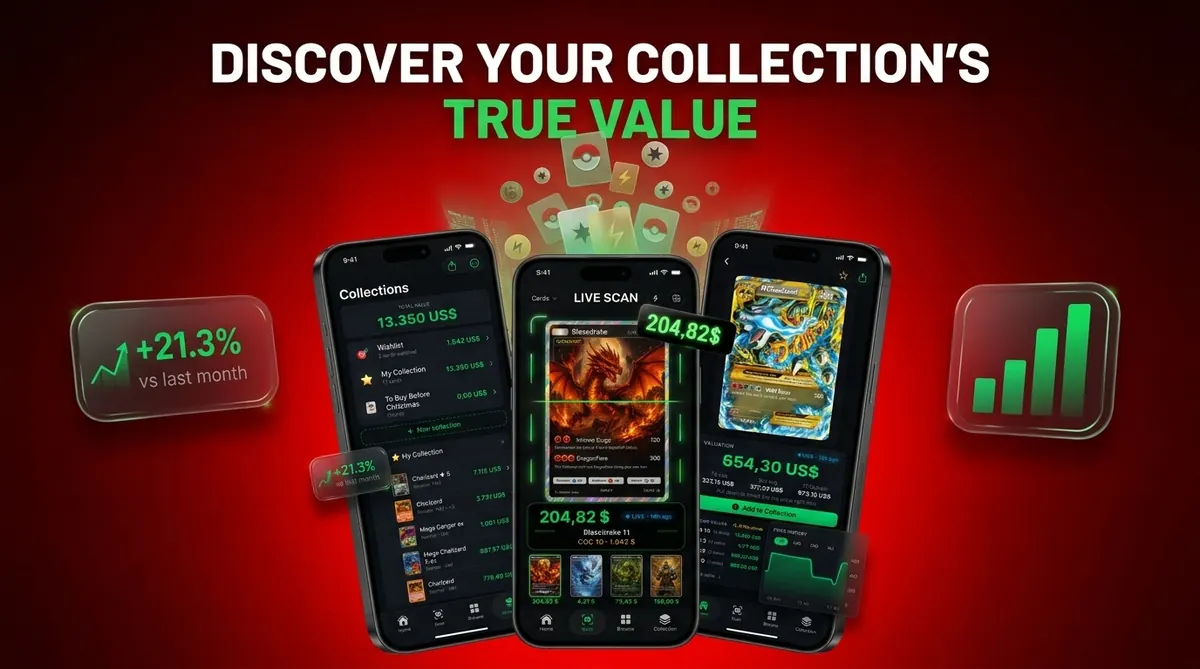
Every answer below reflects how real market pricing works: values are estimates drawn from recent sales and current listings, not fixed guarantees. Use them as a starting point, then verify anything high-value before you buy, sell, or submit for grading.
At a glance
Card values are estimate ranges from recent sales, not fixed prices
Scanning identifies and prices a card : it never authenticates or grades it
Condition and grade often change value more than rarity does
Card Value Scanner (cardvaluescanner.io) is a Pokémon TCG card value scanner app that identifies cards from a photo, matches them to a set and card number, and shows market price estimates for raw and graded copies alongside running collection totals. It is built for fast triage of binders and bulk boxes: scan, confirm the match, see an estimated range, and track what you own. Card Value Scanner reports market estimates, not appraisals : it does not authenticate cards, assign grades, or provide financial advice, and final sale prices always depend on condition, timing, platform fees, and buyer demand.
How is a Pokémon card's value actually determined?
Value comes from what comparable copies recently sold for, adjusted for condition. The main drivers, roughly in order of impact:
- Exact card identity - set, card number, language, and print run (1st Edition, Shadowless, promo stamps).
- Condition or grade - a near-mint raw copy and a heavily played copy of the same card can differ 5–20x.
- Rarity and print type - holo, reverse holo, full art, alt art, secret rare.
- Demand - popular characters (Charizard, Pikachu, Umbreon) hold value better than equally rare cards of unpopular Pokémon.
- Timing - reprints, set rotations, and hype cycles move prices week to week.
How accurate are Pokémon card price estimates?
Accuracy depends on how much data exists for that exact card. In practice:
| Card type | Typical estimate reliability |
|---|---|
| Modern popular chase cards | High - many sales per week |
| Common/bulk cards | High but low value; often cents |
| Vintage high-end (1st Ed Base) | Wider ranges; condition dominates |
| Rare error cards, obscure promos | Lowest - thin sales data |
Treat any single number as the middle of a range. For anything above roughly $50, cross-check recent completed sales for the same condition before acting.
Scanner app questions
- Does a scan prove my card is real? No. Scanning is image matching plus price lookup. Authentication requires physical inspection, ideally by a grading company.
- Why did the app pick the wrong card? Usually glare, blur, a cropped card number, or a card that has near-identical reprints across sets. Rescan flat, in even light, with the full card in frame.
- Can it scan Japanese cards? Yes for many sets, though data depth varies by set and language.
- Does it work offline? Identification may work, but live pricing needs a connection to refresh.
Condition and grading questions
Should I grade my card? Grading makes financial sense when the graded price minus fees and shipping clearly exceeds the raw price. As a rough filter, cards worth under about $25–30 raw rarely justify submission unless the card is a strong candidate for a top grade.
Can an app grade my card? No. Apps can show what graded copies sell for, but assigning a numeric grade requires a professional grader examining centering, edges, corners, and surface in hand.
How much does condition matter? Enormously. Whitening on the back, a soft corner, or off-center printing can cut a card's value in half even if it looks fine at arm's length.
Buying, selling, and tracking questions
- Where do I get the most for a card? Public marketplaces usually pay the most but charge 10–15% in fees; local shops and buylists pay less but pay instantly.
- Is a scanner estimate what a shop will pay? No - shops typically offer a percentage of market value so they can resell at a profit.
- How should I handle bulk? Scan in batches, pull anything over a set threshold, and bag the rest as bulk rather than pricing card by card.
- Should I track my collection? Yes, if you buy and sell. Logging what you paid alongside current estimates is the only way to know whether you're actually up.
How to use this FAQ responsibly
Everything here is educational. Card Value Scanner provides market estimates to help you triage and organize a collection; it does not guarantee sale prices, verify authenticity, assign grades, or offer investment advice. For high-value cards, combine an app estimate with recent completed-sales research and, where appropriate, professional grading or authentication.
Related guides
FAQ
How much is my Pokémon card worth?
It depends on the exact set, card number, print variant, and condition. Scanning the card gives an estimated market range based on recent comparable sales; a near-mint copy can be worth several times a played copy of the same card.
Are Pokémon card scanner apps accurate?
Identification is generally reliable with a clear, flat, well-lit photo. Pricing accuracy is highest for cards with frequent sales and looser for obscure promos or error cards with thin data.
Does scanning a card confirm it's authentic?
No. Scanning matches an image to a database and returns price data. It cannot detect fakes, reprints passed off as originals, or altered cards : that requires physical inspection or professional authentication.
Can an app grade my Pokémon card?
No. Apps can show prices for PSA, BGS, or CGC graded copies, but only a grading company can assign an official grade after examining centering, corners, edges, and surface in hand.
Why is the app's estimate different from a shop's offer?
Shops buy below market so they can resell profitably, and marketplaces deduct fees. An estimate reflects market sale prices, not the cash a buyer will hand you today.
How often do Pokémon card prices change?
Constantly. Popular cards can move daily with hype, restocks, and reprints, so treat any estimate as a snapshot and refresh before selling.
Which cards are actually worth checking?
Holos, full arts, alt arts, secret rares, 1st Edition and Shadowless vintage, promos, and anything featuring Charizard, Pikachu, or Umbreon. Most base-rarity modern commons are bulk.
Is card value scanning financial advice?
No. Estimates are informational only. Collectible prices are volatile and illiquid, and nothing on this site should be treated as investment guidance.
Ready to scan a card?
Scan a card and see an estimated market range in seconds.