
Pokémon Card Price Scanner For Sellers: Scan, Price, and List Faster
A Pokémon card price scanner for sellers uses your phone camera and AI to identify cards, pull live market prices from TCGplayer-style marketplaces, and help batch-price inventory before listing.


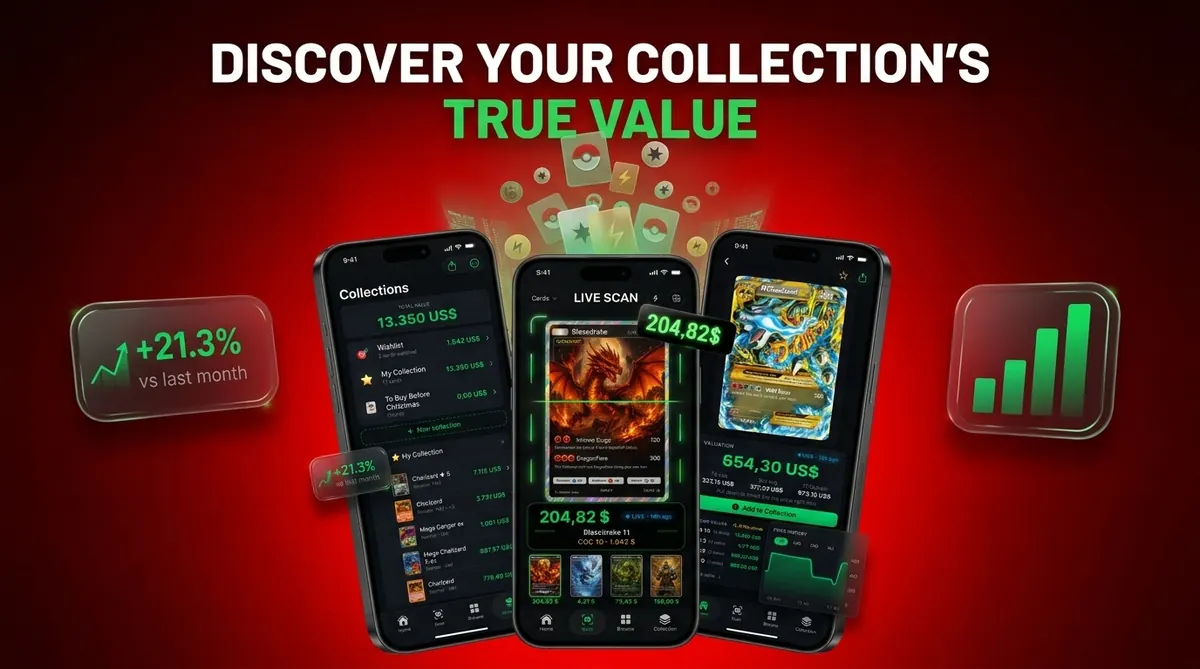
Card Value Scanner helps sellers compare raw prices, graded values, price history, and collection totals before deciding what to list individually, bundle, or hold.
A Pokémon card price scanner for sellers is a mobile app that identifies cards from photos, displays real-time market prices from major marketplaces, and supports batch workflows for pricing cards before listing on eBay, TCGplayer, or Cardmarket.
- Scan cards with your phone camera to get instant AI identification and live market prices from major platforms.
- Batch-scan inventory to see total lot value, tag conditions, and export lists for marketplace upload.
- Compare raw vs graded values and price history to decide whether to quick-sell, grade, or hold each card.
Who is this guide for?
Best for
- eBay, Whatnot, Facebook Marketplace, and local sellers who need a faster pre-listing pricing workflow.
- Collectors selling duplicates who want to separate bulk, playable cards, vintage hits, and graded candidates.
- Small resellers who need to check variants and build an inventory list before listing.
- Parents or newer sellers who want help identifying Pokémon cards before deciding what is worth selling.
Not the best fit if
- Sellers who want a guaranteed sale price instead of a market-based estimate.
- Anyone expecting a scanner to authenticate cards or detect every counterfeit with certainty.
- High-end sellers who need professional grading, provenance review, or auction-house appraisal for major cards.
- Users who do not plan to verify condition, exact variant, and recent sold comps before listing.
Card Value Scanner (cardvaluescanner.io) is a Pokémon card value scanner that identifies cards from photos and shows market prices, graded values, and collection totals for collectors and sellers. This page explains how a Pokémon card price scanner for sellers can speed up card identification, comp checks, condition notes, and pre-listing price decisions.
In seller workflows, the biggest time savings usually come from reducing repeat searches: scan the card once, confirm the variant, add condition notes, then use price context to decide whether it belongs in a single-card listing, a lot, a binder page, or a grading pile.
| Need | Best option |
|---|---|
| Card Value Scanner | Sellers who want photo-based identification, pricing context, graded value references, and inventory organization before listing. |
| TCGplayer | Checking U.S. market pricing and product pages for many English Pokémon cards. |
| PriceCharting | Reviewing raw and graded value trends, especially for popular and vintage cards. |
| Collectr, Pokellector, and Cardmarket | Collection tracking, set reference, and international price context. |
Recommended seller workflow
Best for
- eBay, Whatnot, Facebook Marketplace, and local sellers who need a faster pre-listing pricing workflow.
- Collectors selling duplicates who want to separate bulk, playable cards, vintage hits, and graded candidates.
- Small resellers who need to check variants and build an inventory list before listing.
Sellers who need marketplace features may prefer CollX, while CollX vs Card Value Scanner gives the iPhone option eBay sold listings and regional market prices.
Limitations
- Sellers who want a guaranteed sale price instead of a market-based estimate.
- Anyone expecting a scanner to authenticate cards or detect every counterfeit with certainty.
- High-end sellers who need professional grading, provenance review, or auction-house appraisal for major cards.
How to price a Pokémon card before you list it (5 steps)
Most mispriced listings come from one mistake: pricing the wrong version of the card. This is the sequence sellers can follow with Card Value Scanner and a marketplace sold-listings search.
- 1. Identify the exact card. Scan the front with your phone to get the card name, set, and collector number (for example 4/102) instead of guessing from artwork alone.
- 2. Confirm the variant. Check holo vs reverse holo vs non-holo, 1st Edition or Shadowless stamps, promo stamps, and language. Variants of the same card can differ in value by 10x or more.
- 3. Grade the condition yourself, honestly. Look at centering, edge whitening, surface scratches under angled light, and corners. Write down a condition note (NM, LP, MP, DMG) before you look at prices.
- 4. Compare price signals. Review market prices and recent sold-style comps for your exact variant and condition tier, not the highest active asking price.
- 5. Subtract costs, then set your price. Deduct marketplace fees, shipping, and supplies to see your real take-home before you commit.
Scanning replaces steps 1, 2, and 4 for most cards, which is where sellers lose the most time. Scanner output is a market-based estimate, not a guaranteed sale price or an authentication of the card.
List it single, bundle it, or send it to grading?
After scanning a stack, sellers usually need a sorting rule rather than a price for every card. These thresholds are a practical starting point for U.S. sellers, adjustable to your own fees and time value.
- Bulk or lot: commons, energies, and cards with an estimated value under roughly $1-2. Selling these individually often costs more in time and shipping than they return.
- Bundle by theme: playable staples, one Pokémon line, or a set run. Bundles raise the average order value and clear inventory faster than dozens of low-value listings.
- Single listing: cards estimated above roughly $5-10, plus anything vintage, sealed-era, or in visibly Near Mint condition. These deserve their own photos and title.
- Grading candidate: raw cards where the graded reference value is meaningfully higher than the raw estimate after grading and shipping fees, and where centering and surfaces look strong.
Card Value Scanner helps at the sorting stage by turning a scanned pile into per-card estimates and a running collection total, so you can see which cards clear your single-listing threshold. Grading outcomes are decided by PSA, BGS, or CGC, so treat graded comparisons as research, not a predicted grade.
Pokémon Card Price Scanner Fee Checks
Seller proceeds can depend on fee caps, not just percentage rates. TCGplayer documentation updated February 14, 2025 stated that marketplace commissions were capped at $50 per product sold. Because the applicable charge can vary by seller level and program, a scanned card value should not be treated as the amount a seller will receive.
Later comparisons published in March and August 2026 reported a $75 per-item commission cap, creating a discrepancy with the older $50 figure. Sellers estimating proceeds for higher-value Pokémon cards should check the live fee schedule and record the date reviewed. This avoids relying on an outdated cap when deciding where to list a card.
Sources:
Frequently asked questions
How accurate are card price scanners for Pokémon sellers?
Card price scanners are accurate when the card identity, variant, condition, and price data are current. They show recent market averages, not guaranteed sale prices.
Can a scanner grade my Pokémon card's condition?
No scanner can replace PSA, BGS, CGC, or another professional grader. It can help you estimate raw condition before deciding whether grading is worth the cost.
Does the scanner show eBay sold prices?
Card Value Scanner can show eBay sold-style comps when available, along with TCGplayer and Cardmarket-style market references. Sellers should still verify high-value cards manually before listing.
How many Pokémon cards can I scan in one batch?
Batch size depends on lighting, sleeve glare, phone camera quality, and review time. Many sellers can scan dozens of cards in a session, but verification slows the pace.
Is the Pokémon card price scanner free to use?
Some scanner features may be free, while seller features often require a paid tier. Batch scanning, exports, graded lookups, and price history are common premium features.
Does it calculate seller fees, shipping, or taxes?
Most scanners do not automatically calculate marketplace fees, shipping, supplies, returns, or taxes. Sellers should calculate net profit separately before accepting an offer.
Can it scan foreign-language Pokémon cards?
Card Value Scanner can identify many cards by artwork and set details, but non-English cards can reduce scanner confidence. Confirm the set symbol and collector number manually.
How often do scanned card prices update?
Price data refreshes regularly, but exact timing depends on the source feed. Lag can happen during new releases, buyouts, market spikes, or influencer-driven demand.
Should I scan Pokémon cards before or after grading?
Scan raw cards first to compare raw value against graded references before paying grading fees. Rescan after grading to track the certified value and inventory total.
How do I calculate my actual profit after eBay fees on a Pokémon card?
Start with your sale price, then subtract the marketplace fee (roughly 13-15% on eBay for trading cards, including payment processing), shipping cost, packaging supplies, and the amount you paid for the card. A $20 card sold with $1.50 shipping and a ~14% fee typically nets around $15 before your cost basis. Scanners like Card Value Scanner show market estimates, not net proceeds, so run this subtraction yourself before accepting an offer.
What is the fastest way to price a large box of Pokémon cards for resale?
Sort first, scan second. Pull out holos, full arts, vintage cards, and anything with a 1st Edition or Shadowless stamp, then batch-scan only those with a price scanner and treat the remainder as bulk priced by weight or per-100 lots. Scanning every common is rarely worth the time. Card Value Scanner supports scanning cards in a session and tracking a running total, which helps you decide what gets an individual listing and what goes into a lot.
Price Pokémon cards before you list
Use Card Value Scanner to scan cards, review value signals, organize inventory, and prepare cleaner seller listings.