
Pokémon Card Value Scanner vs Manual Price Lookup: Speed, Accuracy, and When Each Wins
Scanning identifies and prices a Pokémon card in seconds, while manual lookup gives you full control over comps - and most collectors end up using both.
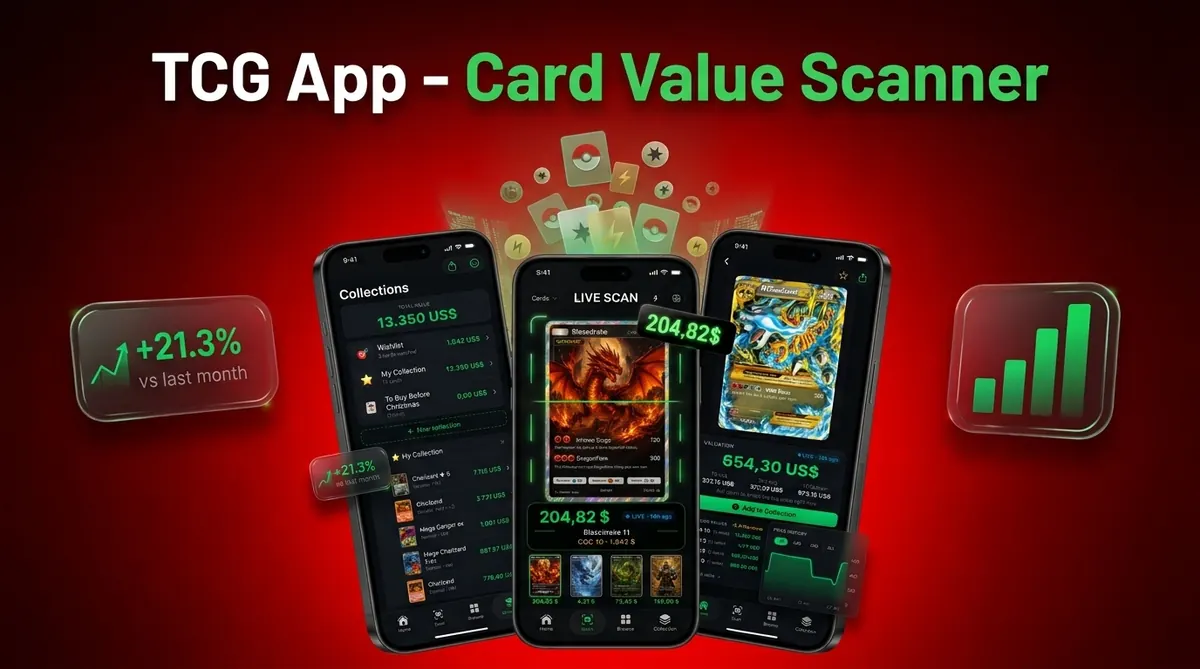
Below is an honest comparison of time per card, where each method is strongest, and how to combine them. All values from either method are estimates, not guaranteed sale prices.
At a glance
Scanning is typically seconds per card; manual lookup often takes 1–3 minutes.
Manual comps still win for rare variants, errors, and high-value sales.
All prices are estimates that move with the market.
Card Value Scanner (cardvaluescanner.io) is a Pokémon TCG card value scanner app that identifies cards from a photo, matches them to set and number, and returns market price estimates plus graded value references and collection totals. It is built to replace the repetitive part of manual price lookup, typing card names, guessing sets, and filtering sold listings, not to replace human judgment. Scanning is identification and pricing only; it is not authentication, not grading, and not financial advice.
The core difference in one table
| Factor | Card Value Scanner | Manual price lookup |
|---|---|---|
| Time per card | Seconds (point, scan, save) | Often 1–3 minutes including set ID and filtering |
| Set / number identification | Automatic from the photo | You read the card and search manually |
| Bulk volume | Strong - hundreds of cards in a session | Impractical past a few dozen |
| Odd variants & errors | May need manual confirmation | Best method - you control the search |
| Collection totals | Calculated as you scan | Manual spreadsheet work |
| Output type | Market price estimate range | Whatever comps you choose to trust |
How much time scanning actually saves
Manual lookup is rarely just one search. A realistic loop looks like this:
- Read the card name, set symbol, and collector number.
- Search a marketplace and pick the right printing among near-identical results.
- Filter to sold or completed listings rather than asking prices.
- Discount outliers, graded copies, and lots.
- Write the result somewhere you will find later.
Scanning collapses steps 1–3 and handles step 5 automatically. Across a 200-card box, that difference is the gap between an afternoon and a coffee break. Use batch card scanning when the pile is large.
Where manual lookup is still better
- High-value cards. Before selling something meaningful, verify with recent sold comps yourself.
- Error cards and misprints. Miscuts, ink errors, and crimps are priced by the market case-by-case.
- Ambiguous variants. Shadowless, 1st Edition stamps, staff promos, and regional prints reward a careful human read - see 1st Edition & Shadowless values.
- Graded copies. Grade, grader, and population all shift value; check a graded value lookup and real auction results.
- Thin markets. If a card almost never sells, an estimate is a wide guess by definition.
Accuracy: what each method can and cannot do
Both methods produce estimates. Manual comps are only as good as the listings you pick; an app estimate is only as good as the match and the data behind it. Two honest limits apply to scanning:
- Match risk. Similar artwork across reprints can cause a wrong set match - always confirm the set and number shown against the card in hand.
- Condition blindness. A photo does not measure centering, edge wear, or surface scratches, so condition is your call. Read are scanner apps accurate? for detail.
Scanning is not authentication and does not assign a grade.
The hybrid workflow most collectors settle on
- Scan everything to sort the pile fast and build a searchable list.
- Set a threshold : for example, anything estimated above a value you care about gets a second look.
- Manually verify the top slice using recent sold comps before pricing or listing.
- Grade candidates only after checking the raw-versus-graded gap in raw vs graded value.
- Re-scan periodically since markets move; totals from any single day are a snapshot.
This gives you speed on the 95% of cards that are bulk and rigor on the few that matter.
Getting scans accurate enough to trust the sort
- Flat, even light with no glare band across the holo.
- Full card in frame, all four corners visible.
- Sleeve off or a matte sleeve - glossy toploaders confuse matching.
- Confirm the set name and collector number the app returns.
More detail: how to photograph cards for accurate scans and how to scan with your phone.
Related guides
FAQ
Is a card scanner really faster than searching TCGplayer?
For most cards, yes. Scanning removes the set identification and listing-filtering steps that dominate manual lookup time. Manual searching remains useful for verifying individual high-value cards.
How much time does scanning save on a big collection?
If manual lookup averages one to three minutes per card and scanning takes seconds, a few hundred cards can go from hours to a single short session. Exact savings depend on your pile and how carefully you verify.
Are app estimates as accurate as manual comps?
Both are estimates. Manual comps can be more precise when you personally pick recent, condition-matched sold listings. App estimates are faster and more consistent across large volumes.
Does Card Value Scanner authenticate or grade cards?
No. It identifies cards and shows market price estimates. It does not verify authenticity and does not assign a condition grade - only a grading company can do that.
When should I stop trusting a scan and look it up myself?
Any time the card is high value, an error or misprint, a rare variant, already graded, or when the set and number shown do not match the card in hand.
Can I use both methods together?
That is the recommended approach: scan everything to sort and total, then manually verify the small slice of cards above your value threshold before selling.
Do scan estimates account for card condition?
Not reliably. A photo cannot measure centering or surface wear, so treat estimates as condition-neutral references and adjust down for played copies.
Is any of this financial advice?
No. Card values fluctuate and nothing here is investment advice. Use estimates as a starting point for your own research.
Ready to scan a card?
Scan a card now and see how long manual lookup would have taken.