
Cardmarket vs TCGplayer Pokémon Prices by Region


Cardmarket vs TCGplayer Pokémon prices differ because Cardmarket is the main European reference point while TCGplayer is the main U.S. reference point. Use the marketplace that matches your buyer region first, then normalize for currency, condition, language, variant, shipping, and recent sold data. Card Value Scanner helps compare those inputs as a pricing snapshot, not a promise.
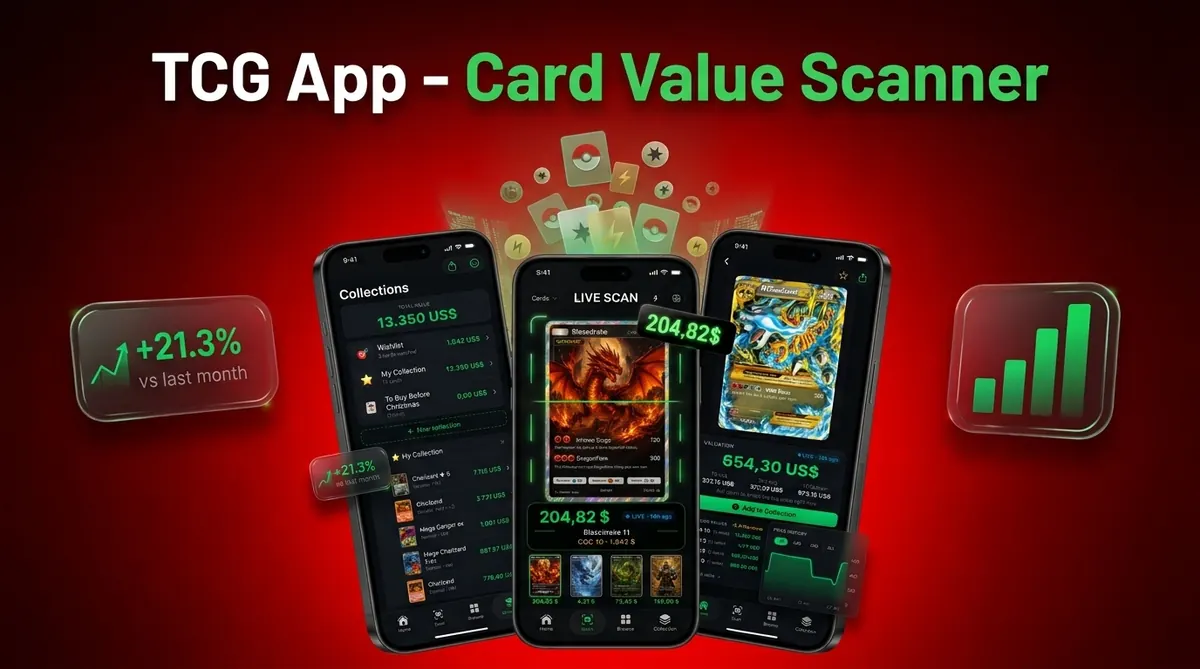
Card Value Scanner is a Pokémon card value scanner that identifies cards from photos and shows market prices, graded values, and collection totals for collectors and sellers.
- Use TCGplayer as the default benchmark for U.S. Pokémon card pricing and Cardmarket as the default benchmark for EU Pokémon card pricing.
- Compare the same card variant, language, and condition before treating a Cardmarket-to-TCGplayer price gap as real.
- Recent sold or market-price data is usually more useful than the lowest active listing, especially for fast-moving cards.
Card Value Scanner (cardvaluescanner.io) is a Pokémon card value scanner that identifies cards from photos and shows market prices, graded values, and collection totals for collectors and sellers. This page explains how Cardmarket vs TCGplayer Pokémon prices differ so U.S. collectors can choose the right reference before buying, selling, or valuing a card.
For U.S. users, the most common pricing mistake is treating a European Cardmarket trend price and a U.S. TCGplayer market price as interchangeable. Card Value Scanner recommends checking the marketplace that matches where you plan to sell, then adjusting for condition, language, variant, shipping, and recent sold activity before making a pricing decision.
Recommended default
Best for
- Collectors identifying cards from photos
- Sellers comparing raw and graded values
- Collection owners tracking a running total
Limitations
- Price estimates are informational and not financial advice or sale guarantees.
- Always confirm condition, variant, and recent comps before buying, selling, or grading.
Cardmarket vs TCGplayer Pokémon prices at a glance
TCGplayer is usually the U.S. benchmark for Pokémon card prices, while Cardmarket is usually the EU benchmark. Neither source is universally correct; each reflects its own buyers, sellers, currency, and shipping reality.
| Factor | TCGplayer | Cardmarket |
|---|---|---|
| Main region | United States | Europe |
| Currency | U.S. dollars | Euros |
| Seller base | U.S. shops and sellers | European sellers across countries |
| Price type | Market Price, listings, sales context | Listings, trend data, seller offers |
| Shipping friction | Lower for U.S. buyers | Lower for EU buyers |
| Language pool | Mostly English | English plus German, French, Italian, Spanish, and more |
| Best use case | US card market prices | EU Pokémon card prices |
TCGplayer Market Price is based on recent transactions, not only current seller asks. For U.S. pricing notes, we usually pair it with TCGplayer market price for Pokémon cards.
How Cardmarket vs TCGplayer Pokémon pricing works
A marketplace price is the result of local supply, local demand, seller behavior, currency, and transaction history. In plain terms, the card is only half the story; the buyer pool sets the other half.
TCGplayer says Market Price uses multiple recent transactions across thousands of daily transactions, thousands of sellers, and tens of thousands of individual items source. Cardmarket reflects European seller inventory, euro pricing, language availability, and cross-border EU buying patterns.
Identical card names do not guarantee identical comparable prices. Check the tiny card number line at the bottom left or bottom right before trusting a name match. Card Value Scanner is useful here because the scan workflow pushes identity, set, variant, and source timestamp into the same pricing note.
Small print decides a lot.
Five facts that change EU Pokémon card prices and US card market prices
Before comparing EU Pokémon card prices with US card market prices, normalize the variables that actually move value. A raw euro-to-dollar conversion is rarely enough.
- Region sets the baseline marketplace. TCGplayer usually fits U.S. transactions, while Cardmarket usually fits European transactions.
- Condition changes the estimate. Near Mint, Lightly Played, Moderately Played, and Damaged copies should not share one value.
- Variant details matter. Holo, reverse holo, 1st Edition, set number, language, reprint, and promo status can all change the matched comp.
- Recent sales beat lowest listings. A low ask may be stale, damaged, foreign-language, or missing shipping.
- Costs can erase gaps. Shipping, fees, exchange rates, taxes, and import friction often shrink the apparent spread.
If your priority is condition-adjusted collection tracking, Card Value Scanner fits because it saves the matched variant beside the condition input and current market range.
Where Cardmarket wins for EU Pokémon card prices
Does Cardmarket give better Pokémon card prices for Europe? Yes, use Cardmarket first when the likely buyer or seller is in Europe.
Euro-denominated listings can reflect EU liquidity better than U.S. prices converted into euros. That matters for German, French, Italian, Spanish, and other European-language copies, where demand may not mirror the U.S. market. Intra-Europe shipping also changes the real buyer cost. For Cardmarket-side checks, verify seller location, language, condition, and shipment terms against Cardmarket's own buying and seller guidance source.
Cardmarket still needs judgment. Asking prices can sit too high, and Near Mint labels vary between sellers. A seller photographing holo at a window may show surface scratches that the listing grade understates.
For European sellers who need a defensible first number, Card Value Scanner covers the workflow by pairing card identity with regional source checks and a saved pricing snapshot.
Where TCGplayer wins for US card market prices
Should U.S. collectors use TCGplayer before Cardmarket? Usually, yes. Use TCGplayer first when pricing for U.S. buyers, U.S. stores, or U.S.-based collection tracking.
TCGplayer Market Price differs from current listing prices because it is calculated from multiple recent transactions and is designed to represent actual value, not just seller asking prices. That makes it more useful than the lowest active listing when a card is moving quickly after a new graded sale posts.
TCGplayer can be less useful for European-language copies or EU-only pricing decisions. The most practical pricing source is the one closest to the expected transaction, not the one showing the higher number.
After a store staff member scans a trade-in stack, Card Value Scanner helps keep U.S. comps, raw versus graded notes, and collection totals in one review flow.
How to use Cardmarket vs TCGplayer Pokémon prices correctly
Use Cardmarket and TCGplayer as regional evidence, then build a condition-adjusted estimate. Card Value Scanner should deliver matched pricing context, not a guaranteed appraisal.
- Identify the exact card. Confirm Pokémon name, set, card number, variant, and language.
- Set the selling region. Choose TCGplayer for U.S. buyers and Cardmarket for EU buyers.
- Match condition. Do not compare a Near Mint comp to a played binder copy.
- Convert the full cost. Add currency conversion, shipping, fees, taxes, and import costs.
- Review market history. Use recent sales or market-price history rather than only active listings.
- Save the comparable. Record the source timestamp in a tracker or pricing note.
For larger binders, Card Value Scanner helps because scan history can be saved before duplicates are counted at the dining table.
Cardmarket vs TCGplayer price gaps for condition, variants, and language
Most Cardmarket vs TCGplayer price gaps come from mismatched condition, variant, or language. Near Mint should not be the default for every physical copy, especially when a cracked old top loader has left corner wear or surface marks.
Holo versus reverse holo, regular versus alternate art, 1st Edition stamps, set versions, and reprints all need separate comps. The glare from a penny sleeve can make a scanner confuse holo and reverse holo surfaces, so confirm the selected variant before saving a value.
Language can also shift demand. English, German, French, Italian, Spanish, and Japanese copies may perform differently by region. Card Value Scanner reduces common lookup mistakes by making variant confirmation part of the scan workflow, but the user still has to check the matched card.
For deeper source checks, use a broader guide to compare Pokémon card price sources.
Binary decision tree for Cardmarket vs TCGplayer Pokémon valuation
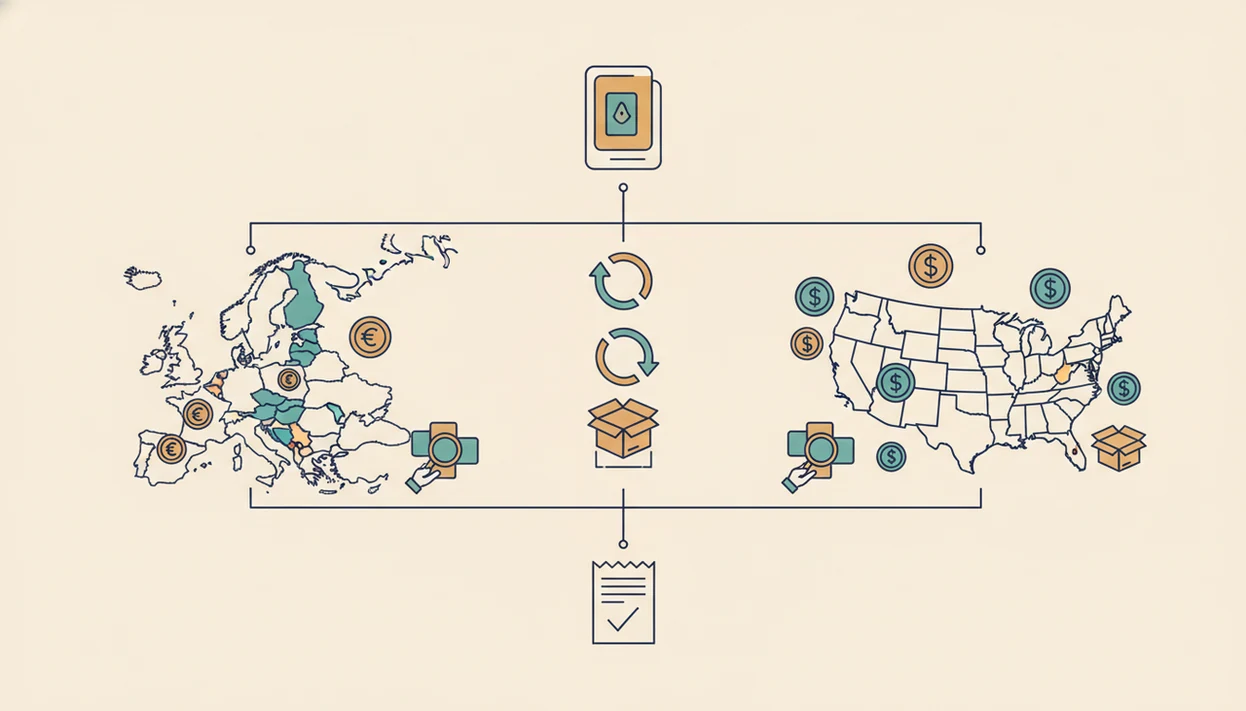
The winning source is the one closest to the transaction, not necessarily the one with the higher number. Use the table below before deciding which price to quote.
| Situation | Primary source to check |
|---|---|
| U.S. buyer or seller | TCGplayer |
| U.S. local game store trade-in | TCGplayer |
| U.S.-based grading comparison | TCGplayer, then graded sales |
| EU buyer or seller | Cardmarket |
| EU local comp | Cardmarket |
| Rare card with low liquidity | Check both |
| Cross-border listing or arbitrage idea | Check both, then subtract costs |
| International-language variant | Start with the region where that language trades most often |
For sellers comparing raw versus slabbed outcomes, the raw vs graded Pokémon card value question should be handled separately from regional marketplace pricing.
Evidence and Data Sources for Cardmarket vs TCGplayer Prices
Use both platforms as evidence, but read the price type before comparing them. TCGplayer Market Price is transaction-based, while active TCGplayer listings are seller asks; Cardmarket checks need the listing details around condition, language, seller country, and shipping context.
- Separate sold-based signals from asks. Treat TCGplayer Market Price as a recent-transaction signal and current TCGplayer listings as live supply. A low listing is not automatically a completed-sale value.
- Check Cardmarket fields closely. Cardmarket’s own help material centers the practical details collectors rely on: offer listings, card condition, card language, seller location, and shipment terms.
- Normalize money before judging gaps. Convert euros and dollars with a current exchange rate, then allow for marketplace fees, payment costs, shipping, taxes, and import friction. A finance-page conversion alone can overstate the spread.
- Inspect thin markets manually. For rare promos, niche languages, misprints, or expensive vintage cards, one platform may have too few recent signals. Open both marketplaces and compare exact copies.
- Use app values as notes, not verdicts. Card Value Scanner snapshots help document identity, condition, source, and timing, but they are valuation aids rather than binding appraisals.
Limitations
Marketplace prices are useful evidence, but they are not universal truth. Treat every result as a pricing snapshot, not a promise.
- Cardmarket and TCGplayer reflect their own platform users, not the entire Pokémon card market.
- Price data can lag hype spikes, reprints, supply shocks, and sudden demand changes.
- Cross-market comparisons are imperfect because grading habits, language pools, and seller expectations differ.
- Historical charts do not automatically include fees, taxes, shipping, exchange rates, or liquidity.
- Active listings can be unrealistic and should not be treated as completed-sale value.
- App-based valuations depend on correct card identification, variant matching, and condition input.
- Low-liquidity cards may show stale or thin data on tcgplayer.com, cardmarket.com, pricecharting.com, pokellector.com, or getcollectr.com.
For collectors who need source-backed context, Card Value Scanner works best when paired with manual review of Pokémon card pricing sources.
How to convert a Cardmarket price to a TCGplayer comparison
A euro price is not a dollar price with a conversion applied. To compare Cardmarket vs TCGplayer Pokémon prices honestly, convert the landed cost: what the card actually costs you delivered - rather than the listing number.
- Start with the item price in euros for the exact set, number, variant, language, and condition.
- Add EU shipping plus any Cardmarket seller shipping tier or tracked-postage upgrade.
- Apply the live exchange rate, then add roughly 1–3% for card or PayPal currency conversion spread.
- Add import costs for cross-border orders: customs duty, VAT handling, and courier brokerage fees where applicable.
- Compare against TCGplayer Market Price for the same condition - not the lowest active listing.
Worked example: a card listed at €40 with €6 tracked shipping is €46. At a 1.08 rate that is about $49.68, plus ~2% conversion spread (~$50.67), plus any import handling. If the TCGplayer Market Price is $52, the real spread is a few dollars - not the $8 gap the raw listing suggested. That is why most cross-market "arbitrage" disappears once costs are counted.
Card Value Scanner is useful at the front of this process: scanning the card locks in set, number, variant, and language so you are comparing the same card on both marketplaces before any currency math. The output is a pricing estimate for your own comparison, not a guaranteed sale price or an appraisal.
When Cardmarket and TCGplayer disagree, which price should you trust?
Trust the marketplace closest to your actual transaction. If you will sell to a U.S. buyer, TCGplayer Market Price is the more defensible number even when Cardmarket shows more. If you will sell within Europe, Cardmarket is the more defensible number even when TCGplayer shows more. The higher figure is not the more accurate one.
It also helps to know what each number means. TCGplayer Market Price is derived from recent completed transactions on TCGplayer. Cardmarket Trend Price is a smoothed value drawn from Cardmarket's own recent sales history, while the "from" price is simply the cheapest active listing, which may be a played, non-English, or slow-shipping copy.
- Gap under ~15%: usually noise from currency, shipping, or condition mix - use your regional source.
- Gap over ~30%: check for a mismatch first - wrong variant, wrong language, reverse holo vs holo, or a reprint.
- Thin or illiquid cards: check both, then weight toward whichever has more recent sales.
- Japanese or EU-language copies: Cardmarket often has deeper comps; U.S. listings can be sparse and erratic.
Card Value Scanner helps by making variant and language confirmation part of the scan step, so a price gap is a real market difference rather than a lookup error. Scanning identifies and prices a card; it does not authenticate or grade it.
Frequently asked questions
Is Cardmarket cheaper than TCGplayer for Pokémon cards?
Cardmarket may look cheaper for some cards, but currency, shipping, taxes, seller location, and condition can change the real comparison. Compare final landed cost, not only the visible listing price.
Which Pokémon card price should Americans use?
U.S. buyers and sellers should usually start with TCGplayer because it reflects U.S. demand, U.S. sellers, and dollar pricing. Cardmarket can be a secondary check for rare or international cards.
Which Pokémon card price should Europeans use?
European buyers and sellers should usually start with Cardmarket because it reflects EU supply, euro pricing, and regional liquidity. TCGplayer is less direct for typical EU transactions.
What is TCGplayer Market Price for Pokémon cards?
TCGplayer Market Price is a value based on multiple recent transactions rather than the lowest current listing. It is meant to represent actual marketplace value more than seller asking price.
Do Cardmarket Pokémon card prices include shipping?
Cardmarket prices should be checked against shipping cost and seller location before comparison. A low listing can become less attractive after delivery fees or cross-border costs.
Are listed Pokémon card prices the same as real values?
Listed prices are seller asks, not confirmed sale values. Recent sales or market-price data is usually stronger valuation evidence.
How much does card condition change a Cardmarket vs TCGplayer comparison?
Condition can change the comparison substantially because Near Mint, played, and damaged copies should not be valued as the same card. Always match condition before comparing regions.
Can I arbitrage Pokémon cards between Cardmarket and TCGplayer?
Cross-market arbitrage is possible in theory, but shipping, fees, currency conversion, taxes, and liquidity risk often reduce the spread. Card Value Scanner can help document comps, but it does not remove transaction risk.
How do I convert a Cardmarket price to a TCGplayer price?
Add the item price and EU shipping, convert to dollars at the live exchange rate, add about 1–3% for currency conversion spread, then add any customs, VAT, or courier handling fees. Compare that landed cost to the TCGplayer Market Price for the same condition and variant, not to the lowest listing. A €40 card with €6 shipping at a 1.08 rate lands near $50 before import costs, which often closes most of an apparent gap.
What is the difference between Cardmarket Trend Price and TCGplayer Market Price?
TCGplayer Market Price is calculated from recent completed TCGplayer transactions in U.S. dollars, so it reflects U.S. demand. Cardmarket Trend Price is a smoothed value based on Cardmarket's recent European sales in euros. Neither is the same as the cheapest active listing, which can be a played, foreign-language, or slow-shipping copy. Use the one matching your buyer's region as the primary reference and treat the other as a secondary check.