
See Pokémon Card Price Trends Without Hype


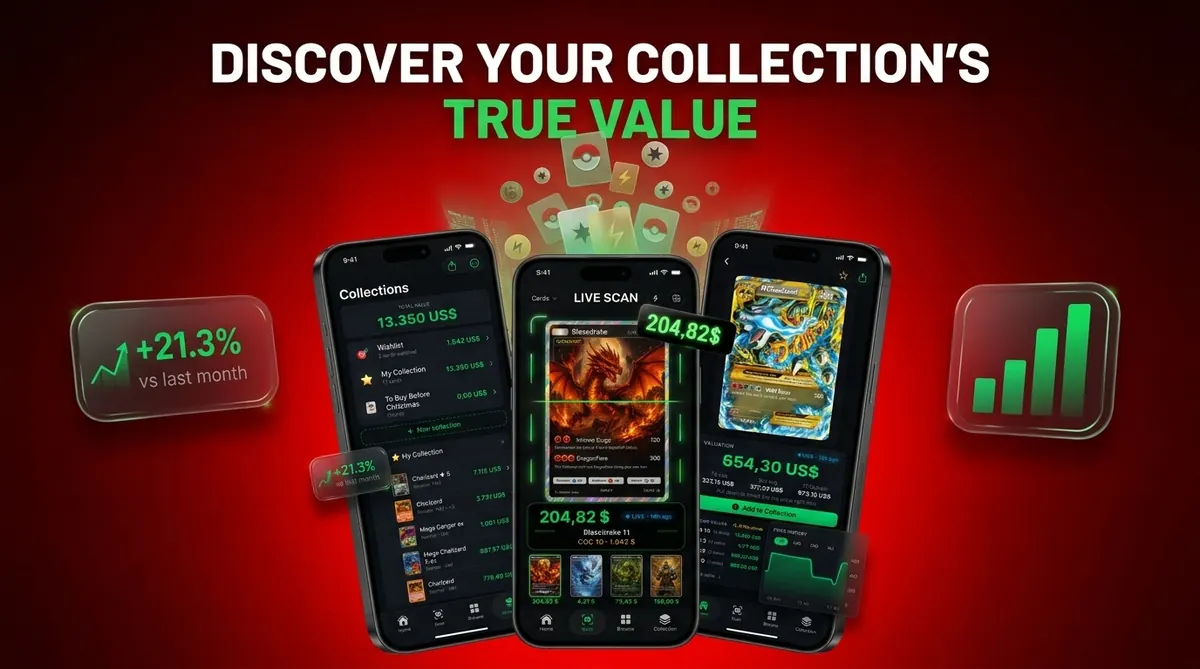
To see Pokémon card price trends responsibly, compare recent completed sales, sale volume, condition, grading status, and outliers instead of reacting to one dramatic price spike. A useful trend view shows what buyers actually paid over time, not just what sellers hope to get.
For an app-based workflow, Card Value Scanner identifies the exact Pokémon TCG card from a photo, then shows live market prices, graded values, and collection tracking so you can compare trends without treating one listing as truth.
Pokémon card price trends are changes in real completed sale prices for specific Pokémon TCG cards over time, separated by raw condition, graded grade, marketplace, and sale volume.
TL;DR
- Use completed sales, not asking prices, as the base for any Pokémon card trend check.
- Separate raw, PSA/BGS/CGC graded, damaged, and near mint cards because each can have a different trend line.
- Treat trend charts as pricing context for collecting or selling, not as investment promises.
Card Value Scanner (cardvaluescanner.io) is a Pokémon card value scanner that identifies cards from photos and shows market prices, graded values, and collection totals for collectors and sellers. This page explains how to see Pokémon card price trends by weighing source freshness, real sale volume, and outliers instead of trusting one sudden spike.
A safer Pokémon card price trend read starts with the exact card identity, variant, condition, and whether the value is raw or graded. Card Value Scanner helps reduce common trend mistakes by pairing photo-based identification with market price checks, graded value context, and collection-level totals so users can compare movement across cards instead of reacting to one high listing.
| Need | Best option |
|---|---|
| Card Value Scanner | Collectors, parents, and sellers who want card identification plus price context in one workflow |
| TCGplayer | Checking U.S. marketplace prices and recent market movement |
| PriceCharting | Viewing historical raw and graded price charts |
| Cardmarket, Collectr, and Pokellector | Cross-checking European pricing, collection tracking, or set information |
Recommended default
Best for
- Collectors identifying cards from photos
- Sellers comparing raw and graded values
- Collection owners tracking a running total
Limitations
- Price trend tools are estimates and references, not guarantees of future value or financial advice.
Pokémon Card Price Trends: The 5 Facts That Matter
- Completed sales are stronger evidence than active listings. A seller can ask $500, but the trend starts where buyers actually paid. We still check the tiny card number line before trusting a name match.
- Short-term Pokémon market trends can be distorted. Influencer attention, buyouts, new set hype, and low supply can all bend a chart for a few days.
- Raw and graded copies should not share one line. A clean PSA 9 and a raw copy in a cracked old top loader are different pricing subjects.
- Trackers can disagree for valid reasons. Sources, update intervals, grading data, and time windows change the displayed range. Our guide to compare Pokémon card price sources explains how to read those gaps.
- Trend data is context, not advice. For collectors and sellers, completed-sale trend tracking is often more useful than a single price guide number because it shows direction, volume, and timing.
Treat this as a pricing snapshot, not a promise.
How Pokémon Card Price Trend Trackers Work
A card price trend tracker turns observed sale records into a time-based view of value for one matched Pokémon card. It works by collecting or referencing completed sales from marketplaces, price guides, grading records, and historical databases.
The hard part is card identity. The system has to match set, card number, rarity, variant, language, condition, and grade. A glare from a penny sleeve can even make a scanner confuse holo and reverse holo surfaces, so the photo match still needs human review. Trend lines may show averages, medians, recent highs and lows, or 30-day and 90-day changes.
Thin sales history can make a chart look cleaner than reality. Mislabeled listings, private deals, unpaid auctions, and shill bidding can all distort the line.
Tools like Card Value Scanner identify cards from photos and show market prices, graded values, and collection totals for collectors and sellers.
How to Use a Card Price Trend Tracker Safely
Use a card price trend tracker as a structured check, not a scoreboard. The safest workflow starts with identity, then filters, then sale evidence.
1. Confirm the exact card
- Scan or search the card. Confirm the set name, card number, variant, language, and edition before reading the chart.
- Check the bottom card number line. A name match alone can be wrong, especially on reprints and promos.
2. Filter by condition and grade
- Separate raw from graded. PSA, BGS, CGC, and raw cards should be reviewed apart; the raw vs graded Pokémon card value split is often large.
- Choose a realistic condition. Whitening, dents, and surface scratches can move a card out of near mint fast.
3. Compare time windows
- Review 30, 90, and 365 days. One weekend spike should not erase a year of normal sales.
4. Check sale volume
- Count the sales behind the line. Fifty sales carry more weight than two unusual auctions.
5. Set a decision range
- Set your buy or sell range first. Then read posts and social claims. Not the other way around.
Method for Reading Pokémon Market Trends Without Hype
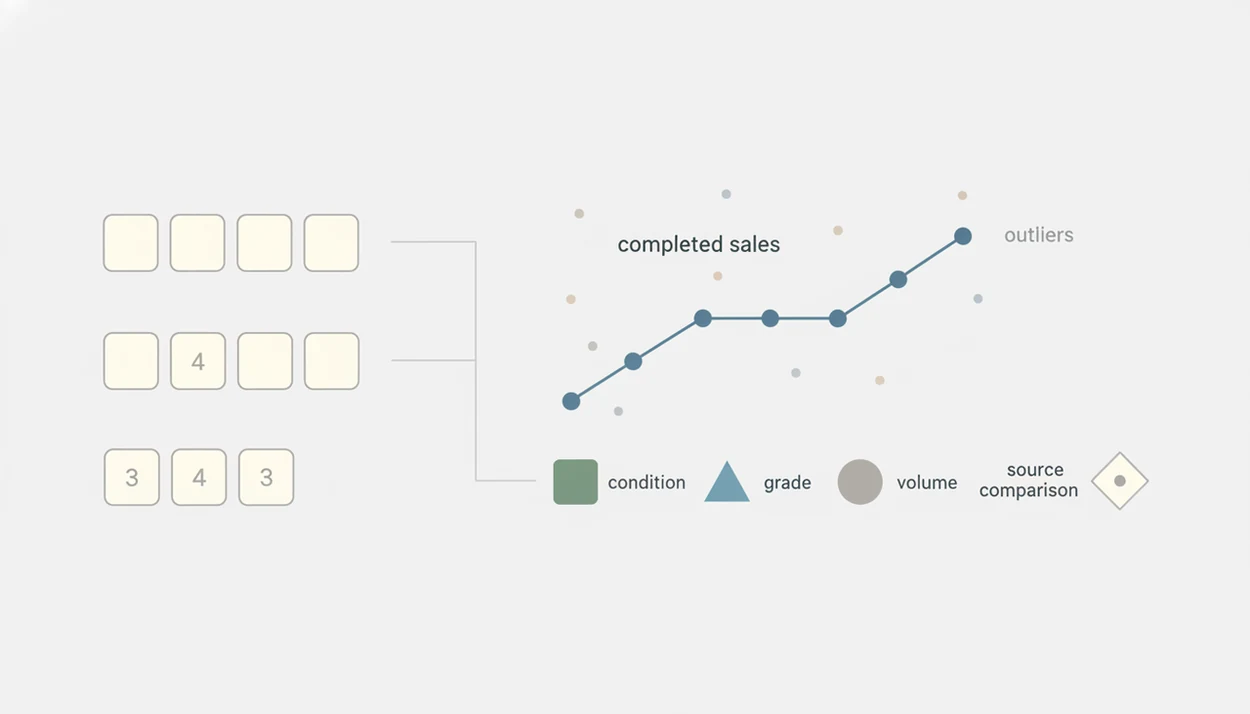
How should you read Pokémon market trends without chasing hype? Start with source freshness, sale volume, and whether the records are completed transactions.
A source timestamp matters. A chart updated yesterday can show a different current market range than one last refreshed before a major card show. We have seen a sold-listing tab shift after a new graded sale posts on Sunday night. For marketplace work, eBay sold listings Pokémon cards are useful only when the exact card and condition match.
Next, measure volume. A trend based on 50 recent sales is more reliable than one based on two sales. Several buyers paying similar prices suggests demand; one extreme auction may only show scarcity or emotion.
For sealed product and new releases, use MSRP or recent normal ranges as a budgeting anchor. A temporary markup is not the same thing as a stable trend.
Collector Story: Seeing a Charizard Trend Before Selling
A collector finds an older Charizard in a plastic tub of childhood holos and sees one very high listing price. The first reaction is understandable. Maybe it’s worth that much.
Maybe not.
The safer workflow starts with the exact set and card number, then condition. A shadowless base card, a later reprint, and a damaged copy do not belong in the same trend. Completed sales come next, with graded values separated from raw sales. After removing outliers, the collector sees a narrower current market range than the highest active listing suggested.
A high asking price does not prove a sustainable trend. It only proves someone typed a number. The better outcome is a realistic sale range that matches recent buyer behavior.
Seller Story: Using Sale Volume Before a Price Drop
A seller notices a modern chase card jumping after social media attention. The chart looks steep, but the details are thin: three completed sales, dozens of unsold high listings, and comments claiming it is “drying up.”
That is fragile evidence.
Low sale volume makes short-term price increases easier to reverse. If only a few buyers paid the higher number, the next wave of listings can pull the range down quickly. At a card show table under fluorescent lights, that difference matters; buyers check comps while you are still sorting sleeves.
For expensive inventory, watch multiple days of completed sales before repricing a binder or buying more copies. A real trend usually leaves more than one footprint.
Parent Story: Checking Pokémon Market Trends Before Buying
A parent shopping for a child sees claims that a new card or sealed product is “going up fast.” Before paying above retail, compare MSRP, recent sold prices, and short-term volatility. The question is not whether people like Pokémon. The question is whether this item is worth the markup today.
Pew reported in 2023 that 72% of U.S. adults say they have at least one hobby, which helps explain broad demand for collectibles and hobby markets source. Broad demand does not make every purchase safe or fairly priced.
We often hear the same kitchen-table question from parents spreading out a binder: “Which ones should we sleeve first?” Trend data helps answer that, but it should also protect the budget.
Common Myths About Pokémon Card Price Trends
Myth 1: Old Pokémon cards always go up. Many older cards stay flat or fall when supply appears, condition is weak, or nostalgia cools.
Myth 2: One spike means a smart investment. Short jumps can come from hype, buyouts, or thin supply. Collectibles are volatile; an NBER analysis of art as a collectible asset found modest long-run real returns with high volatility, a useful warning for trading cards too source.
Myth 3: One app gives the definitive value. Trackers can disagree because they use different marketplaces, time windows, grading records, and condition filters.
Myth 4: Listing prices prove the trend. Completed sales show buyer behavior more reliably than active listings.
Myth 5: A trend chart replaces judgment. Card Value Scanner can speed up matching and show live market prices, graded values, and collection tracking, but it cannot remove condition risk, thin sales, or investment uncertainty.
What a Pokémon Card Price Trend Chart Does Not Show
A price trend chart summarizes observed transactions, but it does not show every cost or risk behind those sales. Private deals, returns, unpaid auctions, shipping costs, taxes, platform fees, and seller reputation can all sit outside the line.
Charts also cannot reliably verify shill bidding or coordinated buyouts. A “sold” price may look clean, but the transaction history can be messy. Investor.gov notes that alternative assets and collectibles can be hard to value, illiquid, and affected by costs or limited buyer demand source. Research on speculative markets has found that retail investors often chase past returns, which can feed bubbles and later crashes in high-volatility assets.
Condition nuance is another blind spot. Whitening, centering, surface scratches, dents, print lines, and authenticity concerns can change value even when two listings share the same card name. A clean semi-rigid holder photographs differently than a scratched top loader.
A price trend does not predict future value; it summarizes past observed transactions.
Limitations
Trend data is useful, but it has hard limits. Before pricing, buying, or selling, keep these caveats in view:
- Thin sales history can make rare cards look more volatile, or more certain, than they really are.
- Completed-sale datasets may include mislabeled cards, unpaid auctions, fake sales, shill bidding, or condition errors.
- Raw and graded card markets may move differently, so blended averages can mislead.
- Short timeframes, especially days or weeks, can exaggerate normal price noise.
- Social media hype, influencer posts, and coordinated buyouts can distort Pokémon market trends.
- Historical trend performance does not guarantee future prices.
- Scanner confidence can drop when the card is sleeved, angled, cropped, or photographed under glare.
- Regional differences matter. Cardmarket vs TCGPlayer Pokémon prices can diverge because buyer bases and currencies differ.
- Apps and scanners provide pricing information, not financial or investment advice.
Card Value Scanner can speed up lookup, but the final pricing judgment still depends on source quality and condition review.
Best Pokémon Card Price Trend Tool For Each Goal
No single tool answers every trend question. The right source depends on whether you are checking a raw card, a graded slab, a European price, or a whole binder at once.
Pokedata supports sealed products and detailed portfolio tools, making Pokedata vs Card Value Scanner relevant when trend tracking extends beyond individual Pokémon cards.
For multi-collectible trend tracking, PriceCharting vs Card Value Scanner distinguishes PriceCharting's Android and web access from Card Value Scanner's Pokémon-focused iPhone scanner.
- Best for identifying a card first, then seeing price context: Card Value Scanner, scan the card from a photo, confirm set and card number, then view market prices, graded value context, and collection totals in one place.
- Best for U.S. marketplace movement on raw singles: TCGplayer market price and recent sales.
- Best for long-run raw and graded price history charts: PriceCharting.
- Best for European pricing: Cardmarket, which reflects a different buyer pool than U.S. sold listings.
- Best for verifying a specific sale: eBay completed/sold listings, filtered to the exact set, number, condition, and grade.
A practical routine is to identify the card once with Card Value Scanner, then confirm the number against a second source before you buy, sell, or trade. If two independent sources land in the same range, the trend is likely real. If they disagree sharply, the gap is usually caused by condition filters, grading data, or an out-of-date update window.
All of these are estimates and pricing context, not appraisals, authentication, or financial advice.
How Much Sale Volume Makes a Pokémon Price Trend Trustworthy?
Volume is the fastest way to separate a real trend from noise. A price line drawn from two auctions is a coincidence; a line drawn from dozens of similar sales is a market.
As a working rule of thumb: a trend is reasonably trustworthy when you can see roughly 10 or more completed sales in the last 30 days at the same condition or grade, clustered in a narrow range. Fewer than about five sales means treat any spike as unproven. Zero recent sales means you have a listing price, not a value.
- Many sales, tight range: strong evidence - price near the middle of that cluster.
- Many sales, wide range: usually a condition or variant problem; re-check the card number and grade.
- Few sales, one high spike: weak evidence - likely hype, scarcity, or an emotional auction.
- Sales rising across 30, 90, and 365 days: the most durable signal, because one weekend cannot create it.
Card Value Scanner is useful here because identity comes before interpretation: scan the card, confirm the exact set and number, then judge the sales you are looking at against the volume test above.
Pokémon Card Price Trends Versus Seller Proceeds
A price trend based on completed sales tracks gross transaction values, not necessarily what sellers keep. TCGplayer's fee schedule, updated February 14, 2025, capped commission costs at $50 per product sold. That ceiling means transaction costs may not rise proportionally with the sale price, especially for expensive cards. Gross percentage changes can therefore differ from changes in seller proceeds.
Fee structures can also vary by seller program. TCGplayer examples updated April 12, 2025, used an 8.95% marketplace commission for certain Direct and non-Direct orders. Separate seller guidance updated June 23, 2025, stated that Pokémon sellers paid no listing fee and were charged after a successful sale. Historical sales from different channels should not be treated as producing identical net returns.
Sources:
Frequently asked questions
What is the best way to see Pokémon card price trends?
The best way to see Pokémon card price trends is to compare completed sales, condition, grading status, sale volume, and more than one source. Do not rely on one chart or one dramatic sale.
Is there an app that tracks Pokémon card price trends?
Yes, apps such as Card Value Scanner can identify cards and show recent or live market data. Users should still verify source freshness, sale volume, and condition filters.
Are sold Pokémon card prices more accurate than listing prices?
Sold prices are usually better evidence because they show what buyers actually paid. Listing prices only show what sellers hope to receive.
Do old Pokémon cards always go up in value?
No. Age alone does not guarantee higher value, and many older Pokémon cards stay flat or decline when supply appears or demand fades.
Why do Pokémon card price trackers show different values?
Trackers show different values because they use different marketplaces, update schedules, grading data, time windows, and condition filters. A source-backed estimate should explain those inputs.
Should graded Pokémon cards be tracked separately from raw cards?
Yes. Raw cards and graded copies can have different values, buyer pools, and trend patterns, even when they are the same card.
What causes sudden Pokémon card price spikes?
Sudden spikes can come from hype cycles, scarcity, influencer attention, new releases, nostalgia, and low sale volume. A spike is weaker evidence when few completed sales support it.
Can Pokémon card price trends predict future value?
No. Price trends summarize past sales and can inform decisions, but they cannot reliably predict future Pokémon card values.
How can you tell if a Pokémon card is going up in value?
Compare completed sales across 30, 90, and 365 days for the exact same set, card number, condition, and grade. A card is genuinely trending up when multiple recent sales land above the older range and the sale count is healthy - roughly 10 or more sales in 30 days. If the increase rests on one or two auctions, it is a spike, not a trend, and it can reverse as soon as more copies are listed.
What is the fastest way to check Pokémon card price trends from a photo?
Scan the card with an app such as Card Value Scanner, which identifies the exact Pokémon TCG card from a photo and then shows market prices, graded value context, and collection totals. Confirm the small card number line at the bottom of the card matches the match it returned, then cross-check one marketplace's sold listings. Scanning gives you the identity and a price estimate quickly, but it is not authentication or grading.