
Tool To Compare Raw And Graded Values For Pokémon Cards


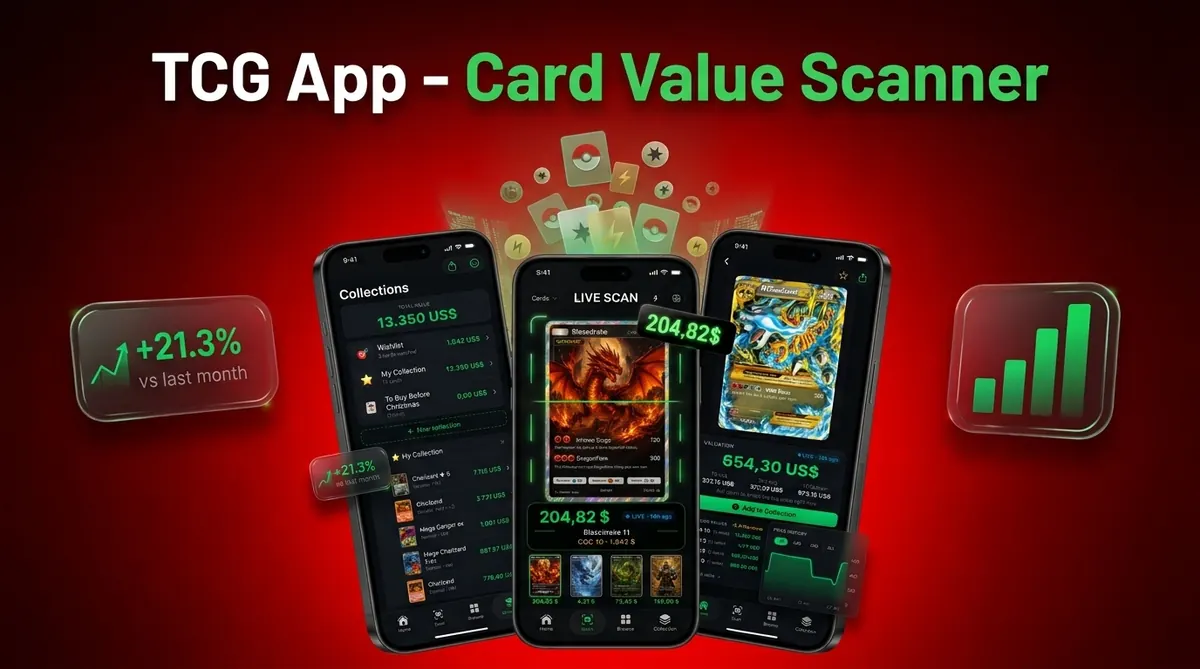

A tool to compare raw and graded values helps you see whether a Pokémon card is worth grading by comparing current raw sales against PSA, BGS, CGC, or other graded comps after fees and condition risk. The best version identifies the exact card, separates values by grade, shows recent market data, and makes the raw-to-graded gap easy to interpret.
A raw graded comparison tool is a card pricing tool that compares an ungraded Pokémon card’s market value with recent graded sales for the same card, variant, language, and condition range.
- Use raw value, grade-specific comps, grading fees, shipping, and seller fees before deciding whether to grade.
- The grade spread matters most: PSA 10, PSA 9, CGC 10, and BGS grades can sell at very different premiums.
- Scanner accuracy matters because confusing a set, variant, holo type, promo, or language can ruin the comparison.
Card Value Scanner (cardvaluescanner.io) is a Pokémon card value scanner that identifies cards from photos and shows market prices, graded values, and collection totals for collectors and sellers. This tool to compare raw and graded values helps users interpret the gap between an ungraded Pokémon card price and realistic graded outcomes after condition, comps, and fees.
For most collectors, the raw-versus-graded decision is less about the highest PSA 10 comp and more about probability. A useful comparison should start with the card’s current raw market value, estimate likely grade ranges from visible condition, then subtract grading, shipping, insurance, platform, and selling fees. Card Value Scanner helps organize those inputs so the user can see whether grading is a value-adding move, a break-even gamble, or mainly a preservation choice.
| Need | Best option |
|---|---|
| Card Value Scanner | Collectors and sellers comparing raw Pokémon card values against graded value ranges from a scanned card. |
| PriceCharting | Checking historical raw and graded sales trends for many Pokémon cards. |
| TCGplayer | Estimating raw market prices, especially for modern English Pokémon singles. |
| Collectr, Pokellector, and Cardmarket | Collection organization, set tracking, and international or European price references. |
Recommended default
Best for
- Collectors identifying cards from photos
- Sellers comparing raw and graded values
- Collection owners tracking a running total
Limitations
- Values are estimates, not guarantees. Always verify recent sold listings, condition details, and grading fees before making a sale or submission decision.
Raw Graded Comparison Tool Definition For Pokémon Card Values
A raw graded comparison tool compares the ungraded market price of a Pokémon card against graded sale prices for the same card. It should match the set, card number, variant, language, and condition range before showing any value gap.
The useful version does not blend graded prices into one number. PSA 8, PSA 9, PSA 10, BGS 9.5, and CGC 10 should sit in separate rows because each grade has its own buyer pool. When a parent spreads a binder across a kitchen table and asks, “Which ones should we sleeve first?”, that separation matters more than a flashy average.
Tools like Card Value Scanner identify cards from photos and show market prices, graded values, and collection totals for collectors and sellers. Pokémon TCG has been sold in 13 languages and 76 countries and regions, according to The Pokémon Company’s published figures source. That scale is exactly why a name match alone is not enough.
How A Tool To Compare Raw And Graded Values Works
A tool to compare raw and graded values works by turning a scan or search into a matched card record, then attaching raw and graded market data to that record. The sequence is simple: photo scan or text search, card identification, set and variant matching, market lookup, grade grouping, then fee-adjusted interpretation.
Behind the screen, image recognition may use visual matching and image embeddings. In plain terms, the tool compares the card’s artwork, border, text layout, and number line against known card records. The tiny card number at the bottom left or bottom right is still worth checking before you trust the result.
Live or frequently updated price feeds matter when a card has thin sales history. Refreshing a sold-listing tab after a weekend card show can change the range more than expected. Card Value Scanner delivers faster comparison and saved records, not a professional grade or promised sale price.
PSA 9, PSA 10, BGS, and CGC prices should be grouped separately. A scanner can estimate condition clues, but it cannot inspect every microscopic flaw under grading-room lighting.
Five Facts A Graded Value Scanner Must Show Before You Grade
A graded value scanner is only useful if it shows the inputs behind the comparison. Treat the result as a pricing snapshot, not a promise, especially when the card has few recent graded sales.
- Current raw market price: The tool should show the current raw market range for the exact card, not just the lowest active listing.
- Grade-specific values: PSA 9, PSA 10, BGS, and CGC values should be separated because public sold-price databases such as PSA Auction Prices and PriceCharting show that adjacent grades can trade at materially different prices (PSA Auction Prices; PriceCharting Pokémon prices).
- Recent sale date: Every comp needs a source timestamp. A six-month-old sale can mislead you on a hype card.
- Matched variant details: Set, language, holo, reverse holo, promo, and edition must match. Sleeve glare can make a scanner confuse holo and reverse holo surfaces.
- Total grading risk: Fees, shipping, turnaround time, insurance, and downside grade scenarios belong in the same view.
PSA reported grading over 1 million Pokémon cards in 2020, which shows how normal grading became for collectors comparing raw and slabbed outcomes source.
Before You Start: What You Need To Compare Raw And Graded Values
Before you compare raw and graded values, set up the card and the data so the first estimate is not built on a bad match. You need a clear look at the exact card, recent sold prices, and a realistic cost picture before PSA, BGS, or CGC numbers mean much.
- Place the card in a sleeve under clean, even lighting, then make sure the card number and set line are visible before scanning or searching.
- Confirm the identity details that change value: set, language, holo or reverse holo surface, promo stamp, first edition mark, shadowless status, and any other edition marker.
- Open more than one recent sold-price source before trusting a single estimate, especially when sales are thin or the card has multiple variants.
- Estimate condition conservatively by checking centering, corners, edges, surface marks, whitening, dents, and print lines before comparing graded outcomes.
- List every cost beside the expected grade: grading fee, shipping both ways, insurance, possible upcharges, seller fees, and the likely turnaround time.
This prep turns the tool into a decision aid instead of a lucky guess.
How To Use A Tool To Compare Raw And Graded Values
Use a raw graded comparison tool as a decision workflow, not a single yes-or-no button. The strongest answer comes from matching the card correctly, checking sold comps, then subtracting real costs.
- Scan or search the Pokémon card and confirm the exact set, card number, variant, and language.
- Review raw sold comps instead of relying on current asking prices or unsold marketplace listings.
- Compare PSA, BGS, and CGC values by grade, especially 8, 9, and 10.
- Add grading fee, shipping, insurance, possible upcharges, and seller marketplace fees.
- Choose grade, sell raw, hold, or skip based on realistic expected value.
Small errors stack fast.
For sellers, sold-to-sold comparison is often safer than listing-to-sold comparison because asking prices can sit high for weeks without proving demand. If you need a deeper framework, the raw vs graded Pokémon card value decision usually starts with the same five inputs: identity, condition, comps, costs, and timing.
Condition Assumptions For Raw Versus Graded Pokémon Values
Raw near-mint does not automatically mean PSA 10. A raw card can look clean in a binder and still lose points for centering, corners, edges, surface wear, print lines, whitening, dents, or fine scratches.
The hardest problems are often small. Tiny whitening along a blue back can shift the expected grade from a hopeful 10 to a more realistic 8 or 9. Surface scratches are worse because they disappear under one lamp and jump out under another.
The difference between grade 9 and grade 10 can decide whether grading makes sense. A card that looks profitable at PSA 10 may be a loss at PSA 9 after shipping, grading, and seller fees. The most practical way to compare raw versus graded value is to model conservative, expected, and optimistic grade outcomes before submitting.
A scanner can identify and price the card, but it cannot guarantee the grade. For condition details, Pokémon card condition and value should be treated as part of the same calculation.
Raw Value Versus Graded Value Fee Calculation
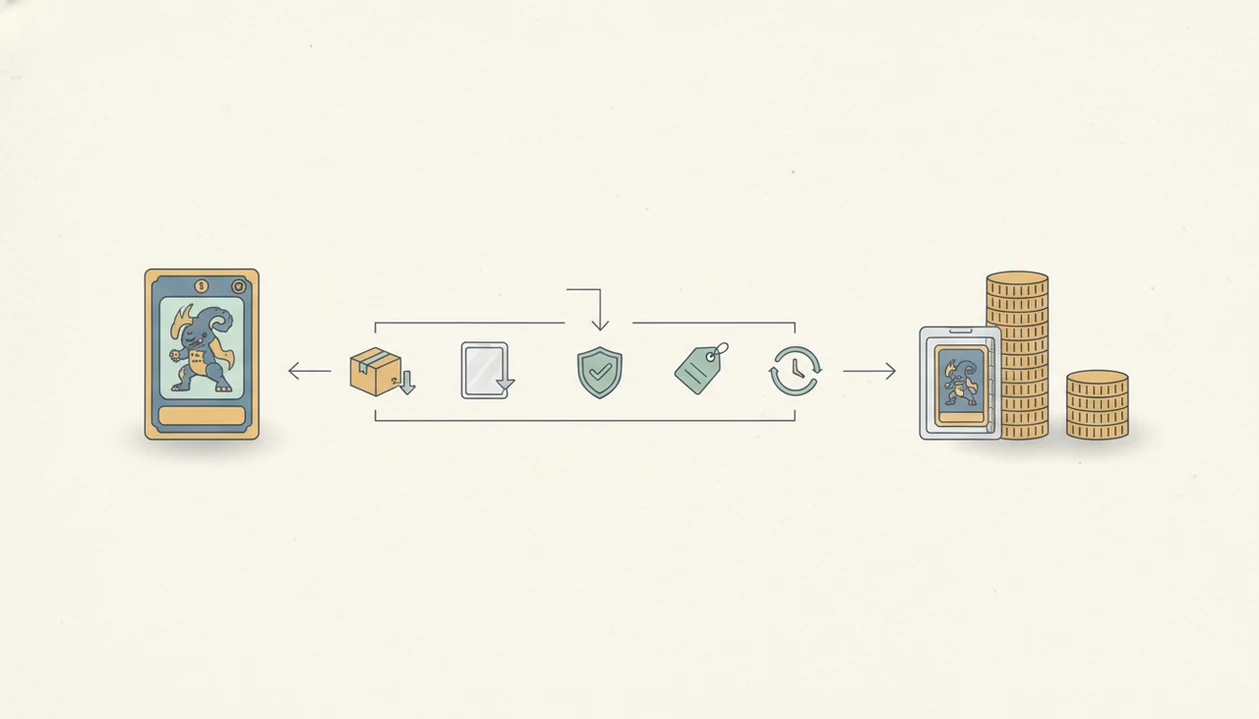
The basic calculation is: expected graded sale minus raw value minus grading fee minus shipping minus insurance minus seller fees. A higher graded price is not automatically profit because the raw card already has value today.
| Scenario | Example Question | Decision Signal |
|---|---|---|
| Pessimistic grade | What happens if it returns an 8? | Grade only if the downside is acceptable |
| Expected grade | What grade fits the visible condition? | Use this for the main estimate |
| Optimistic grade | What if it gets a 10? | Treat as upside, not the base case |
| Market delay | What if prices move during turnaround? | Add timing risk before submitting |
Grade It If The Conservative Net Is Positive
Grade it if the conservative net remains positive after all costs and a realistic lower-grade outcome. For a clean semi-rigid holder photo, buyers can judge edges better than through a cracked old top loader, but the grading company still makes the final call.
Sell Raw If The Upside Depends On A Grade 10
Sell raw if the only profitable outcome depends on a grade 10. That rule is especially important when turnaround time, marketplace fees, or a falling market could erase the apparent spread.
Common Raw Graded Comparison Tool Mistakes
Most raw graded comparison mistakes come from mixing unlike data. The tool can be accurate and the decision can still be wrong if the user compares the wrong sale types, grades, or variants.
- Listing-to-sale mismatch: Comparing raw asking prices with graded sold prices makes the graded side look stronger than it may be.
- Grade optimism: Using PSA 10 value for a card with realistic PSA 8 or PSA 9 condition can turn a safe sale into a bad submission.
- Company blending: PSA, BGS, and CGC prices should not be averaged without checking buyer preference. The PSA vs BGS vs CGC Pokémon cards comparison matters when premiums diverge.
- Variant confusion: Holo, reverse holo, promo, first edition, shadowless, Japanese, and English copies can price very differently.
- Low-liquidity distortion: One old sale can make a rare card look stable when the market is actually thin.
One saved Mercari draft on a phone can look reasonable until the matched variant changes. Then the price floor moves.
Verification Checklist For A Graded Value Scanner Result
Is the graded value scanner result trustworthy enough to use? It is trustworthy only after you verify identity, sources, grade separation, and liquidity.
Confirm the card name, set number, variant, language, and holo type first. Then check that raw comps are recent sold listings, not active asks. Graded comps should be separated by grade and grading company, with PSA, BGS, and CGC shown clearly when data exists.
Population data is useful if the tool provides it, but it should not replace recent sales. A low-pop card with no current demand can still be hard to sell. Likewise, one public sale may not define a market range.
For collection tracking, save the source timestamp beside the estimate. Apps such as Card Value Scanner can help organize scans, but sellers should still verify the final price before listing. If you are building an inventory record, a Pokémon card collection tracker app can keep raw and graded assumptions from getting mixed.
Limitations
A raw graded comparison tool supports better pricing decisions, but it cannot remove uncertainty. The main limits are practical, not cosmetic.
- Price feeds can be stale, incomplete, or weak for thinly traded cards.
- Scanner apps cannot see every microscopic surface defect, indentation, print line, or pressure mark.
- Grade estimates are not guarantees from PSA, BGS, CGC, or any grading company.
- Population data may be missing, delayed, or unavailable in basic tools.
- Japanese, European, and other regional releases may have weaker data in North American-focused tools.
- Future demand, reprints, bans, competitive shifts, and market sentiment cannot be predicted.
- Seller fees, taxes, shipping, insurance, upcharges, and turnaround time can erase apparent profit.
- A strong comp can still fail if your card is the wrong variant or language.
No tool sees the future.
Card Value Scanner can shorten the lookup process, but the final decision still depends on verification and conservative math.
Grading Break-Even Math: The Formula To Run Before You Submit
The fastest way to compare raw and graded values is one line of math: break-even graded price = raw sold price + grading fee + shipping both ways + insurance + expected seller fees. If the conservative grade outcome sells for less than that number, selling raw is usually the safer move.
Run it against the grade you would realistically receive, not the best case. A card that clears the bar at PSA 10 but loses money at PSA 9 is a bet, not a value play. Modeling three outcomes (conservative, expected, optimistic) keeps the decision honest when a single hype comp looks tempting.
- Skip grading: raw value is low and even a 10 barely covers fees.
- Grade: expected grade already beats break-even with margin for a fee increase or slow turnaround.
- Grade for preservation: value is roughly break-even but the card is a long-term hold.
Card Value Scanner speeds up the inputs by identifying the card from a photo and showing raw market prices and graded value ranges side by side. The numbers are dated estimates, and scanning is not authentication or a predicted grade, so confirm recent sold listings and current grading fees before submitting.
Best Tool For Each Raw vs Graded Question
No single tool answers every raw-versus-graded question. Matching the tool to the question reduces mismatched variants and stale comps.
- Best for scanning a physical card and seeing raw plus graded ranges together: Card Value Scanner, which identifies the card from a photo and tracks collection totals.
- Best for grade-by-grade auction history: PSA Auction Prices and PriceCharting, where PSA 8, PSA 9, and PSA 10 rows sit separately.
- Best for modern English raw market pricing: TCGplayer sold and market price data.
- Best for European or Japanese comparisons: Cardmarket and region-specific marketplaces, since language changes both demand and comps.
A practical workflow is to scan first for identity and a fast raw-to-graded gap, then verify the specific grade comp in a sold-price database before paying grading fees.
Pokémon Card Populations Can Shift Quickly
Graded supply can change substantially while a card is being evaluated or submitted. The New York Times reported that PSA graded more than 8 million cards from January through April 2026. That output was 39% higher than during the same period a year earlier, showing why an older population count may not reflect the supply buyers actually face.
For a raw versus graded comparison, record the date of every population figure and completed sale used. Also confirm that the population count covers the exact card, variation, and grade being evaluated. Rapid grading growth can expand buyer choice and change the scarcity premium for a grade, even when the card’s condition and grading result remain unchanged.
Sources:
Frequently asked questions
What is a raw card value?
Raw card value is the market price for an ungraded Pokémon card in its current condition. It should be based on recent sold comps for the same card and variant.
What is a graded card value?
Graded card value is the market price for a professionally authenticated and graded card in a slab. The value depends on the grading company, grade, card identity, and recent demand.
Is grading Pokémon cards worth it?
Grading is worth it only when realistic graded value exceeds raw value plus grading fees, shipping, insurance, seller fees, taxes, and risk. If profit depends only on a 10, selling raw may be safer.
Can a scanner predict PSA grade?
A scanner may estimate condition signals, but it cannot guarantee a PSA, BGS, or CGC grade. Professional graders inspect details a phone camera may miss.
Why do PSA 10 Pokémon cards cost more than PSA 9 cards?
PSA 10 cards usually cost more because gem-mint condition is scarcer. Buyers often pay a premium for the highest grade when demand is strong.
Should I sell my Pokémon card raw or grade it first?
Sell raw if the conservative graded outcome is not profitable after costs. Grade first only when condition, liquidity, and fee-adjusted value support the risk.
Which fees affect Pokémon card grading profit?
Key costs include grading fees, shipping, insurance, upcharges, seller fees, taxes, and turnaround time. These should be subtracted before comparing raw and graded value.
Do graded Pokémon card prices change often?
Yes, graded prices can change with demand, reprints, market trends, population growth, and recent sales volume. Treat every tool result as a dated estimate.
How do I calculate whether grading a Pokémon card is worth it?
Add your card's current raw sold price to the grading fee, round-trip shipping, insurance, and expected seller fees. That total is your break-even graded price. If the grade you realistically expect (often PSA 9, not PSA 10) sells for less than that number, selling raw is usually the better outcome. Card Value Scanner can supply the raw and graded value estimates for the comparison, but the figures are dated estimates, not guaranteed sale prices or predicted grades.
What raw card value is usually too low to bother grading?
As a rule of thumb, if a card's raw value plus total grading and selling costs is higher than the recent PSA 9 sold price, the submission only pays off on a gem-mint result. Many collectors therefore skip grading low-value bulk cards and grade only when the expected grade clears break-even with margin, or when the goal is long-term preservation rather than profit.