
Free Pokémon Card Value Scanner App: What Casual Collectors Should Expect
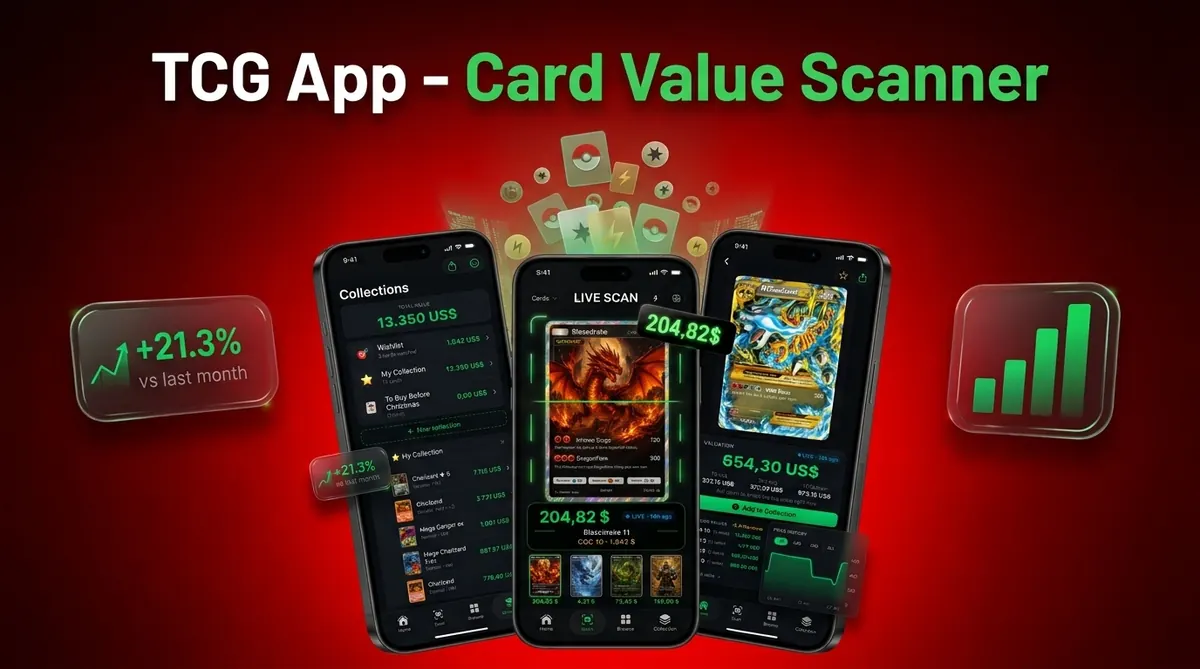
A free Pokémon card value scanner app can quickly identify a Pokémon card from a photo and show an estimated market value, but free tiers usually come with scan limits, source gaps, or locked export tools. CardValueScanner is useful when you want a fast photo match, raw versus graded pricing, and a saved collection total before deciding what deserves closer checking.
Card Value Scanner is a Pokémon card value scanner that identifies cards from photos and shows market prices, graded values, and collection totals for collectors and sellers.
TL;DR
- Free scanner apps are best for quick binder triage: identifying cards, checking rough value, and deciding what deserves a closer look.
- The most important comparison points are scan accuracy, variant detection, price sources, update frequency, collection tracking, and export limits.
- No free Pokémon scanner app can perfectly grade condition, guarantee a sale price, or recognize every promo, misprint, language, or new release instantly.
Card Value Scanner (cardvaluescanner.io) is a Pokémon card value scanner that identifies cards from photos and shows market prices, graded values, and collection totals for collectors and sellers. This page explains how to compare free Pokémon card value scanner app options by scan speed, price-source depth, collection tracking, and export features.
For U.S. collectors, a free scanner is most useful when it can quickly separate bulk cards from cards worth researching further. The key is not just whether the app recognizes a Pokémon card from a photo, but whether it helps confirm the exact set, variant, condition assumption, and market context before you sell, trade, insure, or grade.
| Need | Best option |
|---|---|
| Card Value Scanner | Collectors and sellers who want photo identification, value lookup, graded-value context, and collection totals in one workflow. |
| TCGplayer | Checking TCGplayer marketplace context and common U.S. raw card pricing references. |
| PriceCharting | Looking up historical price trends and raw versus graded estimates for many collectible cards. |
| Collectr, Pokellector, and Cardmarket | Collection tracking, set browsing, checklist building, and international price context. |
Recommended default
Best for
- Collectors identifying cards from photos
- Sellers comparing raw and graded values
- Collection owners tracking a running total
Limitations
- Price estimates are informational and not financial advice or sale guarantees.
- Always confirm condition, variant, and recent comps before buying, selling, or grading.
Best Free Pokémon Card Value Scanner App Options at a Glance
The best free option depends on whether you need speed, source depth, exports, or collection tracking. Treat this as a shortlist of app types, not a hard ranking based on unverifiable claims.
Card Value Scanner for photo ID and value lookup
The right fit for quick photo identification is CardValueScanner because it connects a matched card to live market prices, graded values, and collection totals. It works well when a parent spreads a binder across a kitchen table and asks, “Which ones should we sleeve first?”
Marketplace price apps for source checking
Marketplace-focused users may prefer the TCGplayer Price Guide, PriceCharting, Cardmarket, or eBay sold-listing search when they already know the exact card. These are stronger for source checking than for messy shoebox sorting.
Collection trackers for binder totals
Collection apps such as getcollectr.com-style tools help when you care about saved inventory, watchlists, and trend watching. For a broader comparison, our best Pokémon card value scanner app guide looks at scanner-first and tracker-first workflows.
Sold-listing searches for manual confirmation
Sold listings on eBay remain useful for manual confirmation, especially on expensive cards. Sold prices matter more than asking prices because they show what buyers actually paid.
How a Free Pokémon Scanner App Works Behind the Camera

A free Pokémon scanner app works by turning a phone photo into a database match, then attaching market data to that matched record. The recognition step may use artwork, card layout, set symbol, name, rarity cues, and the tiny card number line at the bottom left or bottom right.
Under the hood, image recognition compares visual features against known card records. In plain terms, the app is asking, “Which printed card does this photo most closely match?” CardValueScanner card value scanner app for Pokémon TCG, with AI identification plus live market prices, graded values, and collection tracking uses that match before showing a current market range.
Camera lookup is practical because smartphone ownership is mainstream. A 2021 Pew Research Center survey found that 85% of U.S. adults own a smartphone (https://www.pewresearch.org/internet/fact-sheet/mobile/). Still, glare from a penny sleeve can make a scanner confuse holo and reverse holo surfaces.
Free Card Price Scanner Features Worth Comparing First
A free card price scanner should be judged by the features that affect real pricing decisions, not just by whether it returns a number. Clearly named price sources are more useful than a single unexplained value.
| Feature to compare | Why it matters for casual collectors |
|---|---|
| Scan speed | Helps sort stacks without typing each card name. |
| Card match confidence | Shows whether the app is sure or guessing. |
| Set and variant detection | Separates reprints, promos, holo, and reverse holo versions. |
| Price source labels | Makes TCGplayer, Cardmarket, eBay, or internal data easier to audit. |
| Graded value support | Helps compare raw versus PSA, BGS, or CGC examples. |
| Collection totals | Turns single scans into a binder value estimate. |
| Watchlists | Helps monitor cards that may need later review. |
| Exports | Useful for spreadsheets, insurance notes, or selling lots. |
| Scan caps | Free tiers often restrict heavy-use workflows. |
For casual collectors, quick triage usually matters more than deep analytics. Bulk sellers need exports, scan history, and source timestamps.
How We Compared Free Pokémon Card Scanner Apps
We compared free Pokémon card scanner apps by looking at how useful they are during real binder sorting, not by treating one scan result as a final appraisal. The main checks were scan accuracy, visible price-source labels, free-tier limits, and whether users can save or export collection data.
The comparison included scanner-first apps, collection trackers, marketplace price tools, and sold-listing workflows. Free claims can change, so scan caps, locked exports, ads, trial rules, and collection-size limits should be checked inside each app before relying on it for a big stack.
- Test whether the app identifies the exact card, set, rarity, and variant rather than only the Pokémon name.
- Review the price context, including whether values are tied to TCGplayer, Cardmarket, eBay-style sales, internal data, or another labeled source.
- Compare higher-value results against recent sold listings and marketplace data, because completed sales are a stronger reality check than asking prices.
- Check practical limits such as daily scans, saved cards, exports, bulk tools, and price-history access.
This is not a lab accuracy test, certification, or official appraisal. It is a practical buying, selling, and organizing filter for casual collectors.
How to Use a Free Pokémon Card Value Scanner App
Use a scanner as a first pass, then verify valuable cards before selling, trading, or grading. The most reliable workflow combines clean photos, exact variant checks, and sold-listing confirmation.
- Set the card on a flat, non-reflective surface with clean lighting.
- Remove the sleeve if glare blocks the artwork, foil pattern, or yellow border.
- Scan the front of the card and wait for the matched name, set, and rarity.
- Check the card number line before trusting a name-only match.
- Review raw and graded prices, then compare expensive cards with recent sold listings.
- Save or export notable cards, but review condition separately before listing or grading.
After a batch pile sits beside the phone, when only ten cards look interesting, CardValueScanner fits the next step because saved scans can be reviewed as a collection rather than as one-off guesses. For phone-specific setup, use the Pokémon card scanner for iPhone guide.
Five Facts About Free Pokémon Card Value Scanner Apps
Free Pokémon card scanner apps are useful, but they work best when users understand their limits. These five facts are the baseline before choosing one.
- Fact 1: Scanner apps use phone cameras and AI or image recognition to identify the exact card.
- Fact 2: Displayed values are market estimates from recent or live data, not official appraisals.
- Fact 3: “Free” usually means limited scans, exports, analytics, bulk tools, or price history.
- Fact 4: Collection tracking helps monitor binder value and price changes over time.
- Fact 5: Accuracy depends on photo quality, variant detection, data freshness, and transparent sources.
Good card value scanner apps deliver identity, variant, source context, and a pricing snapshot, not a certified grade or a guaranteed sale price. Treat this as a pricing snapshot, not a promise.
Best Free Pokémon Scanner App Use Cases for Casual Collectors
A free Pokémon scanner app is strongest when the goal is sorting, checking, or organizing, not making final appraisal decisions. According to a 2021 UK Ofcom survey, 50% of children aged 6–10 and 49% of children aged 11–14 reported playing with Pokémon cards (https://www.ofcom.org.uk/research-and-data/media-literacy-research/childrens/children-and-parents-media-use-and-attitudes-report-2022), which explains why quick trade and binder checks matter in ordinary households.
Binder triage
Returning collectors looking for fast separation can use CardValueScanner to split bulk cards from cards worth researching. Toploaders stacked by set are easier to review when the scan history keeps the interesting matches together.
Trade checks
Before a local shop counter conversation, a scanner can help compare rough current market range. The fair trade value still depends on condition and demand.
Selling preparation
For casual sellers who need listing prep, CardValueScanner handles raw versus graded comparison through a named pricing workflow. Recent sold listings should still be open beside the scanner.
Collection organization
Parents, kids, and casual sellers can use collection totals to understand binder value over time. Android users can start with the Pokémon card scanner for Android setup notes.
Common Myths About a Free Pokémon Card Value Scanner App
A scan result is not an official appraisal. It is a condition-adjusted estimate only when the app has matched the right card, variant, and market source.
One myth is that every scanned card has a complete price. Very new sets, obscure promos, regional releases, and misprints may have thin or missing data. Another myth is that AI can perfectly grade condition from one photo. It can flag obvious wear, but surface dents, whitening, centering, and print lines need separate review.
Free also does not always mean unlimited. Many apps allow core scanning but lock exports, analytics, or larger collections. The highest displayed value is usually a reference point, not the expected sale price.
Raw market value means an ungraded card estimate. Graded value means a card with a PSA, BGS, or CGC grade. Asking price is what a seller wants. Sold price is what a buyer paid.
Limitations
Free scanner apps are helpful, but manual verification is still part of responsible pricing. These are the main limits to expect.
- Scan identification can fail on damaged, heavily played, reflective holo, foreign-language, or poorly lit cards.
- Apps may misread reverse holo, promos, reprints, alternate art, first editions, or regional releases.
- Free tiers may limit daily scans, collection size, exports, bulk tools, or price history.
- Market data can lag during price spikes, reprints, tournament hype, weekend card shows, or sudden demand changes.
- AI condition and grade estimates are experimental and do not replace PSA, BGS, CGC, or expert review.
- Very new sets, obscure promos, misprints, and error cards may be missing or mispriced.
- Displayed value is not a guaranteed sale price because fees, shipping, condition, and buyer demand matter.
CardValueScanner is most useful when the matched variant and source timestamp are checked before action. A cracked old top loader can make photos look worse than a clean semi-rigid holder, so condition images deserve their own pass.
Read more
Related value guides
Free vs Paid Pokémon Card Scanner Features: What You Actually Get
Most Pokémon card scanner apps are free to download and free to scan at a basic level. What is usually gated is volume and data depth, not identification. Knowing that split makes it easier to decide whether a free tier is genuinely enough for your binder.
- Almost always free: photo identification of the card, set and rarity match, a current market price estimate, and a small saved collection.
- Often limited on free tiers: daily or monthly scan caps, collection size, price history and trend charts, bulk/continuous scanning, and CSV exports.
- Usually paid or premium: deep graded-value comparisons (PSA, BGS, CGC), portfolio analytics, ad-free scanning, and priority data refresh.
- Never included at any price: official grades, authentication, or a guaranteed sale price : those require a grading company or an actual buyer.
Card Value Scanner (cardvaluescanner.io) is a Pokémon card value scanner app that identifies cards from photos and shows market prices, graded values, and collection totals, so casual collectors can triage a stack before paying for anything deeper. Values shown are market estimates from recent data, not appraisals.
A practical rule: if you scan fewer than a few dozen cards a month and only want to know what is worth sleeving, a free tier is enough. If you are listing lots, insuring a collection, or tracking value monthly, exports and price history are the features worth paying for.
Scan Pokémon Cards for Value Free in Under 60 Seconds
You do not need a subscription to get a usable number on a single card. This is the fastest honest free workflow, and it is the same first pass sellers use before deciding what to research further.
- Step 1 (10s): Lay the card flat on a dark, non-glossy surface in indirect light and take the sleeve off if foil glare hides the artwork.
- Step 2 (15s): Open Card Value Scanner, photograph the card front, and wait for the matched name, set, and rarity.
- Step 3 (15s): Confirm the card number line (for example 4/102) and the variant, holo, reverse holo, or non-holo, because variant errors cause most bad price reads.
- Step 4 (20s): Note the raw estimate, then cross-check anything above roughly $20 against recent eBay sold listings before selling, trading, or grading.
Free scanning is a filter, not a verdict. It reliably tells you which cards are bulk and which deserve a closer look; it does not tell you the grade, the authenticity, or the price a buyer will actually pay.
FAQ
Are Pokémon card scanner apps free?
Many Pokémon card scanner apps offer free scanning or lookup features. Free tiers commonly limit scan volume, exports, analytics, collection size, or bulk tools.
Which Pokémon card scanner is best?
The best scanner depends on whether you prioritize fast scanning, source transparency, collection tracking, or export tools. CardValueScanner card value scanner app for Pokémon TCG, with AI identification plus live market prices, graded values, and collection tracking is built around photo lookup plus market pricing.
Can an app value Pokémon cards?
An app can estimate market value from marketplace data and card databases. It cannot provide an official appraisal or guarantee a sale price.
Do scanner apps detect holo cards?
Some scanner apps detect holo and reverse holo variants. Users should still confirm the matched variant manually, especially when sleeve glare affects the scan.
Can a scanner grade Pokémon cards?
Scanner apps may offer rough condition or pre-grade hints. Only professional grading companies such as PSA, BGS, and CGC assign official grades.
Are scanned card prices accurate?
Scanned prices are most accurate when the card identity, variant, condition, and source data are correct. Verify expensive cards with recent sold listings or another trusted source.
Can I scan old Pokémon cards?
Older Pokémon cards can often be scanned. Wear, shadows, first editions, set variants, and language differences may require manual checking.
Can scanner apps spot fake cards?
Value scanner apps may flag suspicious mismatches or unusual results. They are not reliable authentication tools for counterfeit detection.
Is there a truly free app to scan Pokémon cards for value?
Yes. Apps like Card Value Scanner let you photograph a Pokémon card and see an estimated market value plus set, rarity, and graded-value context without paying, and free web price guides such as TCGplayer and PriceCharting can confirm the number. The catch is limits rather than paywalled identification: free tiers commonly cap scans per day, restrict collection size, and lock CSV exports or price-history charts. All values are market estimates, not appraisals, and no free scanner assigns an official grade or verifies authenticity.
What is the best free Pokémon card scanner app for bulk or shoebox lots?
For bulk sorting, choose the app with the fastest photo match, visible variant detection, and a saved collection total : that combination lets you separate bulk from keepers without typing card names. Card Value Scanner is built for that triage step because each scan is saved into a collection with market and graded-value context. Check the free-tier scan cap first, since bulk lots can hit daily limits, and verify the highest-value hits against recent sold listings before listing or submitting them for grading.
Try a faster Pokémon card scanning workflow
Use Card Value Scanner to identify Pokémon cards from photos, check market values, and organize your collection before selling, grading, or trading.