
English vs Japanese Promo Pokémon Cards: Language, Scan Value, and Pricing



Quick answer: English Japanese promo Pokémon cards can be worth very different amounts because language, promo release method, condition, grading population, and regional demand all affect value. The safest way to price one is to identify the exact language, promo number, stamp, release source, and recent market sales before selling or grading.
English and Japanese promo Pokémon cards are promotional Pokémon TCG cards released through events, products, magazines, campaigns, tournaments, or store giveaways rather than standard booster-pack set distribution.
- Language matters, but rarity, demand, release method, and condition usually matter more than English versus Japanese alone.
- Japanese promos can be scarcer because many come from limited campaigns, while English promos often benefit from broader global nostalgia and buyer demand.
- A promo card scanner should confirm language, promo number, set mark, stamp, artwork variant, and market comps before you rely on a value estimate.
| Need | Best option |
|---|---|
| Card Value Scanner | Scanning English and Japanese promo cards from photos and organizing values in one workflow |
| TCGplayer | U.S. English-market pricing and seller listings |
| PriceCharting | Raw and graded historical price references |
| Cardmarket, Collectr, and Pokellector | Cross-checking international demand, collection organization, and set identification |
English Japanese Promo Pokémon Cards Value Drivers
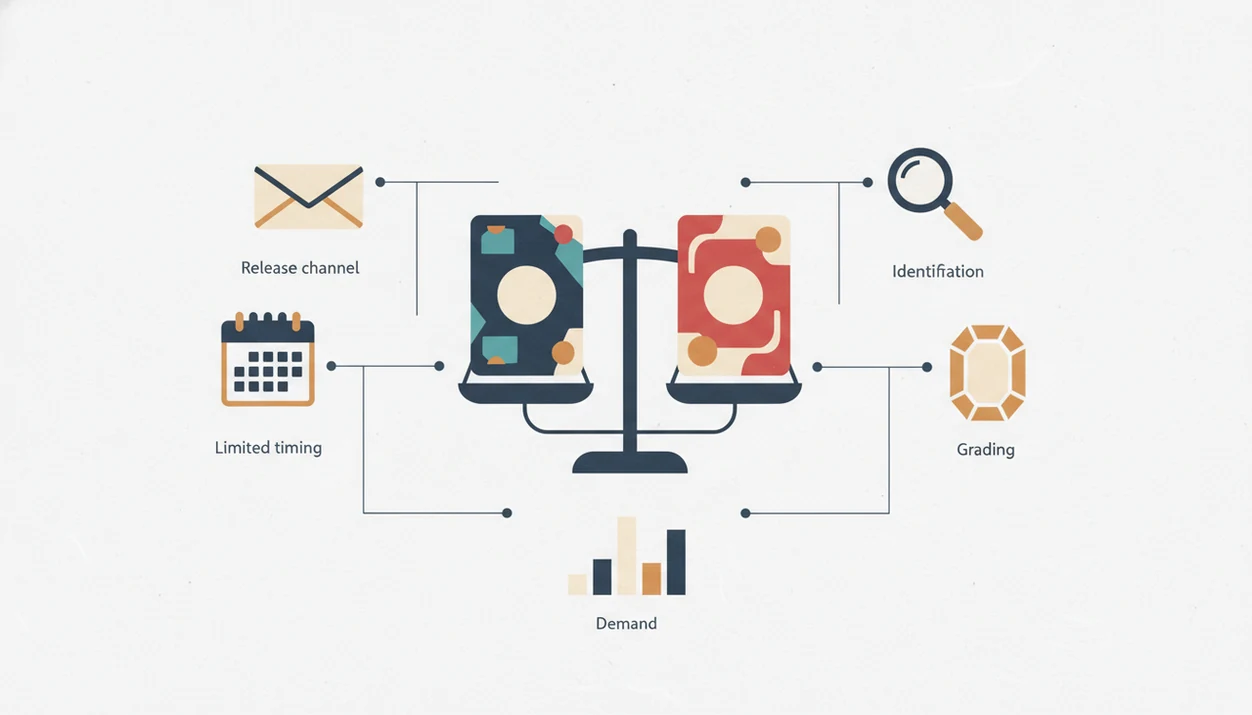
English and Japanese promo Pokémon card value is not determined by language alone. The current market range depends on rarity, exclusivity, condition, grading potential, buyer demand, character popularity, artwork, and the original release method.
A Japanese-only campaign Pikachu may outrun an English card if it had a short distribution window and strong documentation. An English promo can still sell higher in North America, Europe, or Australia when more buyers search for that version and remember the release. We see this often when sold listings sit open beside a scanner and the English raw price has more recent sales than the Japanese copy.
Promo status is only a label, not proof of scarcity. A card from a widely sold product box may remain inexpensive for years. For sellers, recent sold listings usually matter more than asking prices because they show what buyers actually paid.
How English and Japanese Promo Pokémon Card Valuation Works
English and Japanese promo Pokémon card valuation works by narrowing the card to an exact variant first, then pricing that variant against the right market evidence. Language is one signal, but the mechanism is really a mix of supply path, buyer demand, character pull, condition, and sale liquidity.
- Identify the exact variant before comparing prices: language, promo number, stamp, artwork, release source, and any regional mark.
- Separate scarcity from demand by asking whether the release was limited, whether collectors want that language, and whether the Pokémon or artwork has broad appeal.
- Compare raw sales, graded sales, and population reports as different buckets, not one blended price. A population report is the count of graded copies, not proof of raw scarcity.
- Adjust for condition and risk after the match, including whitening, dents, centering, surface scratches, authenticity concerns, and how quickly similar copies actually sell.
- Treat thin sales history as uncertainty. One high sale can suggest a range, but it should lower confidence rather than create a fixed price.
Promo Pokémon Card Release Channels And Scarcity
Promo Pokémon cards differ from normal set cards because they enter circulation through a special release channel instead of a standard booster-pack checklist. That channel is often the first clue to scarcity.
Promos can come from tournament prizes, Pokémon Center campaigns, magazine inserts, product boxes, store giveaways, movie releases, special packs, and regional events. A one-week campaign or event-only prize usually has stronger scarcity potential than a card placed into thousands of retail boxes. Still, mass-distributed promos can stay cheap even when they carry a promo mark.
The Pokémon Company reports more than 64.8 billion Pokémon cards produced worldwide as of March 2024 (https://corporate.pokemon.co.jp/en/aboutus/figures/). In a card pool that large, true scarcity has to be proven with release details, not assumed from the word "promo." The tiny card number line at the bottom left or bottom right is often where the real check begins.
English vs Japanese Promo Pokémon Cards Comparison Table
English and Japanese promo Pokémon cards should be compared by demand, supply path, condition, documentation, and liquidity. Japanese cards often show stronger factory quality, but that does not automatically create a higher raw-card value.
| Factor | English promo cards | Japanese promo cards |
|---|---|---|
| Demand | Often deeper in North America, Europe, and Australia | Strong among Japanese set specialists and global promo collectors |
| Release types | Product boxes, store promos, movie promos, event giveaways | Pokémon Center campaigns, CoroCoro inserts, tournaments, special boxes |
| Print quality | More variable centering and edge wear | Often cleaner edges, gloss, and centering |
| Grading outcomes | High grades can be harder on some eras | Clean copies may grade well, but population matters |
| Documentation | Usually easier for English-speaking sellers to research | Some obscure releases need Japanese source checking |
| Market liquidity | More buyers may search English names | Demand can be intense but narrower |
| Valuation risk | Overpricing common nostalgia cards | Misidentifying campaign, stamp, or promo number |
The Pokémon Company's corporate figures page reports the Pokémon TCG's international footprint by country and language (https://corporate.pokemon.co.jp/en/aboutus/figures/). For English-language liquidity claims, add the specific U.S. trading-card participation source URL used by the author, or remove that clause until it can be sourced.
Five Facts About Japanese Pokémon Card Values And Promos
- Rarity beats language alone. Japanese Pokémon card values usually rise when scarcity, demand, and documented release history line up.
- Limited Japanese channels matter. CoroCoro inserts, Pokémon Center campaigns, tournament promos, and special boxes can create smaller supply pools.
- English demand can win. An English promo may sell higher when nostalgia, search volume, and buyer liquidity are stronger.
- Identification prevents mispricing. Language, set mark, promo number, stamp, and artwork variant should be matched before listing or trading.
- Gem-mint grading can change the math. Professionally graded cards at the highest tiers can sell for substantial premiums over similar raw copies, especially when population counts are low.
A parent once spread a binder across a kitchen table and asked, “Which ones should we sleeve first?” The answer was not “all Japanese cards.” It was the promos with clean surfaces, clear release identity, and real sold comps.
Promo Card Scanner Identification For English And Japanese Promos
A promo card scanner identifies English and Japanese promos by comparing photo details against known card records, then mapping the result to market data. The useful signals include artwork, border style, text language, set symbol, promo number, stamp, and card layout.
Same-art promos are where mistakes happen. A scanner may recognize the illustration quickly, but the value can be wrong if it misses the Japanese promo number, an English stamp, or a release-specific mark near the artwork. Penny sleeve glare can also make a holo surface look like a reverse holo surface. Small problem. Big price swing.
Card Value Scanner is a Pokémon card value scanner that identifies cards from photos and shows live market prices, graded values, and collection totals for collectors and sellers. Tools like Card Value Scanner, tcgplayer.com, pricecharting.com, and cardmarket.com are most useful when the matched variant and source timestamp are visible. For broader photo workflows, our guide to identify Pokémon card by photo covers the matching process in more detail.
Promo Card Scanner Workflow For Card Value Estimates
To use a promo card scanner well, treat the result as a condition-adjusted estimate, not a guaranteed sale price.
Photo identification, PSA values and eBay sold listings favor Card Value Scanner in Dex vs Card Value Scanner, while Dex offers Android, browser and social tools.
- Scan the front and back in bright, even light, outside a cracked old top loader if glare hides corners.
- Confirm the language before comparing prices, especially when the same artwork exists in English and Japanese.
- Check the promo number and stamp against the bottom card number line and any release mark near the art.
- Compare raw and graded prices using recent sold listings, graded comps, and the matched variant.
- Review condition manually for whitening, dents, centering, scratches, and surface clouding.
- Save the card to a collection with a source timestamp, and manually verify rare Japanese campaigns or obscure promos.
For a slower manual check, Pokémon card value lookup by photo can help connect scan results to pricing sources.
Common English Japanese Promo Pokémon Card Mispricing Mistakes
Mispricing usually comes from comparing the wrong card, the wrong condition, or the wrong market. English raw sales and Japanese graded sales should not be mixed as if they were equal.
- The “Japanese is always higher” mistake. Some Japanese promos are scarce, but some English versions sell faster because nostalgia and buyer volume are stronger.
- The “promo means rare” mistake. A product-box promo can be common even when it looks special in a binder.
- The raw-versus-graded mistake. A PSA 10 Japanese sale should not set the price for a played English raw copy.
- The stamp mistake. Promo stamps, event marks, release source, and regional distribution can separate two cards with similar art.
- The search-name mistake. Pikachu, Eevee, Ancient Mew, CoroCoro, Poncho, Nagaba, Battle Festa, and Mario Pikachu are search entities, not price guarantees.
For exact set and variant checks, a tool to identify Pokémon card set and variant is often safer than name-only search.
Limitations
Promo valuation has real uncertainty, even when the scan is accurate. Treat this as a pricing snapshot, not a promise.
- Market data is fragmented across TCGplayer, eBay, auction houses, Japanese marketplaces, and private sales.
- Rare Japanese promos may have limited English documentation, especially older campaign or magazine releases.
- Modern promo prices can spike or crash quickly after a weekend card show, creator video, or new graded sale.
- Scanner estimates depend on image quality, lighting, card angle, database coverage, and variant separation.
- Condition, centering, surface flaws, dents, trimming concerns, and authenticity still require human review.
- Graded values may not apply to raw cards, even when the raw copy looks clean in photos.
- Regional demand can make one language sell faster than another, even at the same apparent rarity.
- Sold listings can be thin for obscure promos, so one unusual sale may distort the visible range.
For source methodology, Pokémon card pricing sources explains why recent sold comps, not active listings alone, should anchor a value estimate.
How to Tell a Japanese Promo From an English Promo in 30 Seconds
Before you price anything, confirm the language and the promo identity. Language is usually visible in seconds, but the promo version takes one extra look at the bottom of the card.
- Card name and attack text: Japanese cards use kana and kanji; English cards use Latin text only. Some Japanese promos still print an English Pokémon name in small type.
- Number line: English promos often read like SWSH###, SM###, XY##, or BW##. Japanese promos commonly read ###/S-P, ###/SM-P, or ###/XY-P - the "-P" suffix is the fastest Japanese promo tell.
- Stamp or campaign mark: event stamps, Pokémon Center marks, tournament prize stamps, and magazine-insert marks can create separate markets for the same artwork.
- Back of the card: older Japanese cards can differ in back design and size cues from English prints, which helps when the front is holo-glared.
Scan the card with Card Value Scanner to pull the likely match and market range from a photo, then verify the number line and stamp by eye. That two-step habit prevents the most common error on this page: pricing an English promo using Japanese comps, or the reverse.
When Japanese Promos Beat English Promos on Price (and When They Don't)
There is no blanket rule that Japanese promos are worth more. A simpler test works better: whichever version has the shorter distribution window and the deeper buyer pool tends to price higher.
- Japanese usually wins on event-only prize cards, CoroCoro and magazine inserts, short Pokémon Center campaigns, and illustration-rare promos that never received an English print.
- English usually wins on nostalgia-heavy vintage promos, cards with heavy North American and European search demand, and any version with more recent eBay sold listings to anchor a price.
- Grading tilts the math: PSA, BGS, and CGC populations differ by language, so a clean Japanese copy and a clean English copy can grade similarly and still sell far apart.
Practical approach: scan both versions in Card Value Scanner if you own them, then compare recent sold prices for each language separately - English comps on TCGplayer and eBay, Japanese comps on Cardmarket and Japanese auction results. All scanner outputs are market estimates, not appraisals, and scanning does not authenticate or grade a card.
Frequently asked questions
What makes a Pokémon card a promo instead of a regular set card?
A promo is distributed outside normal booster packs, often through events, magazines, tournaments, store campaigns, video game releases, or boxed products. Look for a promotional numbering system, special stamp, or release specific artwork. However, some promos reuse artwork from set cards, so confirm the card number and original distribution method before assigning a value.
How can I match a Japanese promo Pokémon card to its English version?
Compare the Pokémon, artwork, illustrator, attacks, collector number, and copyright year. Image searches and card databases can reveal whether the same artwork received an English release. Do not assume matching artwork means the cards are equivalent. The English version may have a different stamp, release source, rarity, border, or foil treatment, which can produce a very different market value.
Why do two promo cards with the same artwork have different prices?
Identical artwork does not guarantee identical scarcity. One version may have been handed out at a limited tournament, while another came in a widely available product. Language demand, print quantity, stamp variations, foil pattern, condition, and grading population also matter. Price each version by its exact card number and release, rather than using sales from a visually similar promo.
Which Japanese Pokémon promo release methods are usually the scarcest?
Promos tied to invitation only tournaments, regional events, short redemption campaigns, and limited lottery distributions are often harder to find than magazine inserts or product bonuses. Scarcity still must be verified because an exclusive sounding campaign may have distributed many copies. Research eligibility rules, distribution period, estimated participation, and recent sale frequency before deciding that a release method makes a card rare.
Do promo stamps make English or Japanese Pokémon cards more valuable?
A stamp can add value when it identifies a limited event, staff release, tournament placement, store campaign, or prerelease distribution. Common stamps do not automatically create a premium. Check the stamp's wording, placement, color, and authenticity against confirmed examples. Small differences may separate an ordinary promo from a scarce variant, while unofficial aftermarket stamps can reduce buyer confidence.
How should I find sold prices for an English or Japanese Pokémon promo?
Search completed sales using the Pokémon name, language, promo number, release name, and any stamp or variant. Match raw cards only with raw cards in similar condition, and graded cards with the same grading company and grade. Exclude listings with unclear photos, bundled cards, accepted offers with hidden prices, and sales that identify the wrong version.
Is it worth grading a Japanese or English promo Pokémon card?
Grading may make sense when the card is valuable, frequently counterfeited, exceptionally clean, or difficult to sell without authentication. Estimate likely grade by checking centering, corners, edges, surface scratches, dents, and print lines under strong light. Then compare grading fees and insured shipping with the price difference between raw copies and realistic grades, not only perfect grade sales.