
Scanner App Vs Professional Grading For Pokémon Cards
Upload a TCG card photo.
Identifying your card…
Unlimited scans in the pokemon card collection tracker app.
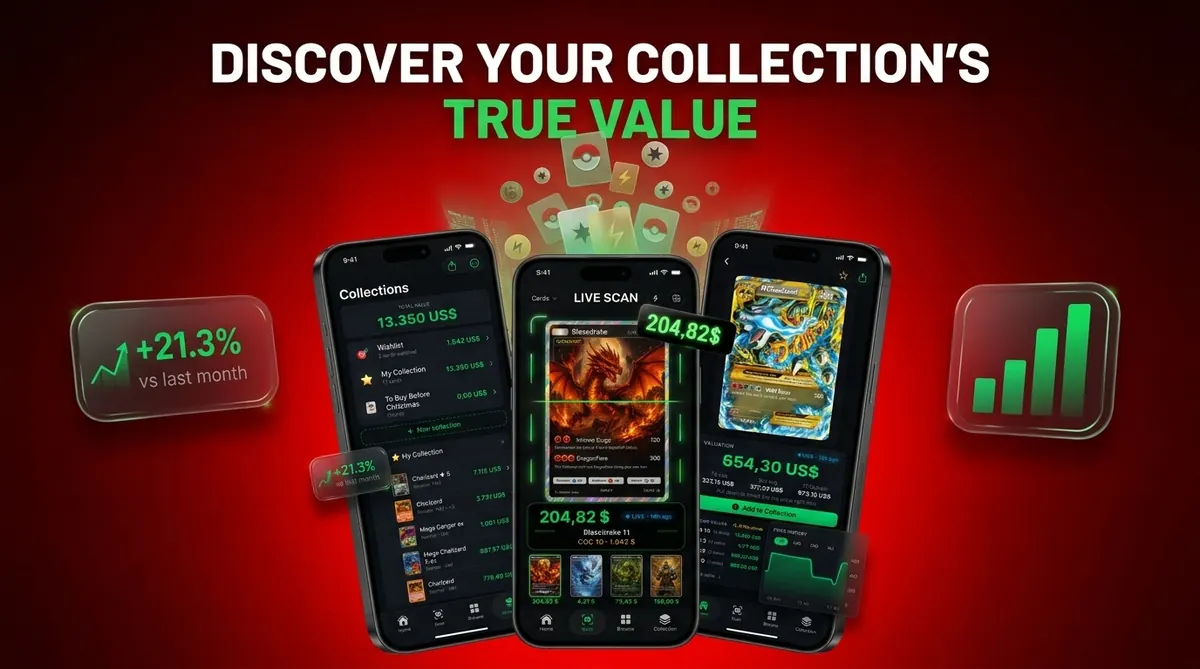
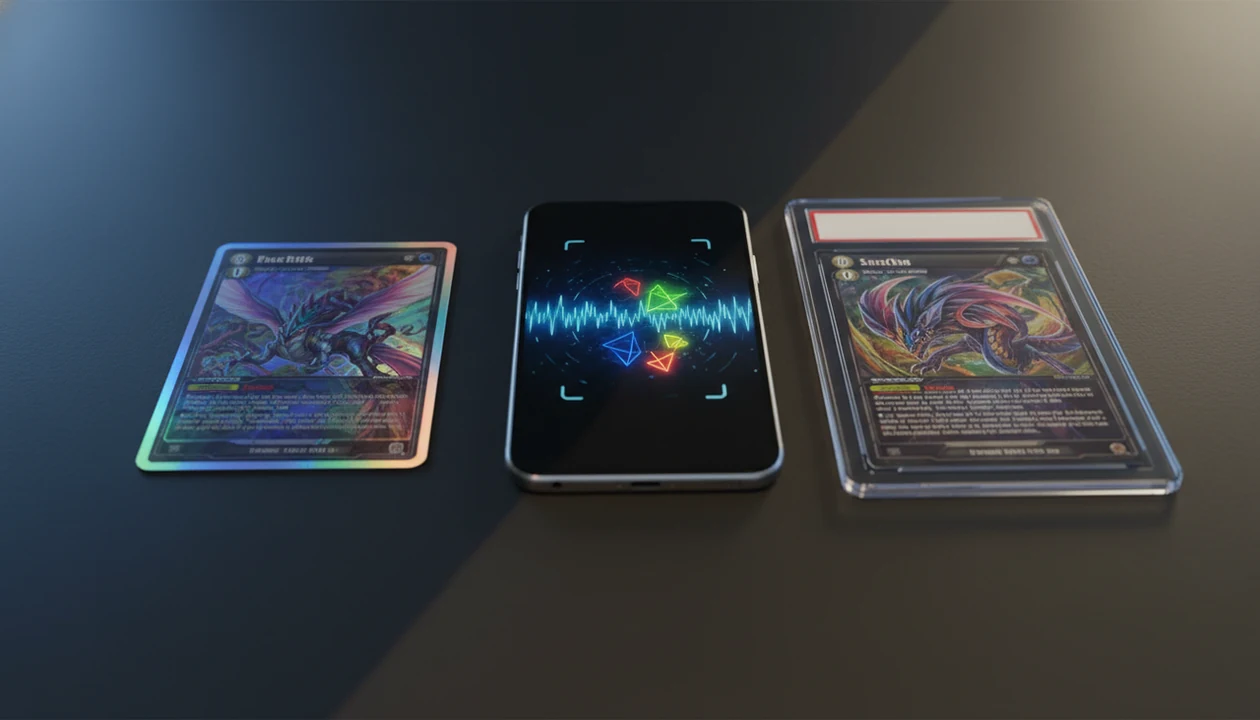
For Pokémon cards, scanner app vs professional grading comes down to speed versus certification: a scanner app is best for fast card identification, price checks, and pre-grading estimates, while PSA, BGS, CGC, and similar services provide the authenticated grade buyers trust. Use an app to decide what might be worth submitting, not to replace a professional slab when resale value depends on market-recognized grading.
This guide is educational pricing and collecting guidance, not authentication, investment, tax, or insurance advice. Use a professional grader, authenticator, or insurer when a card's value or authenticity materially affects a sale, claim, or purchase.
> Card Value Scanner is a Pokémon card value scanner that identifies cards from photos and shows market prices, graded values, and collection totals for collectors and sellers.
- Scanner apps estimate card identity, condition, raw value, and possible graded value from photos and market data.
- Professional grading physically inspects, authenticates, grades, and encapsulates the card, which is why buyers pay more attention to PSA, BGS, and CGC slabs.
- A stronger workflow is to scan first, filter by value gap and condition risk, then submit only the strongest Pokémon cards for grading. See does card scanner grading work for what apps can and cannot estimate.
Card Value Scanner (cardvaluescanner.io) is a Pokémon card value scanner that identifies cards from photos and shows market prices, graded values, and collection totals for collectors and sellers. This scanner app vs professional grading guide explains when a photo-based estimate is enough and when PSA, BGS, or CGC certification is worth considering.
For most collectors, a scanner app is best used before professional grading, not as a replacement for it. Card Value Scanner helps identify the card, check raw and graded market references, organize a collection, and flag cards that may deserve closer inspection. Professional grading adds authentication, encapsulation, and a trusted third-party grade, but it also adds fees, shipping time, and the risk that the final grade may not justify the cost.
Recommended starting point
Best for
- Collectors identifying cards from photos
- Sellers comparing raw and graded values
- Collection owners tracking a running total
Limitations
- Price estimates are informational and not financial advice or sale guarantees.
- Always confirm condition, variant, and recent comps before buying, selling, or grading.
7-Point Scanner App Vs Professional Grading Comparison
A scanner app wins for fast triage, while professional grading wins for certified resale. Scanner app grades are estimates, not official PSA, BGS, or CGC grades.
| Comparison point | Scanner app | Professional grading |
|---|---|---|
| Speed | Seconds to minutes | Weeks or longer |
| Cost | Usually free or low subscription cost | Submission fees, shipping, insurance, and supplies |
| Authentication | Can flag suspicious details | Physical authentication by the grading company |
| Condition review | Photo-based estimate | In-hand review of centering, corners, edges, and surface |
| Resale trust | Useful for pricing discussion | Stronger buyer trust through a slab and certification number |
| Flaws detected | Obvious wear, centering issues, some surface clues | Smaller dents, whitening, print lines, gloss problems, and alterations |
| Best use case | Sorting, lookup, and grading shortlist | Premium resale, registry collecting, and long-term certified storage |
For a parent staring at binder tabs labeled by era, the app answers, “What is this?” Professional grading answers, “What will the market recognize?”
Photo Scanner Apps And PSA-Style Card Grading Workflow
A photo scanner app estimates identity and value from images, while professional grading assigns a certified grade after physical inspection. The difference is not just software versus people; it is estimate versus authenticated object.
A scanner workflow starts with a camera image, then uses computer vision and image matching to identify the Pokémon, set, card number, and variant. The app may read condition signals such as centering, whitening, corner wear, and surface marks. It then checks price feeds for recent raw and graded values. Computer vision can help detect repeatable patterns, but glare from a penny sleeve can still make a holo look like reverse holo.
Professional grading follows a different chain: submission, authentication, human inspection, label creation, and encapsulation. Graders review centering, corners, edges, and surface under controlled standards. The tiny card number line at the bottom left or bottom right still matters before any workflow starts. For deeper testing notes, our Pokémon card scanner accuracy methodology explains how photo conditions affect scanner confidence.
Where A Pokémon Card Scanner App Wins
Scanner apps are strongest when the job is speed, sorting, and pricing context. They are not trying to create a certified grade; they help you decide what deserves closer inspection.
- Bulk collection triage: A scanner can move through binders, lots, trade stacks, and inherited collections faster than manual searching.
- Fast card identity: It can identify the name, set, matched variant, language clues, and likely current market range.
- Raw versus graded pricing: Live comps help compare raw value with possible PSA, BGS, or CGC outcomes before spending money.
- Collection tracking: Saved scans can build a total portfolio value, which is useful before a show, sale, or insurance conversation.
- Pre-grading shortlist: Tools like CardValueScanner combine AI identification, live market prices, graded values, and collection totals for collectors who need a first pass.
The buylist sheet on the store counter gets messy quickly. Fast lookup keeps the conversation grounded.
Where PSA, BGS, And CGC Grading Beats A Scanner App
Does a scanner app provide the same trust as PSA, BGS, or CGC grading? No. Professional graders inspect the physical card under controlled standards, while a scanner app works from the photos you provide.
Professional grading adds authentication, tamper-evident encapsulation, a certification number, and a market-recognized grade. That matters when a buyer is comparing two copies of the same Charizard, one raw with screenshots and one sealed in a slab. A scanner screenshot can support a pricing conversation, but it is not the item being sold.
Third-party grading reduces resale uncertainty because buyers can check the grading company's standards and certification record. PSA publishes its grading standards at https://www.psacard.com/resources/gradingstandards and certificate lookup at https://www.psacard.com/cert; GemRate estimated PSA graded 7.4 million trading cards in 2023 at https://www.gemrate.com/news/2023-year-in-review. The market has built habits around certified labels, not just estimated condition notes. For resale trust, professional grading usually beats a scanner app because the buyer can verify the slab, company, grade, and certification record.
Scanner Versus PSA For Pokémon Card Resale Value
The scanner versus PSA resale question is really about what buyers are paying for. Buyers pay more for PSA grade certainty, population data, authentication, and slab protection, not just a high-looking condition estimate.
| Value factor | App estimate | PSA resale value |
|---|---|---|
| Raw value | Shows recent raw comps | Not the main selling basis once graded |
| Estimated PSA 9 value | Useful for downside planning | Real only if PSA assigns that grade |
| Estimated PSA 10 value | Best-case scenario, not a promise | Often drives premium pricing |
| Grading fee | Must be subtracted manually | Already spent before resale |
| Shipping and insurance | Often overlooked | Part of true cost basis |
| Marketplace fees | Reduce net proceeds | Reduce final profit after sale |
| Risk | Photo estimate may be too optimistic | PSA may return a lower grade |
PSA has noted that Gem Mint 10 share changed as submission volume increased. In plain terms, do not build your plan around every clean modern card becoming a 10. Treat this as a pricing snapshot, not a promise.
6-Step Scanner App Workflow Before PSA, BGS, Or CGC Submission
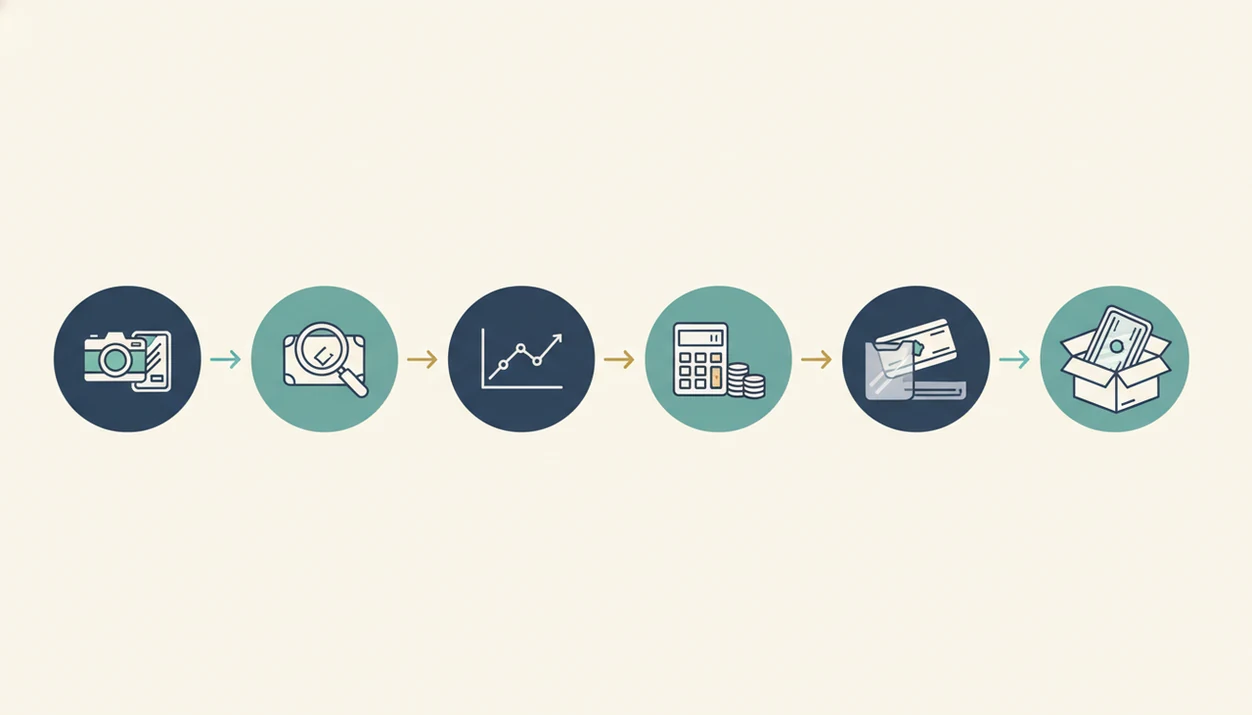
Use a scanner app as a pre-grading filter before PSA, BGS, or CGC submission. The goal is to avoid grading cards where fees and risk erase the upside.
- Scan the card outside the sleeve or top loader when safe, using a clean lens and a flat background.
- Reshoot under better lighting if glare, shadows, or a desk lamp reflected on holofoil lowers scanner confidence.
- Compare raw and graded comps across recent sold listings, not just active asking prices.
- Inspect physical flaws with your eyes, including corners, whitening, dents, print lines, and silvering along vintage borders.
- Calculate net profit after grading fees, shipping, insurance, platform fees, and the time your money is tied up.
- Submit only cards with margin under realistic grade outcomes, not only the best-case PSA 10 value.
A card value scanner app for Pokémon TCG with AI identification, live market prices, graded values, and collection tracking should speed up pre-grading decisions, not certify authenticity.
4 Myths About Grading App Condition Limits
Grading app limits matter because small physical flaws can change the result. A photo-based estimate may be useful, but it should not be treated like a slab label.
- Myth 1: “If the app says 10, PSA will definitely give 10.” A scanner grade is an estimate from images and data. PSA, BGS, or CGC may see pressure marks, edge wear, or surface defects the photo missed.
- Myth 2: “Scanner apps fully replace professional grading for selling.” Serious buyers often want authentication, certification, and tamper-evident encapsulation before paying graded-card premiums.
- Myth 3: “AI sees every flaw better than a human.” AI can help with centering and visible pattern checks, but micro-scratches, dents, gloss issues, and print lines are hard to capture.
- Myth 4: “Professional grading is always profitable if the app shows high value.” A high estimate can disappear after fees, shipping, lower grades, and marketplace costs.
Tiny surface lines are annoying. They also count.
Submit-Or-Skip Decision Rule For Pokémon Card Grading
Submit only when a realistic grade outcome leaves enough margin after grading, shipping, insurance, platform fees, and time. If the math only works at PSA 10, the card is usually a risky submission.
- Choose a scanner app for low-value cards: Use app-only tracking when the card is mainly for binder organization, quick sale pricing, or early triage.
- Choose grading for large value gaps: Professional grading makes more sense when raw value and likely graded value are meaningfully different after costs.
- Favor stronger candidates: Rare cards, vintage holos, clean modern chase cards, and premium resale cards deserve closer grading consideration.
- Avoid best-case-only logic: Estimated PSA 10 value should be one scenario, not the whole plan.
- Review selling context: A local trade, online auction, and high-end consignment may each reward grading differently.
For sellers, a scanner app is often better before grading because it filters weak candidates before submission fees are spent.
Evidence And Source Notes For Scanner Apps Versus Grading
The evidence split is simple: grading companies publish standards and certification tools, while scanner apps produce estimates from photos, testing, and market feeds. Use those sources for context, not as proof that an app has authenticated a card or predicted a guaranteed return.
- Check official grading records through PSA grading standards and cert lookup, BGS card lookup or population tools, and CGC Cards certification lookup before treating a slab as verified.
- Separate volume context from card value. Named market reports such as GemRate’s 2023 year-in-review describe large grading volumes, including millions of PSA trading-card grades, but volume does not tell you whether one raw Pokémon card should be submitted.
- Read scanner claims carefully. Accuracy claims should come from product testing when they discuss identification, photo confidence, or condition signals; price claims usually come from marketplace feeds, recent sales, or graded-value databases.
- Treat estimates as planning inputs. An app result can help shortlist cards, compare raw and graded ranges, and spot obvious downside, but it is not authentication, a professional grade, or an investment recommendation.
That distinction keeps the workflow honest: scan for triage, verify slabs through the grader, and make resale decisions with conservative math.
Limitations Of Scanner App Estimates And Professional Grading
Both scanner apps and professional grading have limits. One depends on image interpretation; the other costs money and still returns an opinion under company standards.
- Scanner apps depend on lighting, focus, angle, glare, sleeves, top loaders, and overall image quality.
- Apps may misidentify variants, reverse holos, promos, reprints, language, or small set symbols.
- AI condition estimates can miss dents, pressure marks, surface scratches, print lines, whitening, or altered cards.
- Professional grading costs money, takes time, involves shipping risk, and may return a lower grade than expected.
- Market prices can move between scan date, submission date, grading return, and resale date.
- Different grading companies may receive different buyer premiums for the same apparent condition.
- An app screenshot is not authentication, certification, or a guarantee of PSA, BGS, or CGC outcome.
A cracked old top loader can make a card look worse than it is. A clean semi-rigid holder can hide less, but it still cannot replace in-hand review. If authentication is the concern, read whether an app can app detect fake Pokémon cards before relying on a photo result.
Read more
Grading Break-Even Math: When Submission Beats Selling Raw
The simplest way to settle scanner app vs professional grading is arithmetic. A submission usually only makes sense when the realistic graded value minus all costs clears the raw value you could get today.
Break-even rule: (Likely graded value × your realistic odds of that grade) − grading fee − shipping and insurance both ways − marketplace fees − supplies > current raw sold price. If the gap is thin, sell raw.
Worked example: a raw modern holo sells for about $40. If a PSA 9 comps near $70 and a PSA 10 near $180, but you assume a conservative 9, then $70 minus roughly $25 in fees and shipping and about 12% marketplace fees leaves near $37 - below the raw price. The card only becomes interesting if a 10 is genuinely likely, and photos cannot promise that.
Card Value Scanner is useful at exactly this step: identify the card and variant, pull raw and graded market references, and see whether the value gap is big enough to justify grading risk. The scan is a pricing estimate, not a grade prediction or an authentication.
- Sell raw when: the raw-to-graded gap is under roughly 2x, or the card has visible edge wear or centering issues.
- Consider grading when: the gap is wide, the card looks clean in hand, and the profit still works at one grade below your hope.
- Always subtract: fees, two-way shipping, insurance, sleeves and top loaders, and the months your money is tied up.
Best For: Scanner App, PSA, BGS, CGC, Or Sell Raw
Different tools solve different problems. Matching your goal to the right option avoids paying grading fees for information a free scan could have given you.
- Best for fast identification, pricing, and collection totals: a Pokémon card scanner app such as Card Value Scanner, seconds per card, estimates only, no certification.
- Best for mainstream resale liquidity: PSA, the most widely recognized label for Pokémon, with public certificate lookup and population data.
- Best for subgrade detail on high-end modern cards: BGS, centering, corners, edges, and surface subgrades, with the Black Label premium chased by some buyers.
- Best for vintage detail and restoration or trimming notes: CGC, strong on detailed labeling and vintage Pokémon submissions.
- Best for cheap or lightly played cards: selling raw - grading fees often exceed the total value of the card.
A practical order of operations: scan first to learn what you own and what it is worth raw, inspect the shortlist in hand under a light, then submit only the small group where the numbers survive a conservative grade assumption. Scanning is triage; grading is certification, and only the grader can authenticate the card.
FAQ About Scanner App Vs Professional Grading
Are Pokémon card grading apps accurate?
Pokémon card grading apps can be useful for estimates, but accuracy varies by photo quality, card type, variant, and visible condition details. They should be treated as pre-grading tools, not certified grading outcomes.
Can a scanner app replace PSA grading?
No. A scanner app cannot replace PSA grading for official authentication, encapsulation, certification numbers, or market-recognized grades.
Does PSA use scanner apps to grade cards?
PSA may offer scanning or digital tools in parts of its ecosystem, but official grades come from its grading process. A public scanner estimate is not the same as a PSA-certified grade.
What does a scanner grade mean for a Pokémon card?
A scanner grade is an estimated condition score based on images, card matching, and data signals. It is not a certified PSA, BGS, or CGC grade.
Should I professionally grade my raw Pokémon cards?
Grade raw cards when realistic graded value exceeds raw value after grading fees, shipping, insurance, marketplace fees, and risk. Do not submit based only on a best-case PSA 10 estimate.
Can Pokémon card scanner apps detect fake cards?
Scanner apps may flag suspicious details, but they should not be treated as full authentication. For safety and privacy context, review Pokémon card scanner privacy before uploading collection photos.
Why did PSA grade my card lower than the app estimate?
Physical inspection can reveal flaws the app or photo missed, including dents, edge whitening, print lines, gloss changes, and surface scratches. Scanner grades are estimates, not grading guarantees.
Which Pokémon cards should I submit for professional grading?
Submit cards with strong condition, meaningful raw-to-graded value gaps, and enough margin after all costs. CardValueScanner can help shortlist candidates, but the final submit decision should use conservative grade assumptions.
What is the minimum value a Pokémon card should be worth before grading?
As a rough working rule, many collectors skip grading unless the card is worth at least $30 to $50 raw and the realistic graded value is roughly two to three times the raw price after fees. With grading, two-way shipping, insurance, and marketplace fees often totaling $25 or more per card, cheaper cards rarely clear break-even. A scanner app like Card Value Scanner can flag which cards pass that threshold, but the estimate is a pricing snapshot, not a grade guarantee.
Should I scan or grade an inherited Pokémon collection first?
Scan first. Photo-based identification and pricing lets you inventory hundreds of cards and see where the value actually sits before spending anything on submissions. From there, pull a shortlist of the highest-value, best-condition cards, inspect them in hand, and only submit the ones where graded value clearly beats raw value after all costs. Scanning is not authentication or an appraisal, so for high-value or questionable cards, use a professional grader, authenticator, or appraiser before selling or insuring.
Scan before you submit
Before paying grading fees or shipping cards, use Card Value Scanner to identify your Pokémon cards, review market prices, and build a shortlist of cards that may be worth professional grading.