
What App Finds Pokémon Card Set Number and Value?



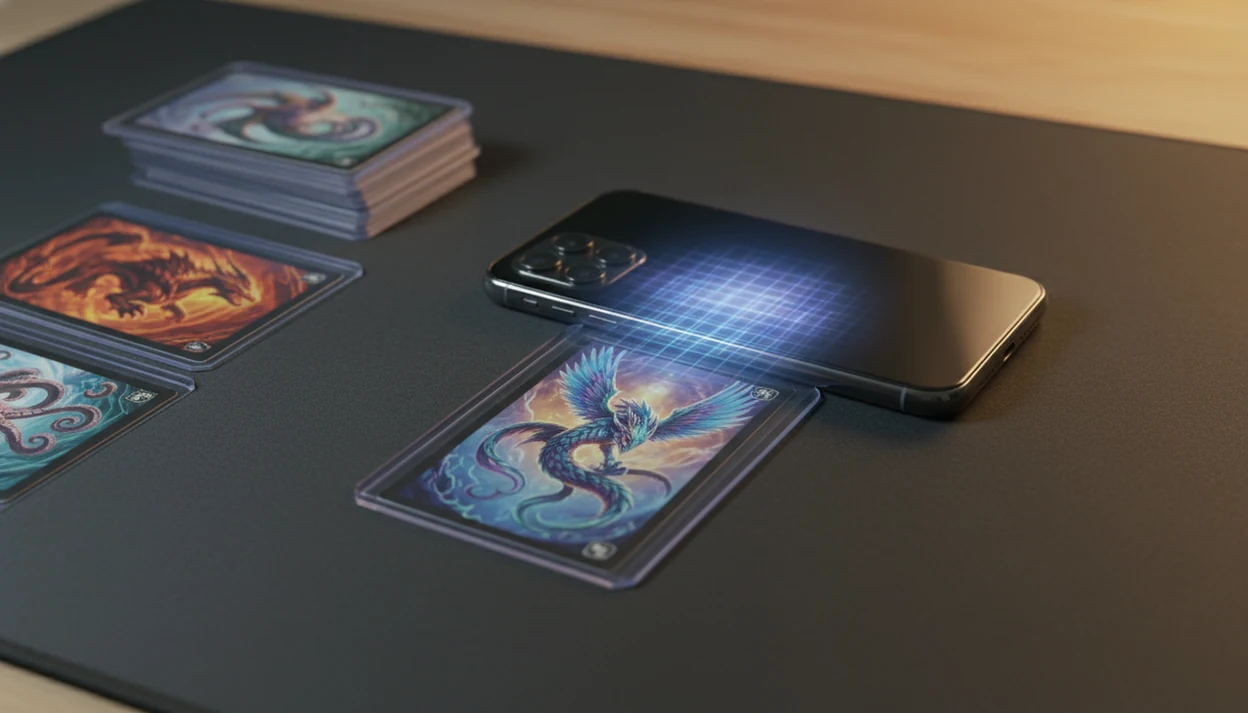
Card Value Scanner is the app to use when a search for what app finds Pokémon card set number means you want the exact set, collector number, variant, and value from a photo. The strongest scanner does more than recognize Pikachu or Charizard; it matches the card to the correct set, collector number, variant, condition context, and live market prices.
Card Value Scanner is a Pokémon card value scanner that identifies cards from photos and shows market prices, graded values, and collection totals for collectors and sellers.
- Use a scanner app that shows both the Pokémon card set name and collector number, not just the card name.
- Exact set-number matching matters because reprints, promos, variants, and similar artwork can have very different values - cross-check Pokémon card rarity symbols when the scan looks uncertain.
- Always verify scan results against the printed collector number, set symbol, condition, and market price before selling or grading.
| Need | Best option |
|---|---|
| Card Value Scanner | Photo-based Pokémon card identification with set number, variant, value, and collection tracking in one workflow. |
| TCGplayer | Checking marketplace listings and U.S. market prices after the exact card has been identified. |
| PriceCharting | Reviewing raw and graded historical price trends for known cards. |
| Collectr or Pokellector | Set browsing, checklist building, and collection organization. |
Pokémon Set Number Lookup: What the App Must Identify
A Pokémon set number lookup app should identify the set name, collector number, rarity, and variant from a clear photo of the card. The useful result is not “Charizard,” it is the exact printing that matches the card in your hand.
The collector number is usually printed near the bottom edge, often as a number like 4/102 or 199/165. The set name and symbol tell you which release that number belongs to. Valuation depends on that exact match, not only the character or artwork.
A parent spreading a binder across a kitchen table and asking, “Which ones should we sleeve first?” is really asking for a collector number scanner, even if they do not use that phrase. Set-number lookup is usually value lookup in disguise.
Five Facts About Collector Number Scanner Accuracy
- The set number is usually printed on the card face, but damaged corners, worn ink, and old binder haze can make it hard to read.
- The same card name or artwork can appear in multiple sets with different collector numbers and current market ranges.
- AI recognition plus live market pricing is often the fastest valuation workflow because it moves from identity to price in one pass.
- Collection tracking helps users save scans, organize duplicates, and monitor value changes after new sales appear.
- No app is exact every time because glare, sleeves, blur, and poor lighting can cause wrong matches.
Penny sleeve glare is a real problem. We have seen a scanner confuse holo and reverse holo surfaces when a phone camera catches the sleeve at an angle.
Before You Scan: Pokémon Card Lookup Prerequisites
Before you scan, set up the card so the app can see the same details a careful collector would check by hand. The goal is a clean image, a visible collector-number line, and a result you are ready to verify before treating any estimate as value.
- Clean the phone camera lens and use steady, even lighting from the side or above, not a harsh reflection pointed straight at the card.
- Decide whether the card can come out of its sleeve safely. If removal could nick an edge, keep it protected and adjust the angle instead.
- Keep the lower collector-number line visible, flat, and free of glare, since that small printed area often separates one set match from another.
- Compare the app’s result against the printed set symbol and collector number before accepting the set name, rarity, or variant.
- Check recent sold-price references before you treat the scan’s estimate as a real market value, especially for holos, promos, and higher-end cards.
A few extra seconds here prevents the common kitchen-table mistake: scanning quickly, saving the wrong printing, and only discovering the mismatch when it is time to sell.
Pokémon Card Set Number Scanner Technology
Pokémon card set number scanner technology works by turning a phone photo into visual features, text clues, and database matches. The app compares artwork, borders, symbols, and OCR-like number reading against set databases, promos, variants, and marketplace records.
For manual verification, compare the result against the official Pokémon card database at https://www.pokemon.com/us/pokemon-tcg/pokemon-cards/ and then check market references such as TCGplayer price guides at https://www.tcgplayer.com/categories/trading-and-collectible-card-games/pokemon/price-guides or PriceCharting Pokémon card data at https://www.pricecharting.com/category/pokemon-cards.
This is how image recognition becomes a pricing tool. Visual feature matching narrows the card identity. Number reading checks the printed collector number. Database matching connects that identity to recent sold listings and raw versus graded price records.
Controlled computer vision systems can perform well in clean test images, but accuracy drops with noisy, obstructed, or poorly lit photos. A card tilted under a desk lamp is not the same as a catalog image. For a broader identification workflow, use identify Pokémon card by photo before trusting a price.
Six-Step Collector Number Scanner Workflow for Pokémon Cards
Use this workflow when you want a set-number result you can actually verify before pricing, selling, or grading.
- Place the card on a flat, non-reflective surface with even light.
- Remove a reflective sleeve when safe, or angle the card until glare leaves the number line.
- Scan the full front of the card, keeping every border inside the frame.
- Check the returned set name, collector number, rarity, and variant.
- Compare the raw and graded value range against recent sales.
- Save the card to a collection with condition notes and duplicate count.
For collectors, this workflow is often easier than manual search because the scan starts with the printed card, not a guessed name.
Step 1: Clear Pokémon Card Face Scan
Does scan quality affect Pokémon card set number lookup? Yes. A scanner can only match what the camera can see, so the card face should be flat, centered, and evenly lit.
Place the card on a playmat or plain table, not patterned fabric. Keep the entire card inside the frame. If the sleeve is safe to remove, take it off for the scan. If not, tilt the phone slightly until the glare leaves the lower number line.
Blur, glare, low contrast, and poor lighting are known failure causes in mobile image-recognition workflows. The phone camera over a playmat works well when your thumb holds the sleeve edge outside the artwork and number area. Small detail. Big difference.
Step 2: Set Name, Collector Number, and Variant Match
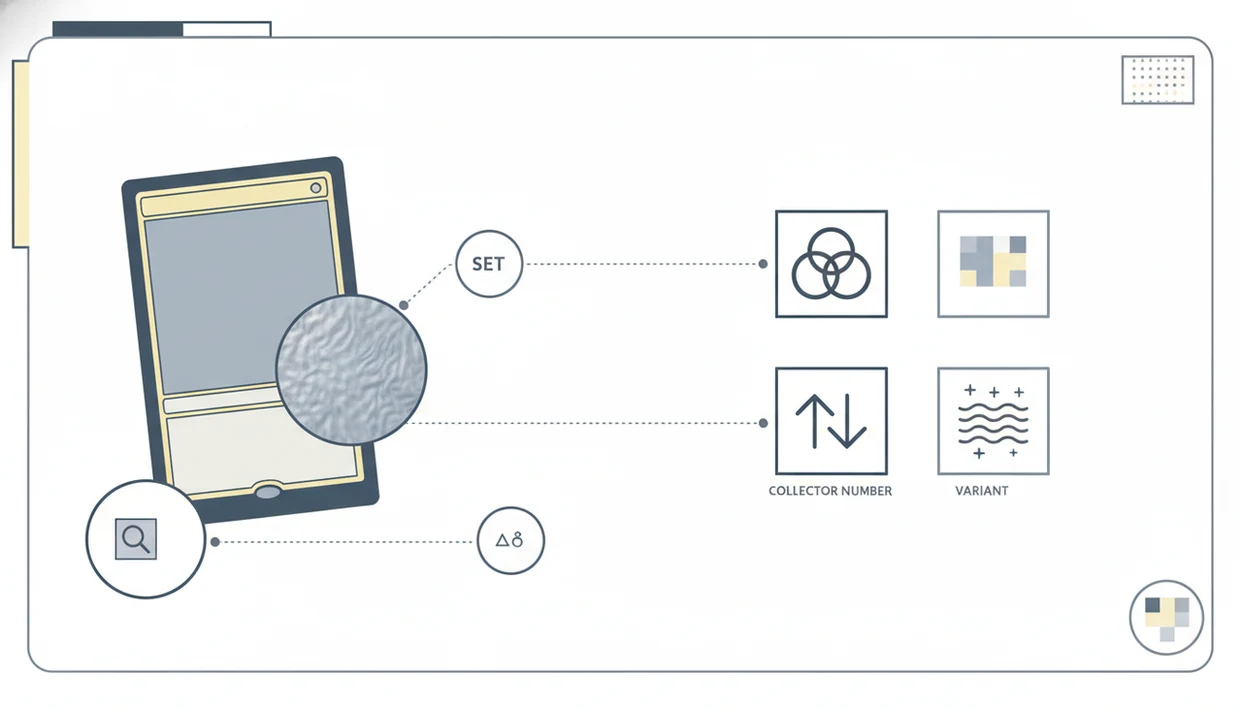
A collector number is necessary, but it is not enough by itself. You still need the set name, set symbol, language, foil treatment, edition, promo status, and special rarity details before trusting a value.
| Detail to verify | Why it matters |
|---|---|
| Set name | The same number format can appear across different sets. |
| Collector number | It confirms the printed slot within that set. |
| Variant | Holo, reverse holo, stamped, and special art versions can price differently. |
| Language | English, Japanese, and other languages often have separate markets. |
| Promo status | Promos may share names or artwork with set cards. |
Similar artwork can hide different values. For tougher matches, a tool to identify Pokémon card set and variant should show the matched variant, not just a title.
Step 3: Pokémon Card Value After Set Number Match
Live market prices are useful only after the correct set and variant are identified. A price attached to the wrong printing is not a condition-adjusted estimate; it is just a bad match with a number beside it.
Value should be read as a current market range. Raw value depends on surface wear, corners, centering, language, and buyer demand. Graded value depends on the grading company, numeric grade, and recent sold listings for the same matched variant.
Apps such as Card Value Scanner, TCGplayer, PriceCharting, and Collectr can help compare price signals, but the final listing price still needs judgment.
Step 4: Pokémon Collection Tracker for Set Number Results
A collection tracker turns one scan into an organized record. Save each card with set name, collector number, variant, condition, duplicate count, source timestamp, and estimated value.
Unlimited free card tracking is Dex's main advantage in Dex vs Card Value Scanner, while Card Value Scanner prioritizes photo identification on iPhone.
That matters once the binder gets large. Two copies of the same card may not belong in the same value row if one has whitening and the other is near mint. A cracked old top loader also photographs differently from a clean semi-rigid holder, so condition notes help later.
For sellers, saved scans become inventory. For collectors, they become a portfolio total that can be refreshed after market changes. The pricing-source side is covered in more detail in Pokémon card pricing sources.
Common Pokémon Set Number Lookup Mistakes
Avoid these common mistakes before you sell, grade, trade, or insure a Pokémon card.
- Blurry Scan as Final: A soft photo should be treated as a draft match, not a result.
- Name-Only Pricing: Do not value a card by character name alone, because reprints can differ widely.
- Collector Number Tunnel Vision: The number needs its set name, symbol, and variant context.
- Ignored Variant Details: Condition, edition, language, promo status, and foil treatment can all change value.
- App Estimate as Sale Price: Treat app values as pricing snapshots, not promises.
At a local shop counter, a fair trade conversation usually starts with the exact printing. Then condition and recent sales enter the discussion.
Limitations
Scanner apps are useful, but they still need manual verification before high-stakes decisions.
- Poor lighting, blur, glare, sleeve reflection, and low contrast can reduce scanner confidence.
- Damaged or worn cards may hide the printed collector number or set symbol.
- Some apps may not support every era, language, promo, misprint, or unusual variant.
- Live prices can lag after a weekend card show or a new graded sale posts.
- Graded-value estimates may be approximate unless grade, company, population, and recent sales are modeled.
- Manual verification is still needed before selling, grading, trading, or insuring a card.
- A raw versus graded comparison can be misleading if the card has dents, surface scratches, or trimming concerns.
Pokémon Set Number Formats Explained (25/102, 199/165, SWSH284)
Most Pokémon card set numbers are printed as a fraction near the bottom edge of the card face. The first number is the card's slot in the set; the second is the number of cards in the main set. Knowing the format tells you the rarity tier before you even look up a price.
- 25/102 - a standard card, 25th of 102 in the set (here, Base Set).
- 199/165 - the first number exceeds the set total, so this is a secret rare, usually printed beyond the main set and often the most valuable slot.
- SWSH284, SM210, XY185 - black star promos. The letters identify the promo series, not a numbered set, so there is no fraction.
- TG05/TG30, GG12/GG70 - subset cards (Trainer Gallery, Galarian Gallery) numbered separately from the main set.
- Japanese cards - often use formats like 054/070 plus a set code such as s12a; the set code, not the number alone, identifies the release.
Because the same character and artwork can appear across several of these formats, Card Value Scanner matches the printed number together with the set symbol, variant and language before returning an estimated market value.
How to Find a Pokémon Card Set Number Without an App
If you would rather check by hand, or the card is too worn to scan, you can find the set number manually in under a minute.
- Look along the bottom edge of the card face, left or right corner, for a number such as 25/102 or a promo code such as SWSH284.
- Find the small set symbol beside the number: it identifies the release the number belongs to.
- On very old cards with no symbol (Base Set) or on promos, use the copyright line and card name to narrow the release.
- Search that set name plus collector number on the official Pokémon card database, then check recent sold listings for a price range.
The manual route works, but it is slow across a binder. Scanning with Card Value Scanner is mainly a speed and consistency tool: it reads the card face, matches the set and variant, and saves the result to a collection total. Either way, verify the printed number and set symbol yourself before selling or submitting a card for grading.
How to Identify Holo, Reverse Holo, Promo, and Reprint Variants
Cards with the same name and collector number can still be different variants. Check the foil placement, stamps, copyright line, set symbol, and artwork before selecting a match or assigning a price.
- Holo rare: The illustration window has a reflective foil effect, while the area around the artwork is usually not foil. Some modern sets use different foil patterns, so compare the pattern with confirmed cards from that set.
- Reverse holo: The card area outside the illustration is foil. Depending on the era, the foil may show set symbols, energy icons, or another repeating pattern. The illustration itself is generally not holographic.
- Promo: Look for a Black Star Promo symbol, a promo code such as SWSH284, or a special event stamp. Prerelease, league, staff, and store promotion stamps can identify separate versions.
- Reprint: Compare the copyright year, set symbol, card layout, foil pattern, and printed code. A reprint may reuse the original artwork while changing one or more of these details.
Do not identify a variant from glare in a photo. Tilt the physical card under a single light source and note exactly where the reflection appears. Sleeves can also create false shine, so remove the card from its sleeve when safe.
If an app returns several matches, use Card Value Scanner or the app’s manual selection controls to compare the physical finish and stamps. Record the exact variant in your collection because holo, reverse holo, promo, and reprint prices can differ even when the collector number matches.
Frequently asked questions
What does a Pokémon card number like 25/102 mean?
The first number identifies that card within the set, while the second usually shows the number of cards in the set's main checklist. For example, 25/102 is card 25 in a 102 card set. This collector number helps narrow the match, but you may still need the set symbol, copyright year, artwork, and finish to confirm the printing.
Why is the first number on my Pokémon card higher than the set total?
A collector number above the printed set total usually indicates a secret rare. For example, 199/165 is card 199 in a set whose standard checklist ends at 165. Secret rares may include special illustration, gold, or other premium treatments. The number alone does not determine rarity or value, so confirm the rarity mark and exact finish.
What does a Pokémon promo number like SWSH284 mean?
A code such as SWSH284 identifies a card from a promotional series rather than a numbered expansion set. SWSH refers to the Sword and Shield promo era, and 284 is the card's place in that promo sequence. Promo cards can come from boxes, tins, events, or store campaigns, so the product source may help distinguish similar versions.
Is the regulation mark the same as the Pokémon card set number?
No. The regulation mark is a letter in a small box near the bottom of many modern cards, and it is mainly used to determine tournament legality. The collector number is a separate number, commonly formatted like 123/198. Two cards can share a regulation mark while belonging to different sets, so do not use that letter as the set identifier.
Why do two Pokémon cards with the same artwork have different collector numbers?
The artwork may have been reused for a promo, reprint, deck exclusive, special set, or regional release. Each printing can receive a different collector number even when the illustration looks identical. Compare the number, set symbol or code, copyright line, card language, rarity mark, and foil pattern. Those details help identify which release you actually own.
Can I scan a Pokémon card through a sleeve to find its set number?
Usually, but clear sleeves work better than textured, cloudy, or reflective ones. Glare can hide the small collector number and set details near the bottom edge. Place the card on a plain dark surface, use bright indirect light, and hold the camera parallel to the card. Remove the sleeve if the result is incomplete or the number looks distorted.
Why is a newly released Pokémon set missing from a card scanner?
Scanner databases may not include every card immediately after a set, promo, or regional product launches. Checklist changes, delayed images, and language specific releases can also cause gaps. Search the printed collector number with the Pokémon name and set code, then compare it with an official checklist. Try scanning again after the database has had time to update.