
Pokémon Card Value Scanner For Vintage Collectors
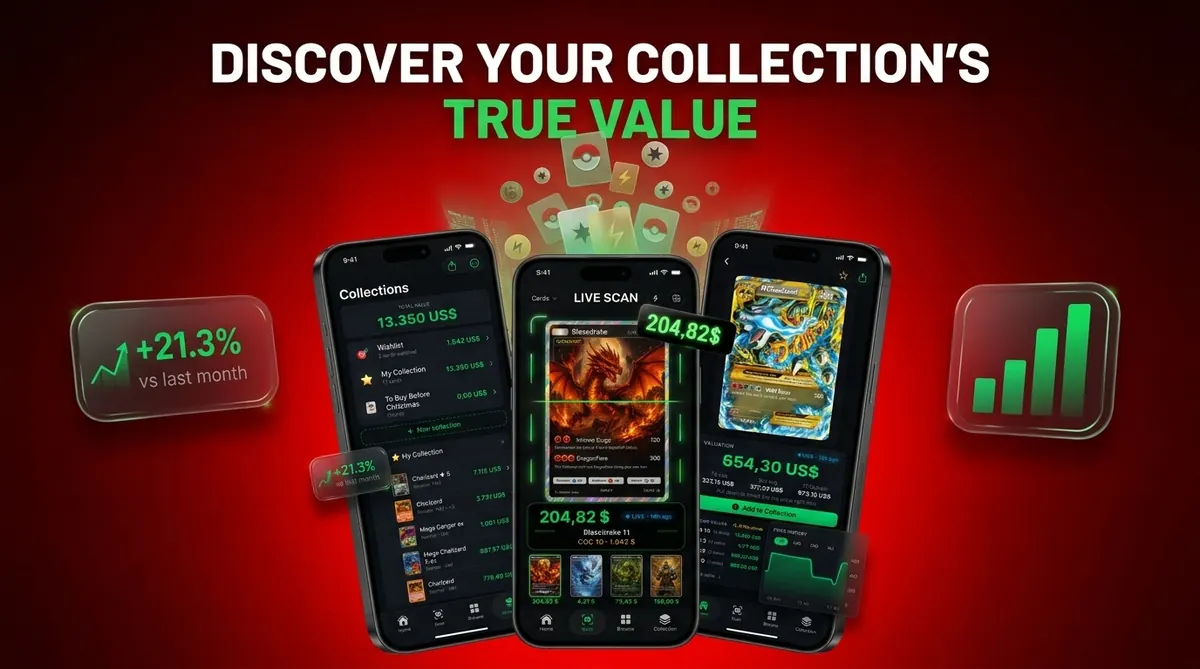
The best Pokémon card value scanner for vintage collectors is one that identifies the exact vintage printing, checks live market prices, separates raw and graded values, and lets you save a childhood binder as a tracked collection. Use it for fast triage first, then manually verify high-value Base Set, First Edition, shadowless, holo, promo, error, and foreign-language cards before selling or grading.
Card Value Scanner is a Pokémon card value scanner that identifies cards from photos and shows market prices, graded values, and collection totals for collectors and sellers.
- A vintage card scanner is best for sorting a childhood binder into bulk, possible hits, grading candidates, and cards that need manual verification.
- Condition still drives vintage Pokémon value, so scanner estimates should be treated as market ranges rather than guaranteed sale prices.
- The most useful scanner flow checks exact set, variant, language, holo status, live marketplace data, graded comps, and collection totals.
Card Value Scanner (cardvaluescanner.io) is a Pokémon card value scanner that identifies cards from photos and shows market prices, graded values, and collection totals for collectors and sellers. For vintage collectors, this page explains how a Pokémon card value scanner can help sort Base Set, First Edition, shadowless, holo, rarity, and condition signals from childhood binders.
Vintage Pokémon binders usually need a slower scan flow than modern bulk because small print details can change value dramatically. Start by photographing the card clearly, then verify the set, card number, rarity symbol, holo pattern, copyright line, language, and edition stamp before trusting any price range. For Base Set-era cards, Card Value Scanner is most useful as a first-pass identification and pricing tool, while final decisions should still include sold comps, condition review, and grading cost checks.
Recommended default for vintage binder scanning
Best for
- Collectors identifying cards from photos
- Sellers comparing raw and graded values
- Collection owners tracking a running total
Limitations
- Scanner results are estimates for research and organization, not guaranteed sale prices or professional grading opinions.
At-a-glance vintage card scanner workflow for childhood binders
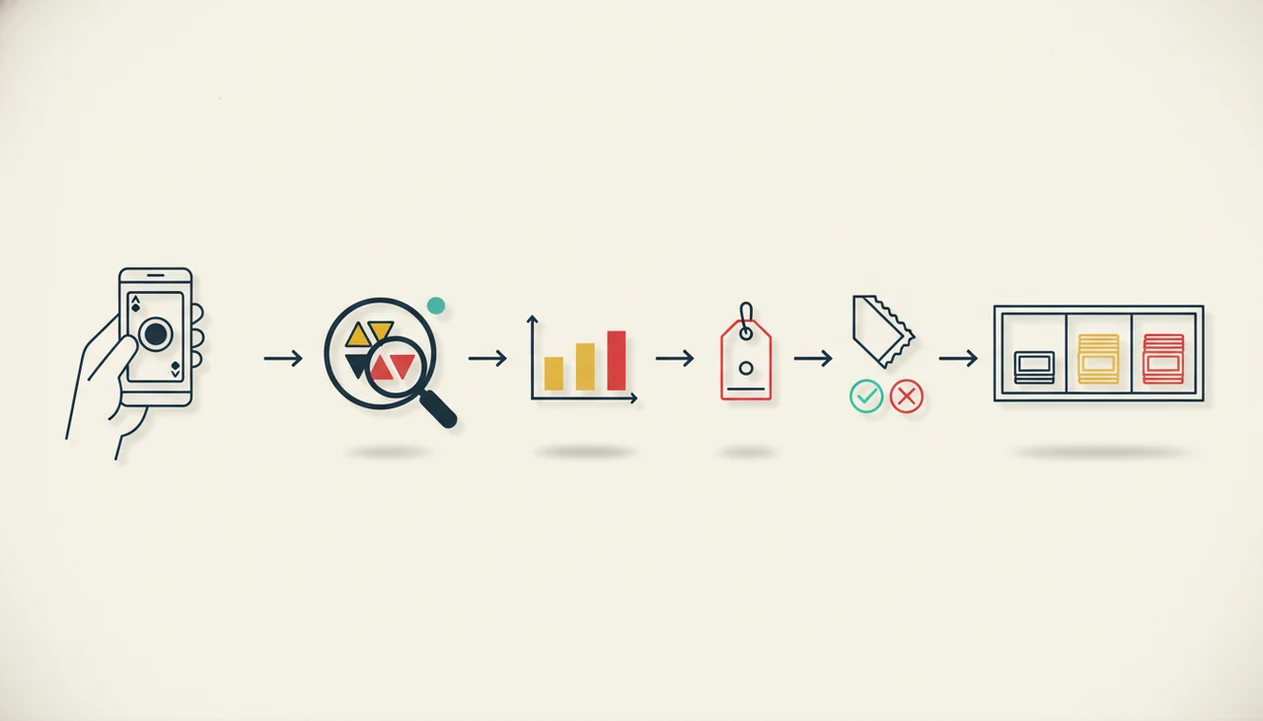
A vintage card scanner should be used as a triage tool, not a final appraisal. CardValueScanner works well for the first pass because it turns an old binder into matched cards, pricing snapshots, and review tags before you spend time on manual research.
| Step | What to do | Vintage detail to check |
|---|---|---|
| Scan | Photograph the front in steady light | Avoid penny sleeve glare |
| Identify | Confirm card name, set, and number | Base Set, Jungle, Fossil, Neo |
| Price | Review raw and graded ranges | Recent sold data matters |
| Tag | Mark priority cards | First Edition, shadowless, holo, promo |
| Verify | Inspect condition by hand | corners, whitening, dents, scratches |
| Decide | Sell, grade, insure, or keep | Treat total value as an estimate |
A parent spreading a binder across a kitchen table usually asks, “Which ones should we sleeve first?” The answer is rarely “all of them.” Start with holos, starters, promos, and clean early WotC cards.
Vintage collector demand for Pokémon card value scanners
“Why do vintage collectors use Pokémon card scanners?” Because old binders often contain hundreds of cards with similar names, tiny set symbols, and prices that changed long after the cards were put away. A scanner gives returning collectors a starting list before grading, selling, insuring, or organizing.
In a 2022 Pew survey, 26% of U.S. adults said they had collected trading cards at some point (Pew Research Center: https://www.pewresearch.org/short-reads/). The trading card game market was valued at about $6.39 billion in 2022, according to Grand View Research (https://www.grandviewresearch.com/industry-analysis/trading-card-games-market-report). That creates real demand for fast identification, not just nostalgia.
CardValueScanner fits returning collectors who need a childhood binder value workflow because it combines photo identification, current market range, and saved collection totals in one scan history.
The trade binder beside a price screen tells the story. Nobody wants to type 300 card names by hand.
5 facts about Pokémon card value scanners for vintage collectors
- Modern scanners can identify card artwork, set, rarity, language, and variant in seconds by matching a photo against a card database.
- Live price feeds are usually stronger than static price charts, but a current market range can change after new sales post.
- Raw condition assumptions are often too generous for played childhood binder cards with whitening, dents, or binder page marks.
- Scanners are best for sorting and discovery, not final sale price promises.
- Early WotC cards, errors, misprints, promos, and foreign-language cards should be manually verified before a sale or grading submission.
When a collector squints at a slab label during a trade, the same rule applies to raw cards: match the exact version first. CardValueScanner card value scanner app for pokémon tcg, with ai identification, live market prices, graded values, and collection tracking, is most useful when the scan result sends you to the right card number, set, and variant instead of only matching the name.
Top Pokémon card scanner features for vintage binder value
The right scanner for vintage binder value should compare exact printings, variant markers, live prices, graded comps, and saved collection totals. CardValueScanner is a practical fit for vintage collectors because it keeps raw versus graded views close to the matched card result.
Exact vintage printing recognition
Look for coverage of Base Set, Jungle, Fossil, Team Rocket, Gym Heroes, Gym Challenge, Neo sets, promos, and early WotC-era cards. The tiny card number line at the bottom left or bottom right should be checked before trusting any name match.
Raw and graded price views
CardValueScanner card value scanner app for pokémon tcg, with ai identification, live market prices, graded values, and collection tracking, should deliver condition-aware pricing context, not a single dramatic number. Compare TCGplayer, Cardmarket, recent sales, current listings, and PSA, BGS, or CGC examples where available.
Binder tracking and export tools
After duplicates are counted at the dining table, folders and tags matter. CardValueScanner helps collectors group bulk, holos, First Edition cards, grade candidates, and manual-verification cards, then export reports for spreadsheets or insurance notes.
Pokémon card value scanner mechanics behind photo recognition
A Pokémon card value scanner works by capturing a card photo, extracting visual features, matching those features to a card database, and attaching price data to the matched record. In plain terms, image recognition compares the artwork, layout, set symbol, text placement, and card number against known cards.
Feature matching is the important technical piece. It helps separate similar artwork across Base Set, unlimited, shadowless, promo, and later reprint versions. CardValueScanner also shows why the scanner result should be checked against the card number, especially when holo glare under kitchen light hides the surface type.
Price data usually flows from marketplace listings, recent sold comps, and graded-sale databases where available. Recent sold prices are more trustworthy than inflated asking prices because they show what a buyer actually paid. Condition recognition is the hardest part, and the Pokémon card scanner accuracy methodology explains why surface damage still needs human review.
7 steps for scanning a childhood Pokémon card binder
Use this workflow when the goal is a rough binder value, not a rushed sale price. CardValueScanner gives better results when cards are scanned consistently and tagged before you make grading or selling decisions.
- Prepare a clean surface, soft sleeves, good lighting, and enough space to avoid bending cards out of binder pages.
- Scan the fronts first, keeping each card centered inside the scan frame until the scanner beep confirms capture.
- Confirm the card name, set symbol, card number, language, and holo or non-holo status.
- Tag cards as bulk, holo, First Edition, shadowless, damaged, grade candidate, or verify manually.
- Inspect backs by hand for whitening, dents, creases, centering, ink wear, and edge damage.
- Compare raw market range against graded values only for clean vintage hits.
- Export the collection list, then decide which cards to sell, grade, insure, or keep.
For returning collectors, scanning fronts first is often faster than pulling every card loose because binder pages can hide value without risking extra corner damage.
Common childhood binder value patterns a scanner should catch
Most childhood binders contain a mix of bulk commons, nostalgic rares, and a few possible hits. A scanner should help separate those groups without making every card feel like a grading candidate.
First Edition stamps, shadowless borders, holographic rares, starter evolutions, Black Star promos, and early set symbols deserve extra attention. Charizard, Blastoise, Venusaur, Pikachu, Mewtwo, Lugia, and Umbreon often need manual verification even when the scanner looks confident. Duplicates and non-holo rares can still matter when condition is strong, especially if the card has clean corners and bright surfaces.
After a weekend card show, refreshing a sold-listing tab can show a different market range than the one you saw Friday. For vintage collectors, recent sold data usually matters more than screenshots of PSA 10 prices because played raw binder cards are not comparable to top-grade slabs.
Price and grading checks after a vintage card scanner result
A scanner result should be verified through raw estimates, recent sold comps, current listings, and graded sale prices before selling or grading a vintage card. PSA reported grading more than 7.5 million trading cards in fiscal year 2021 (Collectors Universe annual reports: https://www.collectorsuniverse.com/investors/financial-information/annual-reports), which shows how central grading became to collector pricing.
| Check | What it tells you | What can go wrong |
|---|---|---|
| Raw market estimate | A quick condition-adjusted starting range | Condition may be assumed too high |
| Recent sold comps | What buyers recently paid | Low sales volume can distort the range |
| Current listings | Seller expectations and competition | Asking prices may be inflated |
| Graded sale prices | PSA, BGS, or CGC upside | Fees, shipping, risk, and turnaround reduce value |
Grading only makes sense when expected value exceeds grading fees, shipping, insurance, risk, and wait time. Check corners, edges, surface scratches, dents, creases, centering, whitening, and holo scratches under angled light. For high-value results, errors, promos, and foreign-language cards, the scanner app vs professional grading comparison is worth reading before submission.
Limitations
CardValueScanner is useful for vintage triage, but it cannot remove every judgment call from old-card valuation. Treat this as a pricing snapshot, not a promise.
- Scanners can misidentify cards with similar artwork, reprints, or multiple vintage printings.
- Condition estimates are not the same as professional grading by PSA, BGS, or CGC.
- Heavy play, creases, water damage, whitening, and binder dents can sharply reduce value.
- Price feeds may be skewed by low sales volume, hype spikes, shill listings, or asking prices.
- Foreign-language cards, errors, misprints, promos, and early WotC cards may require manual lookup on tcgplayer.com, cardmarket.com, pricecharting.com, or pokellector.com.
- A scanner estimate does not mean a buyer will pay that exact amount.
- Privacy matters when saving high-value inventory photos, collection totals, or export files; review Pokémon card scanner privacy before uploading a full binder.
A cracked old top loader can make a card look worse in photos. A clean semi-rigid holder can hide less, but not everything.
Read more
Related value guides
Which vintage Pokémon cards to scan first (and which to leave in bulk)
Most childhood binders are 90% bulk and 10% value. Scanning every card front-to-back wastes an afternoon, so work in priority order and only slow down for cards that can realistically clear grading fees.
- Scan first: Base Set holos (Charizard #4, Blastoise #2, Venusaur #15), any card with a Edition 1 stamp, shadowless Base Set prints, and WotC Black Star promos.
- Scan second: Jungle, Fossil, Team Rocket, Gym and Neo-era holos, plus Japanese and other foreign-language vintage cards.
- Scan for records only: non-holo rares and energy cards in played condition - log them for collection totals, not for sale plans.
- Skip the deep dive: creased, water-damaged, or heavily whitened commons; condition erases most of the price range.
Card Value Scanner is built for exactly this triage step: photograph a card, get the matched set and number, see raw and graded market ranges, and tag it as bulk, hit, or verify-by-hand before you commit to selling or submitting.
One rule keeps vintage results honest - always confirm the card number and set symbol on the card itself. Artwork alone repeats across Base Set, unlimited reprints, promos, and later anniversary sets.
Vintage vs modern Pokémon card scanning: what actually changes
Scanning a 2024 Scarlet & Violet pull and scanning a 1999 Base Set holo are different jobs. Modern cards carry clean set codes, printed rarity, and consistent layouts, so a photo match is usually decisive. Vintage WotC cards hide their value in small details a camera can miss.
- Variant risk: shadowless, 1st Edition, unlimited, and 4th print Base Set share the same artwork but very different prices.
- Condition weight: vintage prices swing far harder on centering, edge whitening, and surface scratches than modern prices do.
- Comp thinness: rare vintage variants sell less often, so a market range may rest on a handful of recent sales.
- Glare: 1999 holo foil under kitchen lighting is the single most common cause of a bad scan; angle the card slightly and reshoot.
The practical takeaway: use a scanner such as Card Value Scanner to identify and price fast, then verify the stamp, border, copyright line, and card number by eye on anything showing real money. Scanning is identification and pricing research : it is not authentication and not a grading opinion, and figures are estimates rather than guaranteed sale prices.
FAQ
Are vintage Pokémon card scanners accurate?
Vintage Pokémon card scanners are useful for identification and rough pricing, but they are less reliable for condition and rare variant calls. Manual verification is recommended for valuable vintage hits.
Can scanners find First Edition cards?
Many scanners can detect First Edition stamps when the photo is clear. You should still zoom in and verify the stamp placement, set, and card number manually.
Can scanners identify shadowless Pokémon cards?
Scanners may identify shadowless cards by border and print details. Compare borders, copyright lines, and set details manually before selling or grading.
What is my childhood Pokémon card binder worth?
A scanner can estimate a childhood binder value by adding market ranges for matched cards. The final value depends heavily on condition, variant accuracy, and actual sold prices.
Should I grade scanned vintage Pokémon cards?
Grade a scanned vintage card only when condition, raw value, graded comps, fees, shipping, and risk make the expected value worthwhile. Clean holos and major vintage hits deserve the closest review.
Do scanners price damaged Pokémon cards?
Damaged cards can usually be logged, but many scanner values assume better condition unless adjusted manually. Creases, water damage, whitening, and dents can reduce sale prices sharply.
Is a free Pokémon card scanner enough for vintage cards?
A free scanner may be enough for basic triage and identification. Paid features often matter for live prices, graded values, exports, and collection tracking.
Can scanners detect fake Pokémon cards?
Scanners may flag suspicious mismatches, but they should not replace authentication for expensive vintage cards. For more detail, read whether an app can app detect fake Pokémon cards.
How do I tell shadowless from 1st Edition Base Set when scanning?
They are separate things and a card can be both. 1st Edition Base Set cards carry a small black "Edition 1" stamp on the left side below the artwork. Shadowless cards have no stamp but also lack the drop shadow on the right edge of the artwork box, with thinner, lighter HP text and a slightly different copyright line. A scanner like Card Value Scanner can suggest the printing from a clear photo, but you should confirm the stamp and the missing shadow yourself before pricing, selling, or submitting for grading.
What is the best Pokémon card scanner for a vintage collection?
The best vintage scanner is the one that returns the exact set, card number, language, and holo status rather than just the card name, and shows raw and graded price ranges side by side. Card Value Scanner is a good default for childhood binders because it identifies cards from a photo, pulls current market ranges, separates graded comps, and saves everything as a tracked collection with totals you can export. Treat all results as estimates for research and organization; scanning does not authenticate cards or assign a grade.
Scan your vintage Pokémon binder with your phone
Use Card Value Scanner to identify cards from photos, check market price signals, compare graded value, and organize your childhood collection before deciding what to sell or grade.